


A Florida 4th of July DUI car insurance problem can start before any court case ends. After an arrest, your insurer may already see you as a higher risk. After a conviction, Florida can require much more coverage, which is why many drivers start reviewing their Florida auto insurance options right away.
What happens to your car insurance after a 4th of July DUI in Florida?
Your car insurance can change fast after a DUI in Florida. A holiday arrest may lead to a license suspension, a tougher renewal, and, if there is a conviction, an FR-44 filing with far higher liability limits than the state’s normal minimum coverage.
How a DUI arrest differs from a DUI conviction for insurance purposes
An arrest and a conviction do not hit your policy the same way. After an arrest, the immediate issue is often your driving privilege. Florida applies an administrative suspension for drivers 21 and older with a breath alcohol level of .08 or above, or for refusing the test, according to the Florida Department of Highway Safety and Motor Vehicles.
If that arrest becomes a conviction, the insurance side gets heavier. For DUI convictions after October 1, 2007, Florida requires FR-44 proof with $100,000/$300,000 in bodily injury liability and $50,000 in property damage liability, far above Florida’s usual $10,000 PIP and $10,000 PDL minimums. The requirement is spelled out by the Florida Department of Highway Safety and Motor Vehicles.
Why are many drivers non-renewed, re-rated, or pushed into high-risk coverage
Insurers look at DUI as a serious risk signal. That can mean a non-renewal at the end of the term, a re-rating during the next underwriting cycle, or an offer only through high-risk coverage options. The Insurance Information Institute says a drunk-driving incident is likely to trigger a nonrenewal from virtually every insurance company.
In plain terms, a driver who carried basic Florida limits before the 4th of July may suddenly need a policy built around FR-44 rules after the case is resolved.
How long can a DUI affect your premium and eligibility in Florida
The biggest hard deadline is the FR-44 filing period. Florida requires drivers to keep that filing for three years after reinstatement of driving privileges. That means the Florida 4th of July DUI car insurance impact can outlast the holiday by a wide margin.
There may also be license consequences tied to the offense itself. A first DUI offense without bodily injury carries a revocation of at least 180 days and up to one year, according to the Florida Department of Highway Safety and Motor Vehicles.
How much does a Florida DUI really cost when insurance, FR-44, and fees are added up?
A Florida DUI usually costs far more than the ticket or court side alone. The real hit comes from stacked consequences: tougher insurance requirements, a long FR-44 filing period, possible license reinstatement steps, and, in some cases, an ignition interlock device.
That is why a Florida 4th of July DUI car insurance problem can keep draining money long after the holiday ends.
FR-44 liability limits versus Florida’s basic minimum requirements
Before a DUI, most Florida drivers meet the law with just $10,000 PIP and $10,000 PDL. After a qualifying DUI conviction, that changes sharply. Florida requires FR-44 proof with $100,000/$300,000 in bodily injury liability and $50,000 in property damage liability, or a $350,000 combined single limit, according to the Florida Department of Highway Safety and Motor Vehicles.
Those higher limits are a big reason insurance gets harder to place and harder to afford.
Typical cost buckets: court penalties, license reinstatement, FR-44 filing, ignition interlock, and premium increases
The exact total depends on the case, but the buckets are predictable. There may be court penalties, reinstatement-related costs after a license revocation or suspension, the FR-44 filing itself, and a premium jump tied to high-risk coverage.
If the case involves a first conviction with a breath or blood alcohol level of 0.15 or above, or a minor in the vehicle, Florida also requires an ignition interlock for at least six months. And the FR-44 filing must stay in place for three years after reinstatement.
Why one holiday weekend DUI can cost far more than a rideshare or designated driver
The math is ugly even without putting a dollar figure on every line item. A rideshare home is a one-night expense. A DUI can affect your license for months, force higher liability limits for years, and even lead to nonrenewal. The Insurance Information Institute says a drunk-driving incident is likely to trigger a nonrenewal from virtually every insurance company.
For a 4th of July driver in Florida, that makes the cheaper option pretty obvious before the first drink.
What is FR-44 insurance in Florida, and why does one DUI trigger it?
FR-44 is not a separate insurance policy. It is a state-required filing that proves you carry much higher liability limits after a qualifying Florida DUI conviction. That is why one bad 4th of July decision can turn a basic Florida 4th of July DUI car insurance problem into a long-term coverage issue.
Florida’s normal requirement for most four-wheel vehicles is just $10,000 in PIP and $10,000 in PDL. After a qualifying DUI conviction, the Florida Department of Highway Safety and Motor Vehicles requires $100,000/$300,000 in bodily injury liability and $50,000 in property damage liability, or a $350,000 combined single limit.
Who must file FR-44 after a DUI conviction in Florida
Drivers convicted of DUI in Florida after October 1, 2007, must file FR-44 to get their driving privileges back. The trigger is the conviction, not just the arrest.
That distinction matters. A holiday stop may start the license and insurance trouble, but the FR-44 requirement attaches when the DUI conviction falls under Florida’s post-2007 rule, according to the Florida Department of Highway Safety and Motor Vehicles.
How long must FR-44 be maintained after license reinstatement
Florida requires the FR-44 filing to stay active for three years after license reinstatement. The clock starts when your driving privilege is reinstated, not on the arrest date, and not on the date of the traffic stop.
For many drivers, that means the Florida 4th of July DUI car insurance impact lasts well beyond the criminal case itself.
What happens if FR-44 lapses or is canceled before the filing period ends
If the FR-44 filing is canceled or lapses before the required period ends, your license can be affected again because the state no longer has proof that you meet the DUI-related insurance requirement. In practical terms, missing a payment is not a small paperwork issue.
It can interrupt reinstatement status and force you back into cleanup mode with your insurer and the state. For drivers already struggling to keep post-DUI coverage in place, that is where costs and complications usually get worse.
Can you lose your license immediately after a DUI arrest in Florida?
Yes. In Florida, a DUI arrest can trigger an immediate administrative license suspension before the criminal case is finished. For many drivers dealing with a Florida 4th of July DUI car insurance issue, that is the first real shock.
The suspension depends on what happened at the stop: an unlawful alcohol level, a test refusal, or facts that later bring added penalties like ignition interlock.
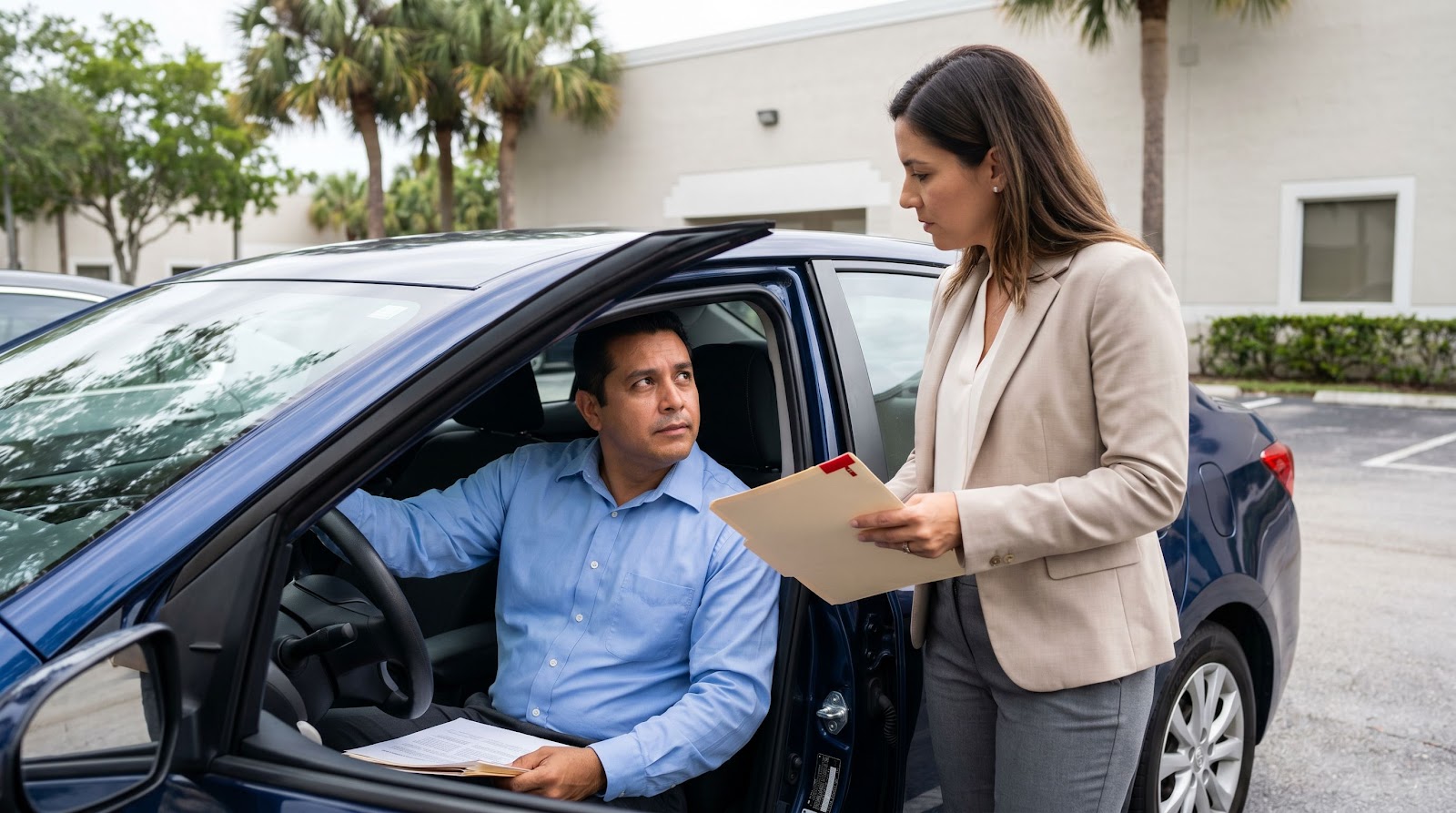
Administrative suspension for unlawful BAC
For drivers aged 21 and older, Florida imposes an immediate administrative suspension when the alcohol level is .08 or above, according to the Florida Department of Highway Safety and Motor Vehicles. The period is six months for a first suspension and one year for a second or later suspension.
That means a holiday arrest can sideline your license fast, even if the insurance fallout and court process come later.
Administrative suspension for refusing a breath, blood, or urine test
Refusing a lawful breath, blood, or urine test can also lead to an immediate administrative suspension in Florida. The key point for drivers is simple: saying no does not avoid license trouble.
In practice, many people focus on the criminal charge and miss the administrative side. But the loss of driving privilege can start right away, which often creates work, family, and insurance problems before the case is resolved.
When an ignition interlock may be required for high-BAC or repeat DUI cases
Ignition interlock is not tied to every arrest, but it can become mandatory after conviction in higher-risk cases. Florida requires it for at least six months on a first conviction if the BAL is 0.15 or above, or if a minor was in the vehicle. Repeat DUI convictions bring longer IID periods, according to the Florida Department of Highway Safety and Motor Vehicles.
That is one more reason a Florida 4th of July DUI car insurance problem rarely stays limited to one court date.
DUI in Florida: license, insurance, and filing requirements compared
For Florida 4th of July DUI car insurance issues, the biggest difference is timing. An arrest can affect your license right away. A conviction is what usually triggers the tougher long-term insurance rules, including FR-44.
| Coverage requirement | Amount |
|---|---|
| Basic Florida PIP minimum | $10,000 |
| Basic Florida PDL minimum | $10,000 |
| FR-44 BI after qualifying DUI conviction | $100,000 per person / $300,000 per occurrence |
| FR-44 PDL after qualifying DUI conviction | $50,000 |
| FR-44 combined single limit alternative | $350,000 |
Arrest vs. conviction: what changes right away and what changes later
After an arrest, the immediate problem is usually your driving privilege. The Florida Department of Highway Safety and Motor Vehicles says drivers 21 and older face an administrative suspension for an unlawful alcohol level, with six months for a first suspension and one year for a subsequent one.
Later, if the case ends in a DUI conviction, the insurance side gets much heavier. A first DUI offense without bodily injury also carries a license revocation of at least 180 days and up to one year.
Standard auto insurance vs. FR-44: liability limits, filing rules, and insurer options
Standard Florida coverage for most four-wheel vehicles starts at $10,000 PIP and $10,000 PDL. FR-44 is a different level entirely. After a qualifying DUI conviction, the state requires $100,000/$300,000 in bodily injury liability and $50,000 in property damage liability, or a $350,000 combined single limit.
The FR-44 filing must stay in place for three years after reinstatement, according to the Florida Department of Highway Safety and Motor Vehicles. And insurer choice often shrinks, since the Insurance Information Institute says a drunk-driving incident is likely to lead to nonrenewal from virtually every insurance company.
First offense vs. repeat offense: why repeat violations create steeper insurance barriers
A first offense is already enough to change your license status and insurance requirements. Repeat violations usually make placement harder because they add another layer of risk for underwriters.
They can also bring longer ignition interlock requirements. Florida requires at least six months on a first conviction when the BAL is 0.15 or above or a minor was in the car, and repeat DUI convictions trigger longer IID periods.
What mistakes make Florida DUI insurance consequences even worse?
The fastest way to make a Florida 4th of July DUI car insurance problem worse is to treat it like a normal policy change. After a DUI, small mistakes can reopen license trouble, delay reinstatement, and leave you paying for coverage that does not actually satisfy Florida’s rules.
Letting your policy cancel while FR-44 is required
This is one of the costliest mistakes. If your policy cancels during the FR-44 period, the state no longer has proof that you meet the DUI insurance requirement. Florida requires that a filing be made for three years after reinstatement, according to the Florida Department of Highway Safety and Motor Vehicles.
A missed payment after reinstatement is not just an insurance lapse. It can put your driving status back in question and force you to start fixing the filing again.
Shopping only by price and ignoring filing compliance
Cheap does not help if the policy is not built to support FR-44 compliance. Florida’s usual minimums for most four-wheel vehicles are only $10,000 PIP and $10,000 PDL, but a qualifying DUI conviction requires much higher FR-44 liability limits.
That is why the lowest quote is not always the right quote. If the filing is wrong, delayed, or unsupported, the Florida 4th of July DUI car insurance issue keeps going.
Missing reinstatement deadlines or interlock requirements
Some drivers focus only on buying insurance and forget the rest of the reinstatement steps. That can backfire. A first DUI without bodily injury carries a revocation of at least 180 days and up to one year, and in some cases, also requires ignition interlock.
Florida requires an interlock for at least six months on a first conviction if the BAL is 0.15 or above or a minor was in the car, based on Florida Department of Highway Safety and Motor Vehicles rules.
Assuming a reduced driving schedule lowers the risk to insurers right away
Driving less after a DUI may be smart, but it does not erase how insurers underwrite the violation. The Insurance Information Institute says a drunk-driving incident is likely to trigger nonrenewal from virtually every insurance company.
So even if you only drive to work and back, carriers may still rate you as a high-risk driver until enough time passes and all filing requirements stay clean.
How can you protect your driving record and keep coverage affordable this 4th of July?
The best way to protect your Florida 4th of July DUI car insurance situation is to avoid the DUI in the first place. One holiday decision can lead to a license loss, tougher underwriting, and, after a qualifying conviction, an FR-44 filing that has to stay active for three years after reinstatement.
Plan alternatives before parties: rideshare, designated driver, and overnight options
Make the plan before the first drink, not after. If you are going to a barbecue, fireworks event, or beach gathering, lock in a rideshare, choose a designated driver, or plan to stay overnight.
That small step can help you avoid the kind of stop that leads to an immediate administrative suspension for drivers 21 and older with an alcohol level of .08 or above, according to the Florida Department of Highway Safety and Motor Vehicles. It also helps you avoid the insurance fallout that can follow a drunk-driving incident.
What to review in your current policy before a holiday weekend
Review your declarations page and confirm your policy is active, your vehicles are listed correctly, and you know who is driving. If you already carry only Florida’s basic limits, remember how little cushion that gives compared with post-DUI requirements.
Florida’s usual requirement for most four-wheel vehicles is $10,000 PIP and $10,000 PDL. A qualifying DUI conviction can push you into the FR-44 limits of $100,000/$300,000 in bodily injury liability and $50,000 in property damage liability, based on Florida Department of Highway Safety and Motor Vehicles rules.
When to speak with an insurance agent if you already have a prior DUI on record
If you already have a DUI on your record, talk to an agent before the holiday weekend if your renewal is close, your policy has changed, or you are worried about keeping coverage in force. This matters even more if you are currently in an FR-44 period, because a lapse can create a new problem with your driving status.
A prior DUI already puts pressure on affordability and carrier options. Another violation can make placement harder and increase the chance of stricter requirements, including longer ignition interlock consequences in repeat cases under Florida rules.
 Vehicle
  Home & Property
  Commercial
  Life
Life  Health