


Yes, adding teen driver car insurance usually costs a lot more once your child gets a license. The good news is that, in most cases, it is still cheaper to add that teen to your current policy than to buy a separate one. If you want to compare options in Texas, start with Texas auto insurance.
How much does adding a teen driver to car insurance in Texas usually cost?
There is no single statewide price because every insurer rates teen drivers differently. What is consistent is the direction: when a newly licensed teen is added, the family premium usually rises sharply because the insurer is taking on a much higher level of risk.
Why premiums often jump when a newly licensed teen is added
Teen drivers are expensive to insure mainly because they are inexperienced. National crash data helps explain why insurers react this way. The Insurance Information Institute reports that drivers ages 16 to 20 were involved in fatal crashes at a rate of 42.40 per 100,000 licensed drivers in 2023.
There is also a compliance issue many parents overlook. The Texas Department of Insurance says you need to insure a new teen driver in your household. If you do not disclose that the teen started driving, the company may back-bill premiums, deny a claim, void the policy, or refuse to renew.
Why adding a teen to a family policy is usually cheaper than buying a separate policy
TDI says adding a teen to an existing family policy is usually cheaper than buying a separate policy for a young driver. A family policy often gives the teen access to existing rating advantages, like multi-car or bundling discounts, instead of pricing that driver alone from scratch.
Which pricing factors matter most: age, driving experience, vehicle, ZIP code, coverage limits, and deductibles
For Texas, adding teen driver car insurance, the biggest price drivers are the teen’s age, how long they have been licensed, and which car they will use. TDI says that if the teen is the main driver of a car, the premium is based on that car. If not, insurers often rate the teen on the highest-rated vehicle in the household.
Your ZIP code matters too, along with liability limits, comprehensive and collision choices, and the deductible you select. Texas minimum liability is $30,000/$60,000/$25,000, but many families choose higher limits for better protection. The NAIC also points to savings options such as good-student discounts, driver education, telematics, and, on older cars, possibly raising deductibles or reducing physical-damage coverage.
What happens if you do not tell your insurer that your teen is driving?
If you leave your teen off the policy, you are not just taking a chance on price. With Texas adding teen driver car insurance, the bigger risk is that the insurer may treat the policy as incorrectly rated once it learns your child is driving.
Back-billed premium and policy re-rating after undisclosed household driver discovery
Texas guidance is clear on this point. Some insurers require every household member of driving age to be listed on the policy. If your son or daughter starts driving or turns 16 and you do not report it, the company may go back, re-rate the policy, and bill you for the premium that should have been charged earlier, according to the Texas Department of Insurance.
That can happen after a crash, during renewal, or even when the company reviews household driver records. And if the teen is the main driver of one vehicle, the insurer may rate that car accordingly. If not, it may rate the teen on the highest-rated car in the household.
Denied claims, coverage disputes, and nonrenewal risks
This is where trying to avoid Texas adding teen driver car insurance can get expensive fast. TDI says that if you do not disclose a teen driver and a crash happens, the insurer could deny the claim, void the policy, or refuse to renew.
Picture a simple situation: your teen backs into another car in a school parking lot or causes a larger liability claim on the way home. If the company finds out the household had an undisclosed driver, you may end up arguing over coverage when you expected the policy to protect you.
When a permit driver or newly licensed teen should be reported to the carrier
Tell the insurer as soon as your teen begins driving. TDI says a learner’s-permit driver does not need separate insurance, but the company should still be notified about the student driver. Once the teen is licensed, they need to be insured on the household policy.
The safest move is simple: report the permit, report the license, and ask how the carrier wants the teen listed before there is any claim.
What does Texas require when adding a newly licensed teenager to your auto policy?
For Texas adding teen driver car insurance, Texas expects families to tell the insurer when a teen starts driving and to make sure that the licensed teen is insured. The hard part is the premium increase. The riskier mistake is staying quiet and hoping the company never notices.
Texas household driver disclosure expectations
Texas guidance is pretty direct. The Texas Department of Insurance says a new teen driver in your household needs to be insured, and the carrier should be told when a student driver begins driving, even at the permit stage. Some companies require every household member of driving age to be listed on the policy.
That matters in ordinary family situations. If your teen drives the family SUV to school a few days a week, or mostly uses an older sedan on weekends, the insurer still wants that driver disclosed. And if your teenager is the main driver of one vehicle, TDI says the premium will be based on that car. Otherwise, the company may rate the teen on the highest-rated vehicle in the household.
Minimum Texas liability limits versus realistic protection for families
Texas minimum liability is $30,000 for one injured person, $60,000 per accident for bodily injury, and $25,000 for property damage. Those numbers satisfy the legal minimum, but they can feel thin once a newly licensed teen is behind the wheel.
A two-car crash with injuries can push past minimum limits quickly. That is why many families look at higher liability limits, even while trimming cost in other areas with higher deductibles, telematics, driver education, or good-student discounts, as noted by the National Association of Insurance Commissioners.
Why compliance matters more than trying to keep a teen off the policy
Trying to avoid adding a teen driver to car insurance can backfire fast. TDI warns that if you do not disclose a teen driver, the insurer may deny the claim, bill missed premium, void the policy, or choose not to renew.
That is a much bigger financial risk than the extra monthly premium. If your teen is licensed and living at home, the safer move is to disclose the driver, review the car assignment, and adjust coverage with your agent before there is a claim.
Which car should your teenager drive to keep rates lower?
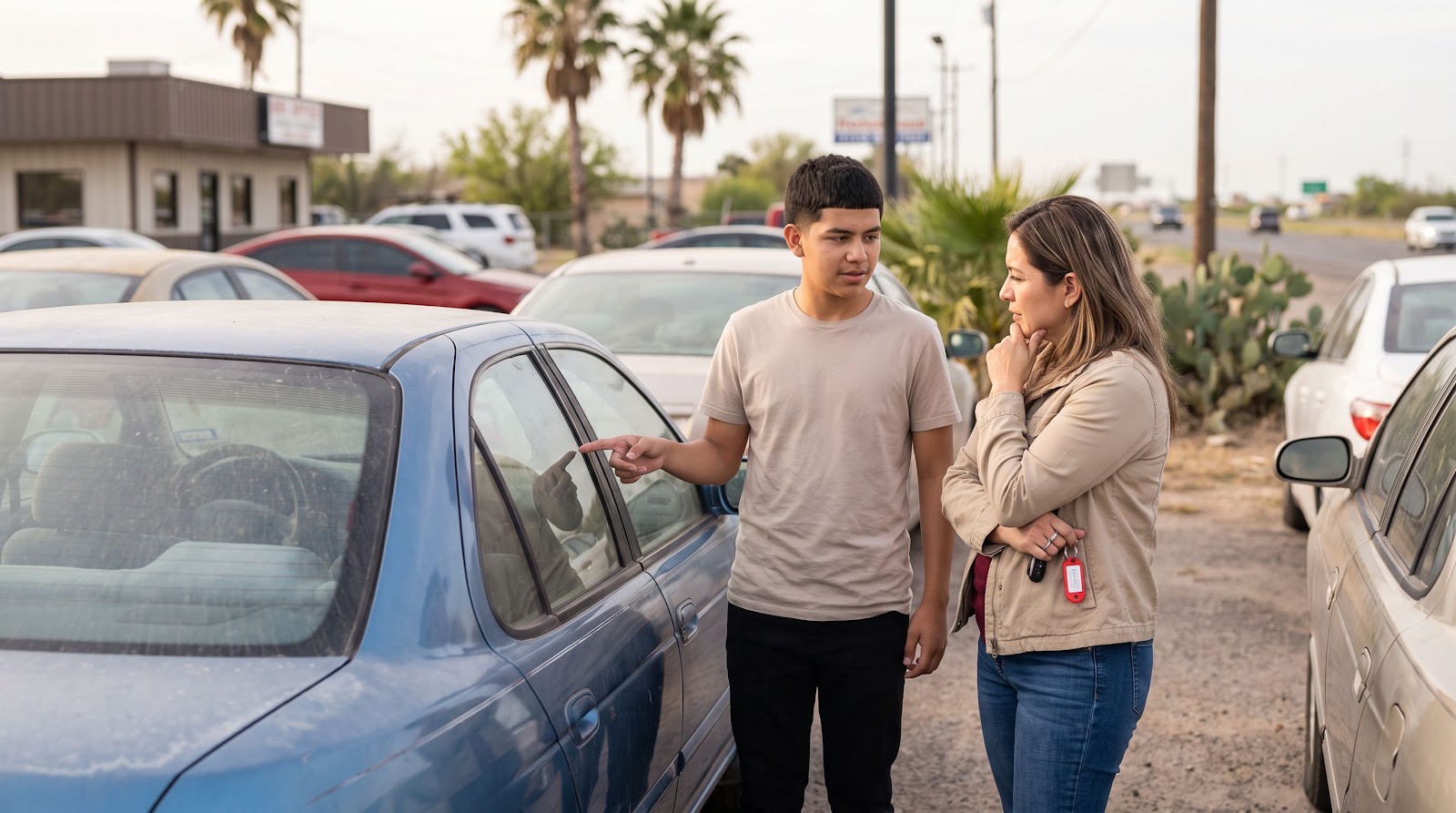
For Texas adding teen driver car insurance, the car assignment can change the price almost as much as the teen driver. In many Texas households, the cheapest move is to have the teen drive the less expensive vehicle that is cheaper to insure, as long as that setup matches reality.
Why the assigned vehicle can change the premium dramatically
Texas Department of Insurance guidance is very specific here. If your teen is the main driver of a car, the insurer will rate the premium based on that vehicle. If the teen is not assigned to one car, the company may rate that driver on the household’s highest-rated vehicle instead.
That means a family with one older sedan and one newer SUV could see very different results depending on which car the teen primarily drives. The key is accuracy. Do not assign your teen to the cheaper car on paper if they actually use the more expensive one every day.
Safer, lower-value vehicles versus newer financed cars
Older, lower-value vehicles often cost less to insure for a teen, especially when they are cheaper to repair or replace. A newer financed car usually pushes the budget higher because lenders commonly require physical damage coverage, and the vehicle itself costs more to protect.
There is a balance, though. Parents still want a car with solid safety features and reasonable repair costs, not just the oldest car in the driveway.
When collision and comprehensive choices affect the total budget
This is where the full cost picture matters. The National Association of Insurance Commissioners says families may lower premiums by reconsidering collision and comprehensive on older vehicles, or by choosing higher deductibles if that fits the household budget.
That approach can help with Texas adding teen driver car insurance, but it works best on cars you could realistically replace after a loss. On a financed vehicle, dropping those coverages may not even be an option.
How can Texas families lower the cost without risking coverage gaps?
With Texas adding teen driver car insurance, the safest way to cut costs is to trim the rating factors around the policy, not hide the driver. Texas and national guidance point to a few practical levers: discounts, deductible choices, bundling, and careful decisions about physical-damage coverage on older cars.
Good student discounts and grade requirements
A good student discount is often one of the first things to ask about when a teen is newly licensed. The National Association of Insurance Commissioners says good-student status can help reduce premiums, which matters when a family is absorbing the jump from Texas adding teen driver car insurance.
The catch is simple: grade rules are set by the insurer. Ask what proof they want, how often they review it, and whether the discount starts right away or at renewal. If your teen’s grades change during the school year, confirm whether that affects the discount before the next billing cycle.
Driver education, defensive driving, and telematics savings
NAIC also lists driver education and telematics as common ways to lower the premium. For a Texas teen, that can make sense because the carrier is pricing a very inexperienced driver from day one.
Telematics is not for every family. If your insurer tracks braking, speed, mileage, or late-night driving, talk through how that fits your teen’s routine. Texas provisional-license rules already restrict driving from midnight to 5:00 a.m. except for work, school, or emergencies, according to the Texas Department of Public Safety, so habits during those early months matter.
Higher deductibles, bundling, and reviewing optional coverages
If cash flow is tight, a higher deductible can lower the premium, but only choose one you could actually pay after a claim. A bundle with home or other policies may help too, and NAIC specifically points to bundling and multi-car discounts.
For older cars, some families also revisit collision and comprehensive. That can be reasonable when the car has limited value. What you do not want is saving a little on premium and ending up with a deductible, coverage choice, or uninsured loss the household cannot comfortably absorb.
Texas cost comparison: add your teen to your policy or buy a separate policy?
For most families, Texas adding teen driver car insurance is still cheaper on the parent policy than on a separate policy. That is the clearest guidance from the Texas Department of Insurance, even though either option can raise the household budget.
The reason is simple: a separate policy usually prices the teen as a stand-alone high-risk driver, while a family policy may spread some of that risk across the household’s existing coverage structure.
| Category | Current Texas / official guidance |
|---|---|
| Disclosure to insurer | Tell the insurer when a teen starts driving or turns 16; failure can trigger added premium, denied claims, or nonrenewal. |
| Best-value policy structure | TDI says it is usually cheaper to add a teen to the family policy than to buy a separate policy. |
| Vehicle assignment effect | If the teen is the main driver of a car, premium is based on that car; otherwise insurers may rate the teen on the highest-rated family car. |
| Common savings levers | Good-student discount, driver education discount, telematics, multi-car/bundling, and reconsidering deductibles or physical-damage coverage on older cars. |
| Legal minimum liability in Texas | 30/60/25 = $30,000 per person, $60,000 per accident bodily injury, $25,000 property damage. |
| Provisional-license restrictions under 18 | No driving from midnight to 5 a.m. except work/school/emergency; no more than one passenger under 21 unless family; no wireless device use while driving. |
Side-by-side budget impact of both options
If your teen is added to your existing policy, the premium usually jumps, but the account keeps its current structure, cars, and possible discounts. A separate policy starts fresh, which often means fewer price breaks and a harsher rating for an inexperienced driver.
Why separate policies are usually more expensive for inexperienced drivers
Texas regulators say separate coverage is usually the pricier route for young drivers. That lines up with how insurers view teen risk: little driving history, higher crash exposure, and no established policy profile to lean on.
If the teen cannot find coverage in the regular market, Texas does have TAIPA after at least two insurer turn-downs within 60 days. But TDI says TAIPA generally offers only the state-required basic liability limits plus limited add-ons.
How liability limits and discounts change the comparison
This is where the gap between the two options can widen. On a family policy, discounts like good student, driver education, telematics, multi-car, and bundling may help offset part of the increase, according to the National Association of Insurance Commissioners.
Coverage choices matter too. Texas minimum liability is $30,000/$60,000/$25,000. If a separate policy is built around only minimum limits, it may look cheaper at first glance than adding the teen with stronger family limits. But that is not an apples-to-apples comparison.
What are the most common mistakes parents make when adding a teen driver?
With texas adding teen driver car insurance, the biggest mistakes are usually simple ones: waiting too long to tell the insurer, buying limits that are too low, and forgetting to ask for every discount the carrier offers. Each one can cost more than parents expect.
Delaying disclosure after licensing
A lot of families think they can wait until renewal or until the teen starts driving more often. That is risky. The Texas Department of Insurance says parents should tell the insurer when a teen starts driving, and once the teen is licensed, that driver needs to be insured on the household policy.
If the company learns later that the teen was already driving, it may bill the missed premium and could deny a claim or refuse to renew. That is a rough surprise after what looked like a small fender bender or a parking-lot accident.
Choosing state-minimum limits that leave the household exposed
Another common mistake is reacting to the premium jump by dropping liability limits to the legal minimum. In Texas, that minimum is $30,000 for one injured person, $60,000 per accident for bodily injury, and $25,000 for property damage, according to the Texas Department of Insurance.
Those limits may satisfy the law, but they do not change the fact that a teen driver brings more claim risk to the household. Saving on premiums is one thing. Leaving family assets exposed is another.
Missing discounts because the insurer was never asked
Parents also miss savings by assuming the insurer will apply every discount automatically. The National Association of Insurance Commissioners points to common options like good-student discounts, driver education, telematics, multi-car, and bundling.
When you call about Texas adding teen driver car insurance, ask the carrier to review discounts line by line. A short question can matter: does the teen qualify now, or only after grades, a course certificate, or enrollment in a tracking program is submitted?
 Vehicle
  Home & Property
  Commercial
  Life
Life  Health