


If your neighbor’s tree caves in your roof in Florida, the short answer is this: your policy usually responds first. That surprises many homeowners. If you’re reviewing home insurance options, this is one of the rules that matters most after a storm.
Who pays when your neighbor’s tree falls on your house in Florida?
Florida’s default rule: your homeowners insurance usually pays first
For most Florida home insurance neighbors’ tree falls claims, the damaged homeowner files with their own insurer first. That is the default rule in Florida, even when the tree came from next door.
The Florida Department of Financial Services says your neighbor’s homeowners policy usually does not pay automatically just because the tree was theirs. Your policy typically covers the house damage, subject to your deductible and policy terms. If the fallen tree damaged insured property, debris and tree removal are also generally covered, although policies often set limits.
If the home cannot be lived in during repairs, homeowners insurance may also provide loss-of-use coverage for extra living expenses, according to the National Association of Insurance Commissioners.
When the neighbor may be financially responsible instead
The main exception is negligence. If the neighbor knew, or reasonably should have known, that the tree was dead, diseased, or dangerous and did nothing, they may be legally responsible.
In that situation, your insurer may still pay first and then try to recover the money from the neighbor or the neighbor’s liability coverage. Triple-I notes that if that recovery succeeds, you may even get your deductible back.
Why fault and ownership are not the same thing after a storm
After high winds, people tend to focus on who owned the tree. Florida law and insurance practice focus more on fault than ownership. A healthy tree that falls during a storm does not automatically make the neighbor liable.
One detail matters right away: as of July 2026, Florida law allows separate roof deductibles in some policies, capped at 2% of Coverage A or 50% of roof replacement cost, whichever is less. But a roof loss caused by a tree fall that punctures the roof deck is excluded from that separate roof deductible under Florida Statutes.
When can you make your neighbor pay for tree damage?
How negligence is proven if the tree was dead, diseased, or visibly dangerous
In Florida, your neighbor usually pays only when negligence can be shown. For Florida home insurance neighbors’ tree falls disputes, that means proving the owner knew, or reasonably should have known, the tree was dead, diseased, or obviously unsafe and still failed to deal with it.
A healthy tree that comes down in a storm is usually not enough. The stronger argument is a tree with visible rot, a dead trunk, major decay, or limbs that had been clearly failing before the loss. Florida DFS ties legal responsibility to negligence, not simple ownership of the tree.
What evidence matters: complaints, photos, arborist reports, and prior warnings
Evidence makes or breaks this kind of claim. Useful proof includes dated photos showing the condition of the tree before it fell, text messages or emails complaining about the danger, and any written notice from the HOA, city, or a tree professional.
An arborist report can carry real weight if it shows the tree was dead, diseased, or structurally compromised before the collapse. Prior warnings matter too. If the neighbor had been told the tree was dangerous and did nothing, that can support a negligence argument far better than a general complaint after the storm.
Keep your own timeline. Save inspection notes, claim photos, and any emergency repair invoices. If debris removal is part of the loss, Florida DFS says it is generally covered when the fallen tree damaged insured property, though limits may apply.
How subrogation works after your insurer pays the claim
Even when negligence looks clear, you will usually still file with your own homeowners carrier first. After paying, your insurer may try to recover what it paid from the neighbor or the neighbor’s liability coverage through subrogation, according to the Insurance Information Institute.
If that recovery works, you may get your deductible reimbursed. Triple-I also notes that tree-removal coverage after a tree hits the home is often limited to about $500 to $1,000, so the claim may still leave some out-of-pocket costs depending on your policy.
What does homeowners insurance usually cover after a tree crushes your roof?
Dwelling coverage for roof, interior, and attached structures
For most Florida homeowners insurance neighbors tree falls claims, the part of the policy that usually responds is dwelling coverage. That generally means damage to the roof itself, plus covered damage inside the home caused by the impact or the opening the tree created.
If the tree tears through shingles, decking, drywall, insulation, or built-in areas of the house, those repairs are usually handled under the same claim, subject to your policy terms. The National Association of Insurance Commissioners also explains that standard homeowners insurance typically includes loss-of-use coverage if the home becomes uninhabitable during repairs.
Attached structures, such as an attached garage, are commonly treated as part of the dwelling as well when they are damaged in the same event.
Debris removal and tree removal coverage limits
When the fallen tree actually damages insured property, debris removal is usually covered even if the tree came from your neighbor’s yard. Florida DFS says that is the general rule, but carriers often set limits on what they will pay.
That limit matters. Triple-I says tree-removal coverage after a tree hits the home is often about $500 to $1,000. If a large oak requires a crane, extra hauling, or a tarp crew before removal, your reimbursement may stop well before the full cleanup bill does.
If the tree falls in the yard and does not damage covered property, there is usually no debris-removal coverage, although Florida DFS says some policies may make a limited exception when the tree blocks the main entrance.
Deductibles, exclusions, and temporary repairs to prevent more damage
Your insurer’s payment still comes after your deductible. One key Florida detail helps here: if the tree fall damaged the roof and punctured the roof deck, the separate roof deductible allowed in some Florida policies does not apply under Florida Statutes.
You should also make reasonable temporary repairs to prevent more damage, like tarping an opening or moving property out of active leaks, then keep photos and receipts for the claim file. If the loss is tied to a windstorm or hurricane, Florida DFS says notice of an initial claim must be given within 1 year.
How do Florida roof deductibles apply if a tree punctures your roof deck?
In this part of a Florida home insurance neighbors tree falls claim, one detail can change the bill fast: if the fallen tree punctures the roof deck, Florida’s separate roof deductible does not apply. That can mean you owe your standard homeowners deductible instead of a larger roof-only deductible.
Why a separate roof deductible may exist in Florida policies
Florida law allows some personal residential policies to carry a separate roof deductible. Under Florida Statutes, that deductible is capped at 2% of Coverage A or 50% of the roof replacement cost, whichever is less.
Insurers use that structure to handle roof-related losses differently from the rest of the home. So a homeowner may see one deductible for general property damage and another one that applies only to certain roof claims.
Why a tree fall that punctures the roof deck is excluded from the separate roof deductible
Here is the exception that matters after a major impact. Florida law says the separate roof deductible cannot be used when a tree fall or another hazard damages the roof and punctures the roof deck.
That means this kind of loss is treated differently from a roof claim involving only surface damage. If the tree breaks through the roof structure itself, the roof-only deductible is off the table.
How this rule can change your out-of-pocket cost on a major claim
On a severe claim, that distinction can save real money. A roof deductible can be substantial, especially on a higher-value home, while your standard deductible may be lower.
For Florida home insurance neighbors tree falls cases, this is why photos from the first inspection matter. If the claim file clearly shows the tree punctured the roof deck, that fact can directly affect what you pay out of pocket before insurance funds are released.
How much could this claim cost you out of pocket?
For most Florida home insurance neighbors tree falls claims, your out-of-pocket cost usually starts with the deductible, then grows if cleanup or repairs hit policy limits. The painful part is that the roof repair may be covered, while several related bills are only covered up to a cap.
| Scenario | Who usually pays first |
|---|---|
| Healthy tree falls in a storm and crushes your roof | Your own homeowners insurer, subject to deductible and policy terms |
| Neighbor’s tree was dead/diseased or clearly hazardous and negligence can be shown | Your insurer may still pay first, then seek reimbursement from the neighbor or the neighbor’s insurer |
| Tree falls but does not hit insured property | Usually no homeowners coverage for removal, unless policy has limited access-blockage coverage |
| Home becomes uninhabitable after covered roof damage | Your homeowners policy may also provide loss-of-use/additional living expense coverage |
Standard deductible vs. separate roof deductible: side-by-side comparison
If the tree punctured the roof deck, Florida law says the separate roof deductible does not apply. That means you would typically owe your regular homeowners deductible instead of a roof deductible that can be capped at 2% of Coverage A or 50% of roof replacement cost, whichever is less, under Florida Statutes.
That distinction matters most on large losses. A claim that looks like a roof claim on paper may actually be treated under the standard deductible if the impact broke through the deck.
Hidden costs homeowners miss, including emergency tarping, tree removal over limits, and code-related repairs
Many owners focus on the roof and forget the side bills. Emergency tarping may be necessary right away, and tree removal can exceed the policy allowance fast. Triple-I says tree-removal coverage is often only about $500 to $1,000.
If the home cannot be lived in, loss-of-use coverage may help with extra living expenses. Triple-I says that coverage is generally 20% of the insurance on the home. Code-related repairs can also increase the final bill, and whether they are covered depends on your policy terms.
When paying cash may cost more than filing a claim
Paying out of pocket can look simpler at first, especially if you want the work started immediately. But if the damage includes a covered roof opening, interior water damage, debris removal, and temporary housing, the total can spread across several parts of the policy.
There is also a timing issue. Florida DFS says notice of an initial windstorm or hurricane claim must be given within 1 year. Waiting too long while trying to handle everything in cash can leave you with fewer options later.
What should you do immediately after a neighbor’s tree hits your roof?
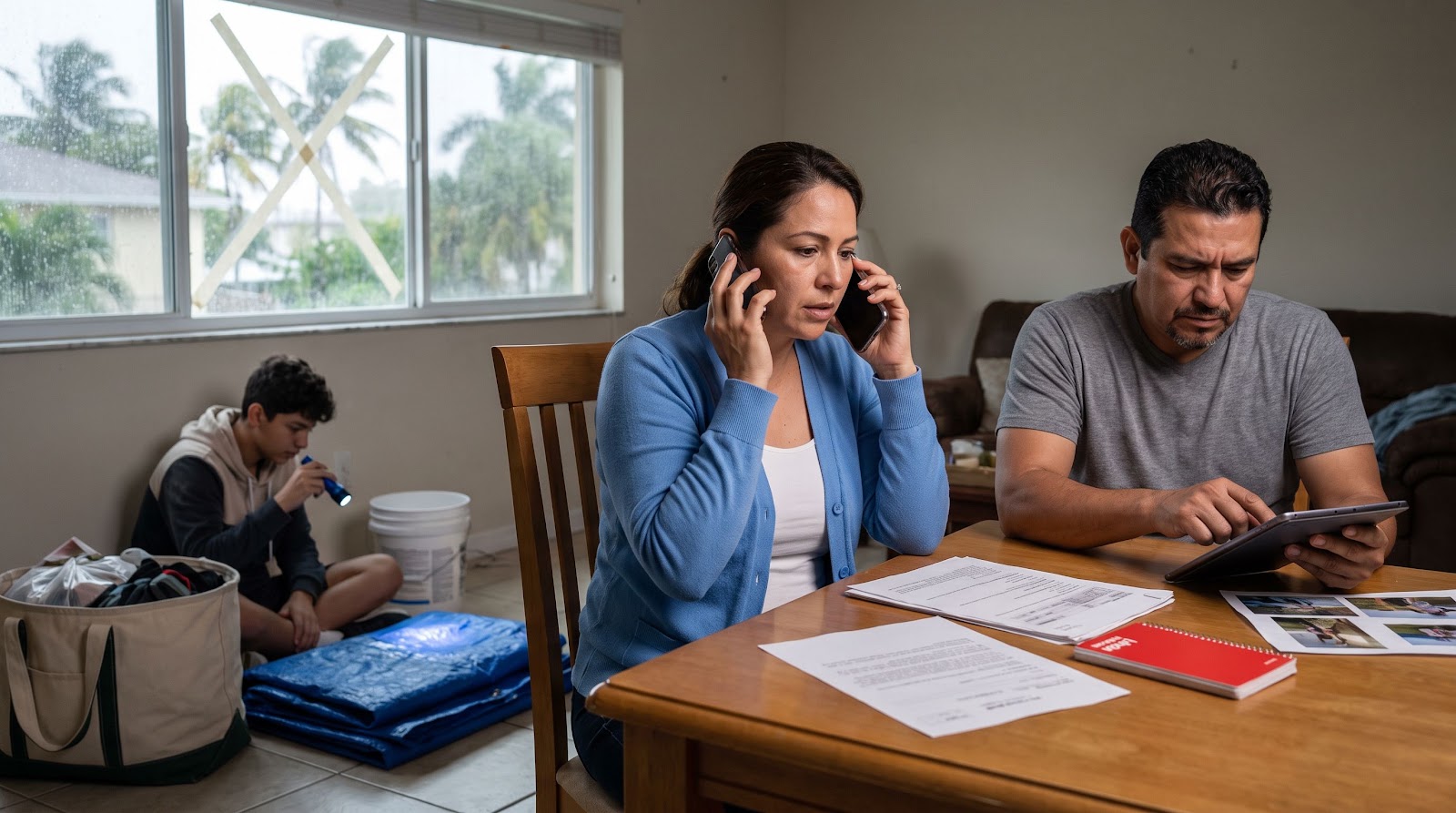
First, protect people, then protect the claim. In most Florida home insurance neighbor’s tree falls situations, the fastest way to avoid bigger problems is to get everyone to safety, document the damage, and open the claim with your own insurer right away.
Safety first: evacuation, power hazards, and emergency services
If the tree brought down power lines, sparked, or left the roof sagging, get out. Do not walk under cracked ceilings or near wet electrical areas. If there is immediate danger, call emergency services and wait for the utility or fire department to say the area is safe.
If rain is entering the home, move people and belongings away from the opening only if you can do it safely. A crushed roof can shift again without warning.
What to document before cleanup begins
Take wide and close photos before anyone cuts branches or removes debris. Capture the roof opening, interior water intrusion, broken drywall, damaged personal property, and the full tree from trunk to impact point. If you can see decay, dead limbs, or hollow sections, photograph that too.
Keep every invoice for tarping, emergency drying, and debris removal. Florida DFS says debris and tree removal are generally covered when the fallen tree damaged insured property, though limits may apply.
Who to call first: insurer, mitigation company, roofer, or the neighbor
Call your homeowners insurer first. That is usually the right first move even when the tree came from next door, and Triple-I says your insurer may later pursue reimbursement if negligence is proven.
Then call a mitigation company if the home is exposed to rain, and a roofer if temporary protection is needed. Notify the neighbor, but do not wait on them before reporting the loss. If the damage followed a windstorm or hurricane, Florida DFS says notice of an initial claim must be given within 1 year.
What mistakes can ruin or delay your Florida tree damage claim?
Yes, a few common errors can weaken a Florida home insurance neighbor’s tree falls claim fast. The biggest ones are blaming the neighbor too early, failing to prevent added water damage, throwing away proof of negligence, and approving repair work before you understand your policy limits.
Assuming the neighbor automatically owes you money
This mistake starts a lot of arguments and delays. In Florida, the tree owner does not automatically pay just because the tree came from next door.
Florida DFS says the damaged homeowner usually files with their own insurer first unless the neighbor was legally liable through negligence. If you spend days pushing the neighbor instead of opening your claim, you can lose time when the house needs tarping, drying, and inspection.
Failing to mitigate further water damage
Once the roof is open, the claim is no longer just about the tree impact. Rain can turn one covered loss into a much larger mess.
Make reasonable temporary repairs right away. A tarp, emergency drying, and moving belongings out of active leaks can help show you did your part to prevent extra damage. Keep every photo and receipt. If the loss followed a windstorm or hurricane, Florida DFS says notice of an initial claim must be given within 1 year.
Removing the tree before preserving evidence of negligence
Cleanup crews often want to start immediately, and sometimes they must. But if you suspect the tree was dead, diseased, hollow, or visibly failing before it fell, document that condition first.
Take clear photos of the trunk, root area, broken sections, and any visible decay before removal if it is safe to do so. That evidence may matter later if your insurer tries subrogation against the neighbor’s liability coverage.
Accepting repair estimates without checking coverage limits and exclusions
The first estimate is not the same as full coverage. Review what part is for dwelling repairs, what part is for debris removal, and whether temporary housing may apply if the home cannot be lived in.
Florida DFS says debris and tree removal are generally covered when insured property was damaged, but limits usually apply. Triple-I says tree-removal coverage is often only about $500 to $1,000. Also verify which deductible applies, because a tree fall that punctures the roof deck does not trigger Florida’s separate roof deductible rule.
 Vehicle
  Home & Property
  Commercial
  Life
Life  Health