


If a lightning strike destroys your TV, laptop, or gaming console, florida lightning strike home insurance usually helps. Standard homeowners policies generally cover lightning losses, and personal property coverage often includes electronics. If you want to review your options, see Univista’s homeowners insurance page.
Does homeowners insurance cover electronics damaged by a lightning strike in Florida?
Usually, yes. A standard homeowners policy generally covers electronics damaged by a direct lightning strike or a lightning-caused power surge because lightning is a covered peril under standard home insurance, according to the NAIC and the Insurance Information Institute.
That said, the source of the surge matters. If the damage came from the utility grid and not from lightning itself, the base policy may not respond the same way.
What counts as a covered lightning loss under a standard homeowners policy
A covered lightning loss usually means the damage can be traced to lightning itself. That includes a direct strike to the home and many electrical losses caused by a lightning-related surge, based on guidance from the Insurance Information Institute.
For example, if a storm rolls through Miami and a nearby strike fries a television, modem, and desktop computer, that is generally the kind of event standard homeowners insurance is meant to cover. If the surge came from another electrical source, coverage may depend on whether you added Equipment Breakdown Coverage or a similar endorsement.
Which home electronics are usually included under personal property coverage
Personal property coverage usually applies to the contents inside the home, including electronics. That often means items like TVs, computers, tablets, printers, routers, speakers, and gaming systems are included when they are damaged by a covered peril such as lightning.
How much you get back is a separate issue. In Florida, contents claims may be settled at actual cash value unless you bought Personal Property Replacement Cost Coverage, according to the Florida Department of Financial Services.
Why proof that the damage came from lightning matters for approval
Insurers need a clear link between the damaged electronics and the lightning event. That is what helps separate a covered lightning loss from wear and tear, a mechanical failure, or a non-covered utility surge.
Keep photos, a list of damaged devices, and any repair technician notes that identify surge or lightning damage. Florida homeowners also have claim-handling rights: insurers must acknowledge a claim within 7 days and, in most property claims, pay the undisputed amount or deny the claim within 60 days, under the Florida Department of Financial Services.
What is the difference between lightning damage and a utility power surge claim?
With Florida lightning strike home insurance, the key difference is the cause of the surge. If your electronics were damaged by lightning, the claim is usually stronger under a standard homeowners policy. If the surge started with the utility grid, the base policy may treat it very differently.
That distinction matters because two homes can lose the same TV, router, and refrigerator control board after a storm, yet only one loss clearly ties back to a covered peril.
When a lightning-caused surge is typically covered
A lightning-caused surge is generally covered because lightning is a standard covered peril, and personal property coverage usually includes electronics. The NAIC and the Insurance Information Institute both support that basic rule.
If a thunderstorm passes through Orlando and a nearby strike sends a surge into the house, damaging a laptop and two TVs, that usually fits the kind of loss homeowners insurance is designed to pay. The easier it is to connect the damage to the lightning event, the smoother the coverage question tends to be.
When a utility-origin surge may be denied under the base policy
A utility-origin surge can be a problem under the base policy because the damage may not have come from lightning itself. The Insurance Information Institute warns that surges from other electrical sources, including the utility grid, may fall outside standard homeowners coverage.
So if power flickers after a neighborhood outage and your electronics fail, the insurer may ask whether the cause was lightning, a grid issue, or an internal mechanical problem. If the evidence points away from lightning, the claim may be denied even though the damage looks almost identical.
How Equipment Breakdown Coverage can fill the gap
Equipment Breakdown Coverage can help when the base policy does not fully protect against utility-supplied surges or certain electrical and mechanical failures. This is often the endorsement that fills the gap between a covered lightning loss and a denied utility-surge claim.
It also helps to check how your contents are settled. In Florida, damaged electronics are often paid at actual cash value unless you added Personal Property Replacement Cost Coverage, according to the Florida Department of Financial Services.
How much will insurance pay for fried TVs, computers, and other electronics?
With Florida lightning strike home insurance, the payout for damaged electronics depends less on the device and more on your policy terms. The biggest factors are whether your contents are settled at actual cash value or replacement cost, your deductible, and any policy limit that applies to personal property.
Actual cash value vs. replacement cost for personal property
If your policy pays personal property losses at actual cash value, the insurer usually subtracts depreciation. That means an older TV or laptop may be covered, but the check can be lower than what it costs to buy a similar new item today.
If you added Personal Property Replacement Cost Coverage, Florida guidance says contents losses can be paid at replacement cost without depreciation. The Florida Department of Financial Services explains that this upgrade is usually optional and comes with an added premium.
How deductibles reduce the final payout
Even when lightning damage is covered, your deductible comes out of the claim payment. So if a lightning-caused surge destroys several electronics at once, the insurer looks at the covered amount first and then subtracts the deductible before issuing payment.
That is why smaller losses can be frustrating. If the total value of a fried TV, modem, and printer is close to your deductible, the final payment may be limited, or there may be no practical recovery at all.
When policy limits and special limits can cap recovery
Your policy can also cap what you recover. Personal property is covered up to the limits in your homeowners policy, so a house full of damaged electronics may run into that ceiling even if the cause of loss is clearly lightning.
Special limits can matter too, depending on how your policy classifies certain items. The cleanest way to avoid surprises is to review the contents section before storm season and check how your insurer settles electronics losses under your Florida homeowners policy.
What should Florida homeowners do immediately after a lightning strike damages electronics?
Start by protecting the evidence. If you plan to file a Florida lightning strike home insurance claim, document the damage before you throw anything away, unplugged devices included.
Take clear photos of each damaged item where it was found, plus wider shots of the room, power strips, outlets, and any visible signs of a surge. Then move the items to a safe place and avoid disposal until the insurer or adjuster says it is okay.
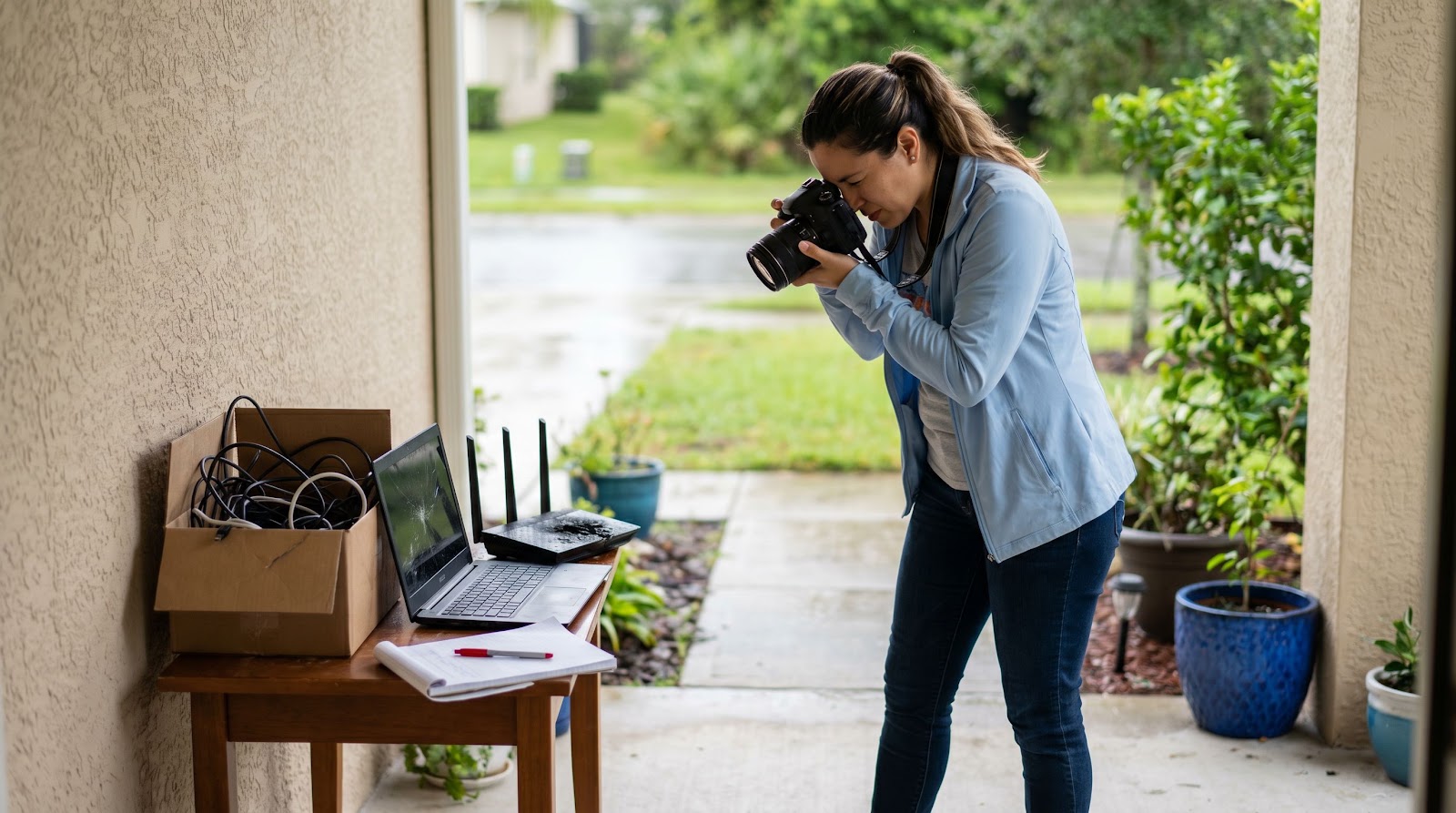
Steps to document the loss before cleanup or disposal
Make a simple timeline while the details are fresh. Note the date of the storm, when the power went out or flickered, and which electronics stopped working right after. That timing can help connect the loss to lightning instead of a separate electrical problem.
If a TV, router, laptop, and gaming console all failed at once, photograph each one separately. Include model labels, serial numbers if visible, and any burned plugs, damaged chargers, or tripped surge protectors.
What evidence insurers want, including photos, receipts, and repair opinions
Insurers usually want proof of ownership and proof of damage. The strongest file includes photos, purchase receipts if you still have them, credit card statements if that is what shows the purchase, and short repair opinions from an electronics technician saying the item was damaged by a surge or lightning-related event.
The Insurance Information Institute says lightning-caused electrical damage is generally covered, so the key is showing that link clearly. Once you file, Florida’s Homeowner Claims Bill of Rights says the insurer must acknowledge the claim within 7 days and, in most property claims, pay the undisputed amount or deny it within 60 days, according to the Florida Department of Financial Services.
How to prepare a complete inventory of damaged items
Build one list with the item name, brand, model, room, purchase date if known, and whether it appears completely dead or only partly working. Add what came with it if those pieces were damaged too, like remotes, speakers, monitors, docking stations, or chargers.
Keep the inventory consistent. A complete list makes it easier for the adjuster to review your Florida lightning strike home insurance claim and compare it with your receipts, photos, and repair notes.
Florida claim deadlines and policyholder rights: how fast must an insurer respond?
For a Florida lightning strike home insurance claim, Florida gives homeowners clear timing rules. In most property claims, the insurer must acknowledge the claim within 7 days and, within 60 days, pay the full claim, pay the undisputed amount, or send a written denial, according to the Florida Department of Financial Services.
Prompt acknowledgment requirements for property claims
Once you report the loss, the carrier cannot let the file sit quietly. Florida’s Homeowner Claims Bill of Rights says the insurer must acknowledge the claim within 7 days.
That acknowledgment does not mean approval. It means the company has to confirm receipt and start handling the claim. If your electronics were damaged after a lightning strike, keep a record of the date you reported it, the claim number, and every email or text that follows.
The 60-day timeline for payment of the undisputed amount or denial in most claims
The bigger deadline is 60 days. In most homeowners property claims, the insurer must either pay the full claim, pay the undisputed portion, or issue a written denial within that window, based on Florida Department of Financial Services guidance.
This matters in partial-payment cases. If the adjuster agrees that the lightning damaged your TV and router but disputes the laptop, the company may still have to pay the undisputed amount rather than wait on every item.
When to escalate a delayed or underpaid claim
If the insurer misses these timelines, stops communicating, or offers payment that does not match the documented damage, it is time to escalate. Start by asking for the status in writing and request a written explanation for any reduction or denial.
If the response still does not make sense, cite the Florida Department of Financial Services and the Homeowner Claims Bill of Rights when you follow up. That is especially useful when a Florida lightning strike home insurance claim is delayed even after you provided photos, receipts, and repair opinions.
What does fried electronics coverage really cost compared with the risk?
For many Florida homeowners, the real question is simple: will the payout be big enough to justify a claim? With Florida lightning strike home insurance, that usually depends on how much electronics you have in one room, how your contents are valued, and where your deductible lands.
The broader risk is not small. Florida had 5,167 lightning-related homeowners claims in 2025, with an average cost of $35,993 per claim, according to the Insurance Information Institute. That average includes more than electronics, but it shows how expensive a lightning loss can become once several items fail at once.
Typical value at risk inside a Florida home: TVs, laptops, gaming systems, routers, and smart devices
A single fried device may not change much. A whole entertainment setup can. Think about a living room TV, a laptop used for work, a gaming console, the router, a smart speaker, and a few connected home devices hit in the same surge.
That stack of damaged electronics can add up fast, especially if the items were bought recently. And if the strike affects multiple rooms, the contents loss can be much larger than most people expect on the day of the storm.
Comparing a homeowner’s deductible with the replacement cost of common electronics
This is where many claims become a math problem. If the loss is only one older TV or one aging laptop, your deductible may absorb most or all of it. If several devices fail together, the claim starts to make more sense.
Your settlement method matters just as much. Florida Department of Financial Services guidance says contents claims are often paid at actual cash value unless you added Personal Property Replacement Cost Coverage. That means depreciation can shrink the check even when the lightning loss itself is covered.
When adding Equipment Breakdown Coverage may be worth it
Equipment Breakdown Coverage may be worth a look if you want protection beyond clear lightning losses. The Insurance Information Institute says it can help with utility-supplied surges and certain electrical or mechanical failures that may fall outside the base homeowners policy.
That can matter in Florida, where storm season brings plenty of power problems that do not always trace cleanly to a direct lightning event.
What mistakes cause homeowners to lose money after a lightning electronics claim?
The most common mistakes are simple: assuming every surge is covered, tossing damaged items too early, and misunderstanding how the policy pays. With Florida lightning strike home insurance, the loss can be covered and still pay less than you expected.
That happens a lot with electronics because coverage, proof, and valuation all move together. If one piece is missing, the claim can shrink fast.
Assuming every power surge is automatically covered
This is one of the biggest errors. Standard homeowners insurance generally covers electronics damaged by lightning or a lightning-caused surge, according to the NAIC and the Insurance Information Institute. But a surge from the utility grid may not be covered under the base policy.
If a homeowner treats every post-storm outage as a lightning claim, the insurer may push back once the source of the damage is reviewed. Equipment Breakdown Coverage can help in some of those non-lightning surge situations, but only if it was added before the loss.
Throwing away damaged electronics before the insurer documents them
Once the TV, modem, or laptop is gone, part of your proof may be gone too. That can make it harder to show what was damaged, how badly, and whether the loss matches the reported event.
Keep the items until the insurer says they can be discarded. Florida also requires the insurer to acknowledge the claim within 7 days and, in most property claims, pay the undisputed amount or deny the claim within 60 days, according to the Florida Department of Financial Services.
Missing the settlement difference between actual cash value and replacement cost
Many homeowners focus on whether the claim is covered and overlook how it will be paid. That is expensive. Florida guidance says contents losses are often paid at actual cash value unless you bought Personal Property Replacement Cost Coverage.
So a three-year-old computer may be covered, but the check may reflect depreciation instead of the price of a new replacement.
Forgetting to review endorsements, limits, and deductibles before storm season
The best time to spot a gap is before the storm, not after the adjuster explains it. Review whether your policy has replacement cost for personal property, whether Equipment Breakdown Coverage was added, and how your deductible affects smaller electronics losses.
Florida saw 5,167 lightning-related homeowners claims in 2025, with average claim costs of $35,993, according to the Insurance Information Institute. That does not mean every electronics claim is large. It does show how costly these losses can become when homeowners find out too late what their policy actually says.
 Vehicle
  Home & Property
  Commercial
  Life
Life  Health