


The clocks went back one hour on Sunday, November 1, 2026, at 2:00 AM, so the drive home from work now falls in the dark. Same route, less light. Driving at night in Florida means headlights on because the law says so, more attention at crosswalks, and an honest look at your car insurance coverage.
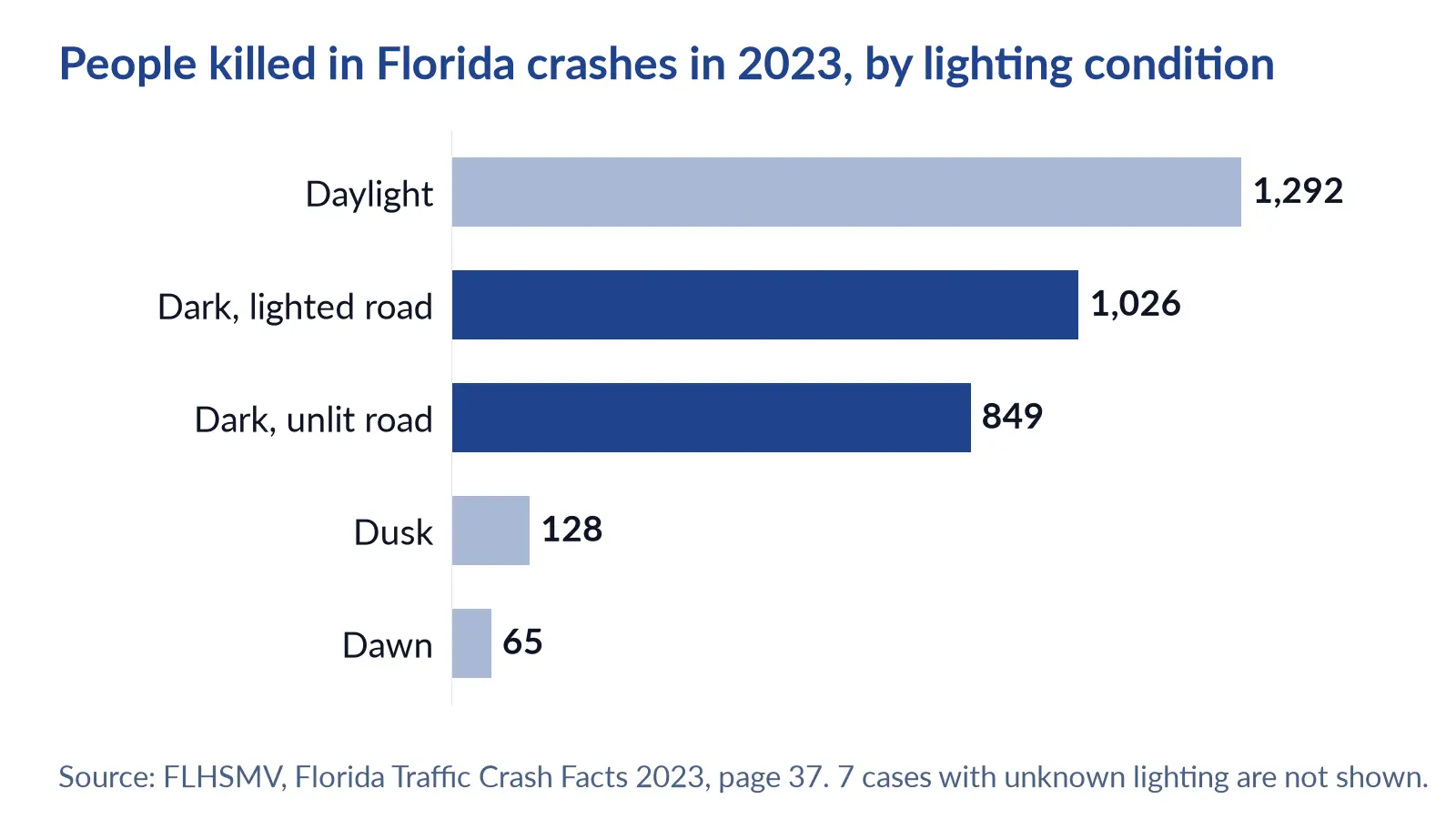
FLHSMV’s 2023 crash report counts 3,375 people killed on Florida roads. Of them, 1,875 died in crashes in the dark, on lit or unlit roads.
None of this means you should drive less. It means driving a little differently for a few weeks, until your body adjusts to the new schedule. And knowing what happens if something goes wrong, because auto insurance in Florida follows its own rules, and you want to understand them before you need them.
When do you have to turn your headlights on in Florida?
Florida law requires headlights from sunset to sunrise. Section 316.217 of the Florida Statutes covers that window, and twilight counts. You also need them on in rain, smoke, or fog, no matter the hour. It is a statute requirement, not a suggestion, even when the road still looks clear to you.
Twilight is the part most drivers skip. That half hour when the sky still has color and your car feels visible. It isn’t. The driver coming toward you sees far less of your vehicle than you think.
Daytime running lights on many newer models do not always turn on the rear lights. If your dashboard lights up automatically, step out and check that the taillights are on too.
High beams: 500 feet and 300 feet
Section 316.238 requires you to dim your high beams within 500 feet of an oncoming vehicle, and not to use them within 300 feet behind another car. Breaking that rule is a noncriminal traffic infraction punished as a moving violation, with everything that carries for your points and your record.
Three hundred feet is roughly the length of a football field. If you are behind someone on I-95 and you are lighting up their rearview mirror, you are already too close to keep the high beams on.
What does the FLHSMV recommend in rain, fog, or smoke?
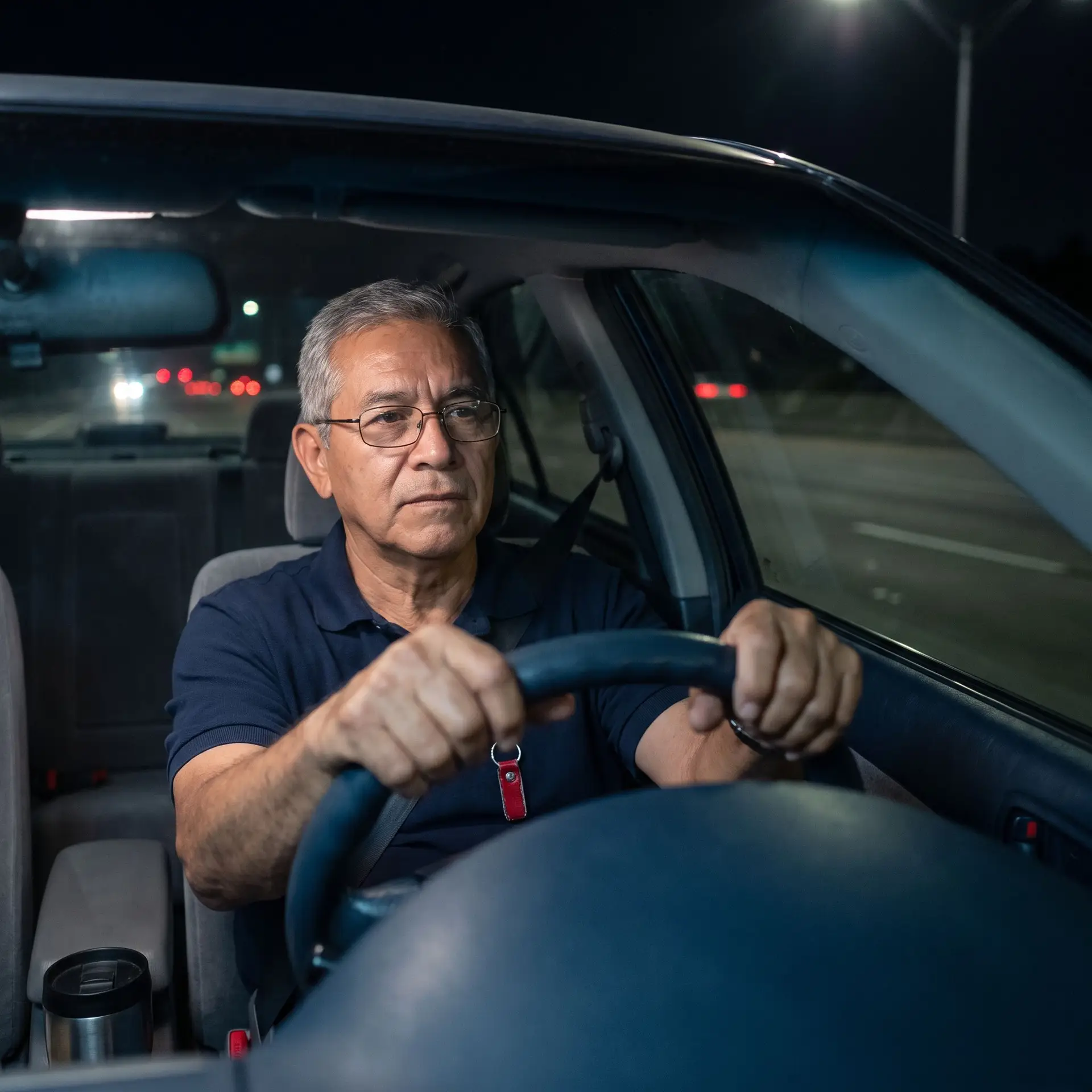
The FLHSMV asks you to use low beams in rain, fog, or smoke, because high beams bounce off the particles and throw a white wall back at you. It also recommends slowing down and leaving more space between you and the car ahead, so you keep enough room to brake.
In Florida that means early morning fog in rural stretches, smoke from a burn, and downpours that show up with no warning. Different situations, same answer. Low beams, foot off the gas, more space.
Small habits that make a big difference
- Clean the inside of the windshield. The film of grease you never notice in daylight turns every oncoming headlight into an eight-point star.
- Clean your headlights. Yellowed plastic cuts your reach even with new bulbs.
- Replace the wiper blades before they start squeaking, not after.
- Dim the dashboard and your phone. Your pupils adjust to the brightest light near you.
- If an oncoming car blinds you, look toward the white line on the right edge instead of at the headlight.
Pedestrians are the risk that changes most after dark
FDOT reported in October 2024 that nearly 80% of pedestrian deaths in Florida happen in low light conditions. In that same report it noted it had installed LED lighting at more than 2,500 intersections across the state. That is why the crossing is the critical moment.
Before you turn right on red, look twice toward where pedestrians come from, not only at the traffic you care about. Plenty of people walk in dark clothes, wearing headphones, pushing a stroller or a bicycle. On many residential streets, people cross wherever they can, not only where the paint is.
Does Florida’s minimum coverage protect you in a night crash?
Every vehicle registered in Florida must carry at least $10,000 of PIP and $10,000 of PDL, according to the insurance requirements published by the FLHSMV. That minimum does not change with the hour of the day. And it does not pay to repair your own car.
| Coverage | Florida minimum | What it pays, in general terms |
|---|---|---|
| PIP (Personal Injury Protection) | $10,000 | Part of your medical expenses and those of covered passengers, regardless of who caused the crash. |
| PDL (Property Damage Liability) | $10,000 | Damage you cause to someone else’s property: their car, a fence, a pole. |
Read the third column again. PIP handles injuries up to its limit, PDL pays for what you broke that belongs to someone else, and nobody pays for your tow truck or your fender. That takes collision and comprehensive coverage, which are optional in Florida and bought separately.
There is another very common nighttime situation the minimum does not solve: the car that cuts you off, drives away, and never turns up. Or the one that hits you and has nothing to respond with. That is where uninsured and underinsured motorist coverage comes in. It is optional too, and worth pricing before you rule it out.
Review your policy before your renewal arrives
The time to adjust coverage is now, calmly and with room to compare. Pull out your declarations page, see whether it says anything beyond PIP and PDL, and ask what it would cost to raise your liability limit or add collision. Sometimes the monthly difference is smaller than you expect. Sometimes it isn’t, and the honest answer is to leave things as they are.
If the budget is tight, there is still room to look for cheap car insurance without dropping to the legal minimum. Renewing on autopilot every year doesn’t help, because your situation changes: a different car, a different address, a different driving schedule.
Licensed agents at Univista Insurance compare more than 20 companies in a single free quote. By phone, online, or sitting down with you at a Univista Insurance office. In English or Spanish, your choice, with no rush.
Frequently asked questions about driving at night in Florida
More answers in our auto insurance FAQs.
Do I need my headlights on at dusk in Florida?
Yes. Section 316.217 of the Florida Statutes requires headlights from sunset to sunrise, and twilight falls inside that window. The same rule applies in rain, smoke, or fog at any hour. Turning them on is also about being seen, not only about how well you can see the road.
Can I get a ticket for using high beams too close to another car?
You can. Section 316.238 requires dimming high beams within 500 feet of an oncoming vehicle and bans them within 300 feet behind another car. Not following it is a noncriminal traffic infraction punished as a moving violation.
Does Florida require different insurance for driving at night?
No. The FLHSMV requires $10,000 of PIP and $10,000 of PDL to register a vehicle in Florida. The same policy covers you at 7 in the morning and at 9 at night. After dark the risk changes; the legal requirement does not.
Will the state minimum pay to fix my car after a night crash?
No. PIP goes toward medical expenses for you and covered passengers, and PDL pays for damage you cause to another person’s property. Repairs to your own vehicle come from collision and comprehensive coverage, which are optional in Florida and added to your policy separately.
 Vehicle
 Home & Property
 Commercial
 Life
 Health