


Flash floods can ruin a car fast, but Texas flood car insurance is simple on one key point: your own vehicle is usually protected only if you have added comprehensive coverage. If you want help checking your current policy in Texas, start here: Texas auto insurance.
What does Texas flood car insurance actually cover in Texas?
In Texas, flood damage to your car is generally covered under comprehensive coverage. If you only carry liability, your insurer will not pay to repair or replace your own flooded vehicle, according to the Texas Department of Insurance.
| Scenario | What current official guidance says |
|---|---|
| Your car is flooded, and you have liability-only insurance | Damage to your own car is not covered; liability coverage pays for damage you cause to others, not flood damage to your vehicle. Source: Texas Department of Insurance / NAIC |
| Your car is flooded, and you have comprehensive coverage | Flood damage to your own car is generally covered under comprehensive coverage. Source: Texas Department of Insurance / NAIC / III |
| You are about to start a flooded car | Do not start it until a mechanic inspects it; hidden water damage can worsen mechanical and electrical problems. Source: Texas Department of Insurance / NHTSA |
| Water is rising around the vehicle on the road | Do not drive through floodwater; if water rises around the car, abandon it and move to higher ground if safe. Source: National Weather Service / NHTSA |
| You need to check whether a used car was previously flooded in Texas | Use TxDMV Title Check; flood-related history may appear as a Texas Flood Damage brand. Source: TxDMV |
Why liability-only insurance will not pay for flood damage to your own car
Liability coverage is for damage you cause to other people or their property. It does not cover weather losses to your own vehicle. So if a flash flood gets into your sedan, pickup, or SUV, liability-only coverage will not pay for your car’s flood damage.
How comprehensive coverage applies to flash flood losses, water intrusion, and engine damage
Comprehensive is a part of Texas flood car insurance that usually responds when rising water damages your vehicle. That can include flash flood losses, water intrusion, and the kind of hidden damage that affects electronics or the engine after submersion. The Texas Department of Insurance also warns drivers not to start a flooded car before a mechanic inspects it.
What may insurers review before approving a flood-related vehicle claim?
Expect the insurer to look at photos, the extent of submersion, and when the damage happened. Texas guidance says you should contact your insurer as soon as possible and document the vehicle’s condition with pictures. If the car was heavily flooded, the company may also review inspection findings before deciding whether to repair it or treat it as a total loss.
What should you do immediately after flash flood damage to your car?
Act fast, but do the safe things first. After flash flood damage, the right move for a Texas flood car insurance claim is to document the car, report the loss quickly, and leave the vehicle alone until it is inspected.
If water is still around the car, do not try to move it through flooded streets. The National Weather Service says never drive around barriers on flooded roads, and if water is rising around the vehicle, get to higher ground if you can do so safely.
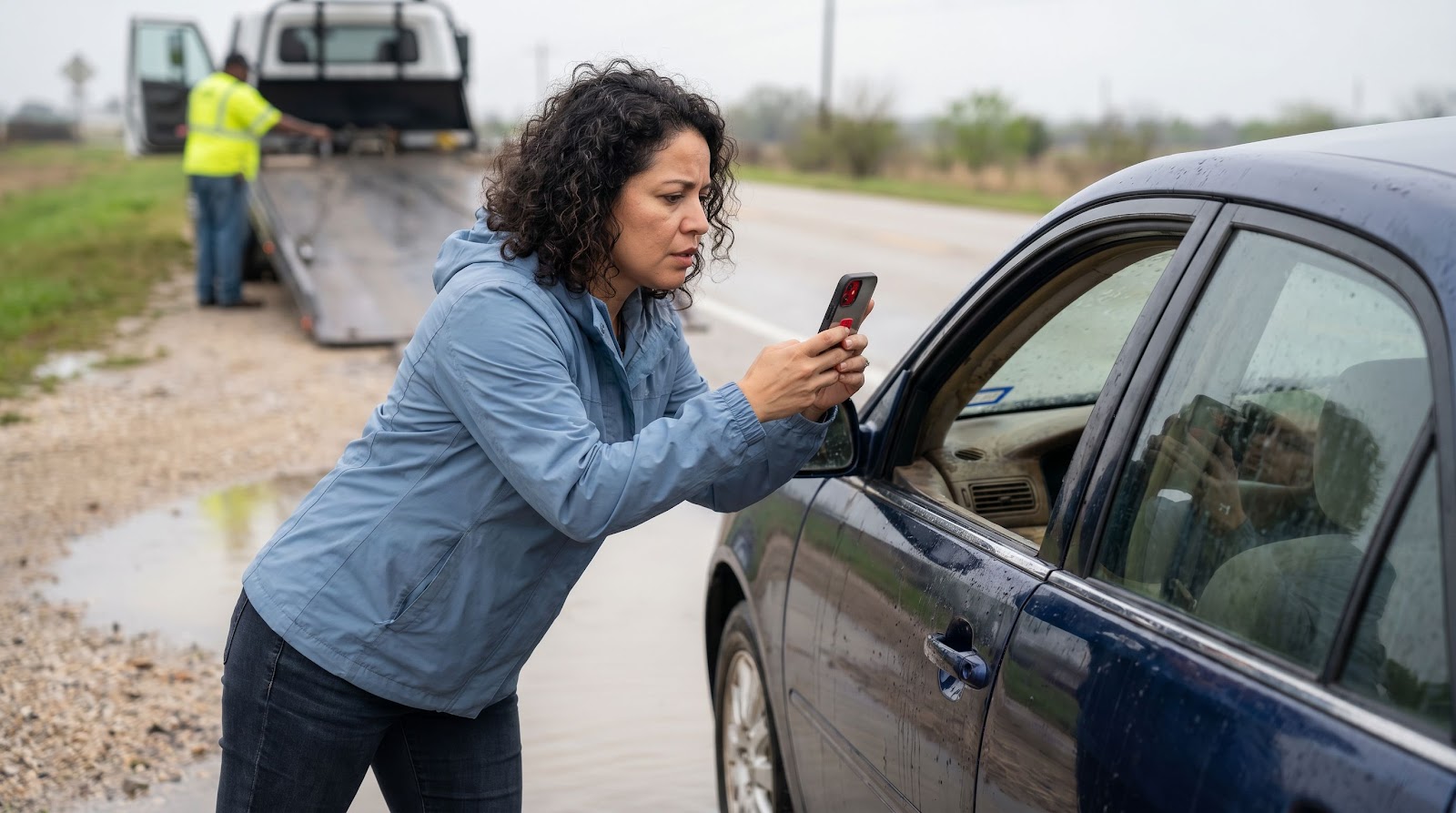
How to document flood damage for your insurance claim
Start with photos. Take wide shots of the whole car, then closer images of the water line, interior, seats, dashboard, trunk, and any visible mud or debris. The Texas Department of Insurance says to take photos of the damage or submersion and call your insurer as soon as possible.
If it is safe, keep notes on where the car was parked, when the flooding happened, and whether the water entered the cabin. That helps the claim adjuster understand the extent of the loss from the start.
Why you should not start or dry out a flooded vehicle before inspection
Do not start the engine. Do not plug in fans. Do not try a DIY dry-out if water got inside. According to the Texas Department of Insurance, improper drying can lead to mold, electrical problems, and more damage.
This matters even more for hybrid and electric vehicles. NHTSA warns that wet batteries can create shock and fire risks, and a damaged lithium-ion vehicle should stay 50 feet away from a house, structure, another vehicle, or combustibles.
When to call your insurer, a tow service, and a mechanic
Call your insurer first, or as soon as everyone is safe. Then ask whether they want the car towed to a specific location for inspection. If the vehicle cannot be driven, arrange a tow instead of trying to restart it.
Call a mechanic after the tow is set or once the insurer gives instructions. The mechanic should inspect the vehicle before any attempt to start it, especially if floodwater has reached the interior or electronics.
How much can a flooded car claim cost without comprehensive coverage?
It can cost you the entire loss. With Texas flood car insurance, the part that usually pays for flood damage to your own vehicle is comprehensive. If you skipped it, Texas minimum liability coverage generally leaves repair or replacement bills in your hands.
That is why a flood claim can feel very different from a crash claim. One policy may leave you paying only a deductible. The other may leave you paying for everything after the water recedes.
Out-of-pocket repair risks for drowned engines, electronics, and interiors
Flooded cars rarely have just one problem. Water can reach the engine, wiring, sensors, seats, carpet, and dashboard controls at the same time. The Texas Department of Insurance warns against trying to dry the vehicle yourself or starting it before a mechanic inspects it, because mold and electrical damage can get worse.
If your policy does not include comprehensive coverage, those hidden problems are usually your out-of-pocket cost. That applies whether the water reached only the cabin or the whole vehicle was submerged.
Comprehensive deductible vs. total-loss payout: what changes your real cost
With comprehensive coverage, your real cost often starts with the deductible. Without it, your real cost may be the full repair bill or the full value of the car if the insurer would otherwise have treated it as a total loss.
The practical difference is simple: comprehensive can turn a major flood loss into a deductible-based claim. Liability-only does not do that for your own car.
Why basic Texas minimum coverage can leave you paying the full loss
Basic Texas minimum coverage is liability coverage. According to the Texas Department of Insurance, it pays for damage you cause to others, not flood damage to your own vehicle. So if flash floodwater ruins your sedan in a parking lot or stalls your pickup on a flooded street, your own flood loss is generally not covered.
The driving risk is real in fast water, too. The National Weather Service says 12 inches of floodwater can carry away most cars, and 2 feet can carry away SUVs and trucks.
Can you drive through floodwater in Texas without risking a total loss?
No. The safest answer for drivers is simple: do not drive into floodwater. From a Texas flood car insurance standpoint, one bad decision on a flooded road can leave you with severe damage, a stalled engine, or a vehicle that is no longer worth repairing.
The danger shows up fast. The National Weather Service says 12 inches of water can carry away most cars, and 2 feet can carry away SUVs and trucks.
National Weather Service and NHTSA safety warnings every driver should follow
The National Weather Service says never drive through flooded roads and never go around barriers. If water is over the street, treat that road as closed, even if another driver tries it first.
NHTSA adds another problem after the water drops: flood-damaged vehicles can have hidden electrical and mechanical damage. For hybrid and electric models, wet batteries can create shock or fire risks.
What to do if water starts rising around your vehicle
If water begins rising around your car, abandon the vehicle and move to higher ground if you can do so safely. That guidance comes from the National Weather Service. Your car can be replaced more easily than your safety can.
Once you are safe, call for help and report the damage to your insurer as soon as possible. If the vehicle is later recovered, do not try to start it unless a mechanic has inspected it first.
Common driver mistakes that turn minor water exposure into major damage
The biggest mistake is thinking shallow water is harmless. A curb lane, underpass, or shopping center exit can hide deeper water than it looks from the driver’s seat.
Another common mistake is restarting a stalled car in standing water. Texas Department of Insurance guidance says not to start a flooded vehicle before a mechanic inspects it. Trying to dry it out yourself can also make electrical issues, mold, and interior damage worse.
For EVs and hybrids, there is one more rule from NHTSA: keep a damaged lithium-ion vehicle 50 feet away from a house, structure, other vehicle, or combustibles.
What mistakes can ruin a Texas flood car insurance claim?
The mistakes that hurt a Texas flood car insurance claim most are usually simple: waiting too long to report it, moving the car before documenting it, or trying to restart and dry it yourself. Those steps can make the damage harder to verify and, in some cases, worse than it was right after the flood.
Texas Department of Insurance guidance is clear on the basics. Call your insurer as soon as possible, take photos of the damage or submersion, and have the vehicle inspected before anyone tries to start it. After disasters, claim deadlines can be extended, but that is not a reason to sit on the claim.
Waiting too long to report the loss
A delayed report can create problems fast. If the water line fades, mud is cleaned up, or the car is moved several times before the insurer sees it, the adjuster has less to work with. For a flooded pickup, SUV, or commuter car, early photos and a prompt report usually make the claim cleaner.
Trying to fix the car before the insurer or mechanic sees it
This is a common mistake, especially after a sudden street flood. If water got inside, do not try to dry it out yourself, and do not start the engine before a mechanic inspects it. The Texas Department of Insurance warns that improper drying can lead to mold, electrical trouble, and additional damage.
Ignoring hidden safety issues with EVs and hybrids
Flood damage is not always visible. NHTSA warns that wet batteries in hybrid and electric vehicles can create shock and fire risks. If a lithium-ion vehicle were damaged by flooding, it should not be parked in a garage or within 50 feet of a house, structure, another vehicle, or combustibles.
How do Texas flood-damaged titles affect resale and trade-in value?
They usually hurt both. When a vehicle carries a Texas Flood Damage brand, buyers, dealers, and lenders have a clear warning that the car has a flood history, which can make resale harder and trade-in offers weaker.
That matters even if the car looks clean today. Hidden electrical, mold, and corrosion issues can show up later, so a flood history changes how the market sees the vehicle long after the storm.
What the Texas Flood Damage brand means for buyers and sellers
According to TxDMV, a Texas title can show a Flood Damage brand when the vehicle has a qualifying flood-related history. TxDMV also says NMVTIS brands, such as Flood Damaged and Salt Water Damaged, map to the Texas title brand Flood Damage.
For buyers, that brand is a signal to slow down and inspect everything carefully. For sellers, it means the car may attract tougher questions, lower offers, or more hesitation from a dealer handling a trade-in. This is separate from Texas flood car insurance coverage, but it becomes part of the financial fallout after a flood loss.
How to use TxDMV Title Check before buying a used vehicle after a storm
Before you buy, run the vehicle through the TxDMV Title Check. TxDMV says it can reveal whether a vehicle has a flood history, including a Texas Flood Damage brand.
Use it before you hand over money, not after a test drive. If the title history raises questions, ask for a mechanic’s inspection before moving forward.
Warning signs that a seller may be hiding prior flood damage
Be cautious when the story does not match the paperwork. A seller who avoids title-history questions, rushes the sale right after a major storm, or minimizes prior water exposure deserves extra scrutiny.
NHTSA warns that flooded vehicles can have hidden damage. If a used car seems unusually cheap, smells musty, or shows signs that the interior was cleaned aggressively after a storm, treat that as a reason to verify the title and get it inspected before you buy.
 Vehicle
  Home & Property
  Commercial
  Life
Life  Health