


What Florida’s Move Over law asks of you near a stopped car
Florida’s Move Over law asks one concrete thing: if you see a vehicle stopped on the side of the road, clear the lane next to it. If you can’t change lanes safely, slow to 20 mph below the posted limit. And if the posted limit is 20 mph or less, go 5 mph.
That’s it. There is no fine print and no hidden exception, unless an officer on the road tells you to do something else. It’s a driving rule, not a policy rule. But it ends up touching your wallet and your record, so it helps to have it clear before you hit the road this holiday season. Good time to look at your auto insurance coverage too.
What does Florida Statutes section 316.126 actually say?
Section 316.126(1)(b) says that on a highway or road with two or more lanes in your direction, you must vacate the lane closest to the stopped vehicle. If you can’t do that safely, you slow down. On a two-lane road, you drop to 20 mph below the posted limit when that limit is 25 mph or higher.
And when the posted limit is 20 mph or less, the speed the statute asks for is 5 mph. You can read the full text in Florida Statutes section 316.126, on the Florida Legislature site.
Which vehicles the law protects
The statute names a list: emergency vehicles, sanitation vehicles, utility service vehicles, tow trucks, road maintenance or construction vehicles and disabled cars. If you see any of them stopped on the side of the road, you move over or slow down.
Does the law cover a broken-down car or a flat tire?
Yes. According to the Florida Department of Highway Safety and Motor Vehicles (FLHSMV), the law changed on January 1, 2025. Since that date it also covers any vehicle stopped on the side of the road with hazard lights on, flares out or emergency signals showing. A broken-down car or a flat tire is protected.
That change matters because it widens how often you’ll apply the rule. It’s no longer only patrol cars and ambulances. A family changing a tire on the shoulder of I-95 falls under the same rule. It’s explained on the FLHSMV Move Over page.
How this looks behind the wheel
You spot the flashing lights from a distance. You check your mirror. If the next lane is clear, you move over early and signal. If traffic is coming and you can’t shift over, you stay where you are and slow to 20 mph below the limit. No last-second braking.
| Situation | What the law asks of you | Source |
|---|---|---|
| Highway or road with two or more lanes in your direction | Vacate the lane closest to the stopped vehicle | Florida Statutes, s. 316.126(1)(b) |
| You can’t change lanes safely, limit of 25 mph or higher | Slow to 20 mph below the posted limit | Florida Statutes, s. 316.126(1)(b) |
| Posted limit of 20 mph or less | Drive at 5 mph | Florida Statutes, s. 316.126(1)(b) |
| An officer directs you otherwise | Follow the officer’s direction | Florida Statutes, s. 316.126(1)(b) |
| Vehicle stopped with hazard lights, flares or signals visible | Same duty, since January 1, 2025 | FLHSMV, Move Over page |
What happens if you don’t move over?
Under section 316.126(6), not following the Move Over law is a noncriminal traffic infraction, punishable as a moving violation. FLHSMV says it brings a fine, court costs and points on your driving record. It isn’t a crime, but it goes on your record and adds to whatever you already have.
The FLHSMV numbers give you an idea of the size of this. In 2024 Florida had 205 crashes and more than 17,500 citations issued to drivers who did not move over. Those are tickets written on the road, to people driving like any other day.
What we can’t tell you here
The amount of the fine and the exact number of points don’t appear in the two sources we used for this article. We’re not going to invent them. If you get a citation, the paper they hand you shows the amount and the deadline to respond.
How to get ready for holiday driving in Florida
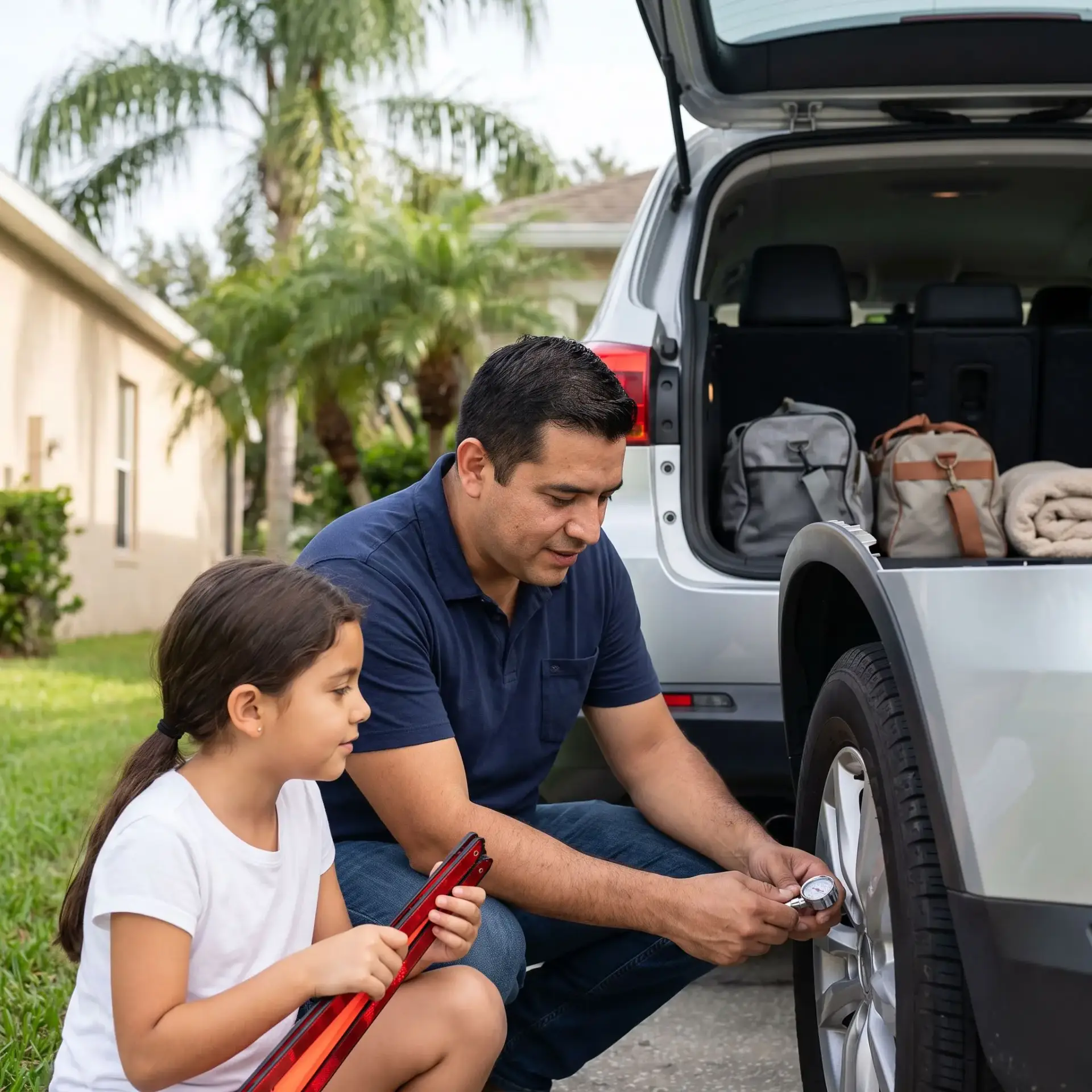
Florida highways fill up at Thanksgiving and a good part of the traffic is passing through. The Move Over law applies several times on a single trip. On I-4, the Turnpike and I-75 you’ll see shoulders full of stopped cars, tow trucks and patrol cars with their lights on.
Do these three practical things before you pull out:
- Leave early. The driver running late is the one who can’t slow down.
- Look far ahead, not at the car in front of you. Seeing the lights early is what lets you change lanes calmly.
- If you’re the one stopped, turn on your hazard lights. Since 2025 the law also protects you when they’re on.
If you’re driving long distances these days, also go over what to check before hitting the road for Thanksgiving. And confirm that your Florida auto insurance is active and has the right information.
Frequently asked questions about the Move Over law
These are the questions drivers ask most about this rule. There are more answers about policies and requirements in our auto insurance FAQs.
What does Florida’s Move Over law require?
You must vacate the lane next to the stopped vehicle and, if that isn’t safe, slow to 20 mph below the posted limit. When the posted limit is 20 mph or less, you drive at 5 mph. That’s what Florida Statutes section 316.126 sets out, unless an officer directs you otherwise.
Does the law apply to a car with a flat tire?
Yes. Since January 1, 2025, according to FLHSMV, the law covers any vehicle stopped on the side of the road. It’s enough that it has hazard lights on, flares out or emergency signals showing. A broken-down car or one with a flat tire is protected like a patrol car or a tow truck.
Is failing to move over a moving violation in Florida?
It is a noncriminal traffic infraction, punishable under chapter 318 as a moving violation, under Florida Statutes section 316.126(6). FLHSMV says it carries a fine, court costs and points on your driving record. It isn’t a criminal charge, but it does stay on your driver record.
How slow do you go if you can’t change lanes?
If you can’t move over safely, slow to 20 mph below the posted limit when that limit is 25 mph or higher. If the posted limit is 20 mph or less, drive at 5 mph. Those speeds come from Florida Statutes section 316.126(1)(b), unless an officer on scene says otherwise.
Drive calmly and check your insurance before you leave
This holiday season you’ll share the road with a lot of people heading out just like you. Slow down when you see lights on the shoulder and clear the lane if you can. Before you go, review your auto insurance. Licensed UniVista Insurance agents compare more than 20 companies in a free quote. By phone, online or at one of our offices in South and Central Florida.
Get a free quote and compare in minutes.
Reviewed on November 19, 2026, against Florida Statutes section 316.126 and the FLHSMV Move Over page, read that day.
 Vehicle
 Home & Property
 Commercial
 Life
 Health