


If you want real Florida hurricane hail car insurance protection, the short answer is simple: your policy needs comprehensive coverage before the storm hits. Florida’s legal minimum keeps you on the road legally, but for your own car, it helps to review your Florida auto insurance with hail in mind.
What does Florida hurricane hail car insurance actually cover in Florida?
In Florida, Florida hurricane hail car insurance usually means one thing: comprehensive coverage for damage to your own vehicle from hail and other weather events. Without it, dents, cracked glass, and storm damage to your car may come out of your pocket.
Why Florida minimum required auto insurance does not repair hail damage to your own car
Florida’s minimum required auto insurance is $10,000 in personal injury protection and $10,000 in property damage liability, according to Florida Highway Safety and Motor Vehicles. That requirement is about injuries and damage you cause, not hail damage to your own car.
So if a severe thunderstorm drops hail on your parked vehicle, minimum PIP and PDL do not pay to fix your hood, roof, or windshield.
How comprehensive coverage pays for hail dents, cracked windshields, and storm-related vehicle damage
Comprehensive coverage is the part of Florida hurricane hail car insurance that handles non-collision weather losses. The National Association of Insurance Commissioners says it pays for severe weather damage, including wind and hail, and the Insurance Information Institute also includes hurricanes and broken windshields under comprehensive.
That means a pitted hood after quarter-size hail, side glass broken by wind-driven debris, or a cracked windshield during a tropical storm may be covered, subject to your deductible.
When coverage applies during hurricanes, tropical storms, and severe thunderstorms
Coverage applies when the loss is caused by a covered weather event while your policy is active. In practice, that can include hurricanes, tropical storms, and ordinary Florida thunderstorms that suddenly turn severe.
The risk is real. National Weather Service Melbourne uses 1-inch hail as the severe-thunderstorm threshold, and South Florida recorded 47 events involving damaging wind and/or large hail in 2025, according to National Weather Service Miami-South Florida. Tampa Bay Times also reported recurring 2026 alerts for marble-size to quarter-size hail in Central West Florida.
How can you actually protect your car before hail starts falling?
The most effective move is physical, not paperwork: get the car under cover before the storm reaches you. For Florida hurricane hail car insurance, coverage matters after the damage, but parking decisions often decide whether you have damage at all.
Why moving the vehicle into a garage or under a carport is the most effective step
A garage gives the best protection because it blocks direct hail impact. If you do not have a garage, a carport is still better than leaving the car exposed in an open driveway or parking lot.
The National Weather Service office in Melbourne, Florida, specifically advises drivers to move vehicles into garages or under carports before severe thunderstorms, as time and safety permit. That advice matters in Florida because 1-inch hail already meets the severe-thunderstorm threshold, and hail at that size can dent metal and crack glass.
What to do if you have no garage at home, work, or while traveling
If covered parking is not available, act early and look for the closest sturdy shelter area where parking is allowed, such as enclosed parking at work, a parking garage, or another legal covered spot on your route. Waiting until hail is already falling usually leaves you with fewer safe options.
If you are caught on the road, protect yourself first. National Weather Service guidance says a vehicle is safer than being outside during a severe thunderstorm, but if there is enough time, go to the closest secure shelter. Do not stop under a highway overpass to wait out hail.
How to use weather alerts and severe thunderstorm warnings to act early
Weather alerts buy you time. If your phone shows a severe thunderstorm warning, treat that as your cue to move the car now, not after the rain starts.
This is especially useful in Florida, where storms can build fast and still produce hail. Tampa Bay Times reported recurring 2026 local alerts for marble-size to quarter-size hail in Central West Florida, which is a good reminder that Florida hurricane hail car insurance works best when you combine coverage with early action.
What should you do if hail hits while you are driving during a Florida tropical storm?
If hail starts hitting while you are driving, your first job is not to save the paint. It is to avoid injury and get to safer shelter if you can do it without creating a worse situation.
That is the hard truth behind Florida hurricane hail car insurance: coverage can help with repairs later, but it cannot undo a crash, flying glass, or a bad stop in the wrong place.
Why personal safety comes before protecting the vehicle
The National Weather Service says a vehicle is safer than being outside during a severe thunderstorm. So if hail begins falling, stay calm and keep your attention on traffic, visibility, and where you can safely pull in.
A dented hood or cracked windshield may be repairable under comprehensive coverage. Your safety is not something to trade for better sheet metal.
How to reach sturdy shelter safely and why overpasses are dangerous
If there is enough time, head to the closest secure shelter, such as a gas station with a solid covered area, a parking garage, or another sturdy structure where stopping is allowed. Do not make sudden lane changes or slam on the brakes just because hail starts getting louder.
Do not stop under a highway overpass. National Weather Service severe-weather guidance warns against using overpasses as shelter during hail or severe storms. They can create dangerous traffic backups and leave you exposed in a place that feels protected but is not truly safe.
How to reduce injury risk from shattered glass inside the car
If glass starts cracking or hail is striking the windshield hard, keep your seat belt on and turn your body slightly away from the side windows when possible without losing control. Passengers should stay low and face away from the windows.
If you reach a safe stop, keep everyone inside the vehicle until the worst passes unless a sturdier shelter is immediately available. In a Florida storm, broken glass is a bigger threat to people than cosmetic damage is to the car.
How common is hail damage in Florida, and what do recent numbers show?
Hail is less constant in Florida than heavy rain or wind, but it is common enough to matter for Florida hurricane hail car insurance. Recent weather records show the risk is real, especially when fast-building thunderstorms or tropical systems turn severe.
That matters because many drivers still treat hail like a Texas problem. In Florida, the pattern is more episodic, but a single storm is enough to leave dents, cracked glass, and a repair bill your minimum policy will not pay.
What South Florida’s 2025 damaging wind and/or large hail events reveal
South Florida recorded 47 events involving damaging wind and/or large hail in 2025, according to National Weather Service Miami-South Florida. The same annual summary reported the largest hail at 1.5 inches.
Those two numbers tell you something practical: hail in Florida is not just a rumor or a one-off social media photo. It shows up often enough to be tracked across the region, and it can reach sizes that go beyond minor cosmetic spotting.
What 2026 local warnings for marble-size to quarter-size hail mean for drivers
Local 2026 reporting by Tampa Bay Times showed repeated warnings in Central West Florida for marble-size to quarter-size hail. For drivers, that means hail risk can appear during ordinary thunderstorm days, not only during a named hurricane landfall.
If you rely on Florida hurricane hail car insurance, this is why timing matters. The useful move happens before the ice starts falling: get the car under cover when alerts begin, not after roads get slick and visibility drops.
Why quarter-size hail matters: because it meets the severe-thunderstorm threshold
Quarter-size hail matters because the National Weather Service Melbourne, FL uses 1-inch diameter hail as the severe-thunderstorm threshold. Quarter-size hail is right at that mark.
So when a warning mentions quarter-size hail, treat it as a serious signal for your car, especially if it is parked outside with no garage or carport nearby.
How much can hail damage cost compared with adding comprehensive coverage?
For most Florida drivers, the practical comparison is simple: one hailstorm can leave you paying the full repair bill yourself, while comprehensive coverage usually limits your share to the deductible. That is why Florida hurricane hail car insurance often comes down to one decision made before the weather turns bad.
The Insurance Information Institute says the average annual cost of comprehensive coverage is a little over $134 in the U.S. By contrast, Florida’s minimum required auto insurance still does not pay to fix your own hail-damaged car.
| Option | What it does |
|---|---|
| Garage or enclosed parking before storm arrival | Best physical protection; NWS Melbourne specifically advises moving vehicles into garages or under carports before severe thunderstorms, as time and safety permit. |
| Carport or other covered parking | Reduces direct hail impact when a garage is unavailable, though less protective than a fully enclosed structure. |
| Comprehensive auto insurance | Pays for hail and other non-collision weather damage to your own car, subject to deductible; Florida minimum required insurance does not replace this coverage. |
| Florida minimum PIP/PDL only | Helps meet state legal insurance requirements but does not pay to repair your own hail-damaged vehicle. |
| Driving during hail | Raises risk of windshield and body damage; NWS guidance says seek a sturdy shelter if time allows and do not stop under overpasses. |
Typical repair categories: dents, paint damage, broken glass, and full-panel repairs
Hail damage is rarely just one problem. A storm can leave small roof and hood dents, chipped paint, cracked windshields, or damage that forces replacement of a panel instead of a simple touch-up.
That matters because Florida hurricane hail car insurance is not just about major losses. Even moderate hail can create several repair categories on the same vehicle.
How deductibles change your out-of-pocket cost after a hail claim
If you carry comprehensive coverage, your insurer generally pays the covered hail loss minus your deductible. So your real question is not whether hail repairs cost money. It is how much of that bill stays with you after the deductible.
Without comprehensive, the deductible question disappears because you are typically paying the entire repair cost yourself.
Why paying for comprehensive coverage can be cheaper than paying for repairs yourself
Comprehensive can be the cheaper path because it turns an unpredictable weather loss into a more predictable insurance cost. According to the National Association of Insurance Commissioners and the Insurance Information Institute, comprehensive is the coverage designed for hail, wind, and other non-collision storm damage.
So if your car sits outside during Florida storm season, a little over $134 per year on average may be far easier to absorb than a sudden repair bill after one bad hail event.
What mistakes leave Florida drivers unprotected against hurricane hail?
The biggest mistakes are simple: adding coverage too late, assuming any hurricane-related damage is covered automatically, and mixing up what flood, collision, and comprehensive actually do. With Florida hurricane hail car insurance, timing and coverage type decide whether you get help or a repair bill.
Waiting until a storm is approaching to add comprehensive coverage
This is the mistake that hurts most. Comprehensive coverage needs to be in place before the loss happens. If hail starts falling on your car today, you cannot use tomorrow’s policy change to pay for today’s damage.
That matters in Florida because hail can show up fast during tropical systems and severe thunderstorms. The Insurance Information Institute and the National Association of Insurance Commissioners both place hail under comprehensive, which means waiting until a warning is already on your phone is often waiting too long.
Assuming hurricane season means every storm loss is automatically covered
Florida hurricane season does not turn a minimum auto policy into hail coverage. Florida Highway Safety and Motor Vehicles makes clear that the state minimum is $10,000 in PIP and $10,000 in property damage liability, and that minimum does not repair your own hail-damaged vehicle.
A lot of drivers hear “storm damage” and assume the weather itself triggers payment. It does not. The policy has to include the right protection in the first place.
Confusing flood, collision, and comprehensive protection
These cover different problems. Collision is for impact losses, like hitting another car or backing into a pole. Comprehensive is for non-collision damage, including hail, wind, and broken glass from severe weather, according to NAIC and Triple-I.
Flood confusion causes trouble too. If rising water damages the vehicle during a tropical storm, that is still not something Florida’s legal minimum handles for your own car. Drivers who want real Florida hurricane hail car insurance protection need to read the coverage list, not just the declarations page headline.
How do you file a hail damage claim and get your car repaired faster?
Move fast, document carefully, and file while the storm details are still easy to verify. With Florida hurricane hail car insurance, the speed of your claim often depends on how clearly you show when the damage happened and what parts of the car were hit.
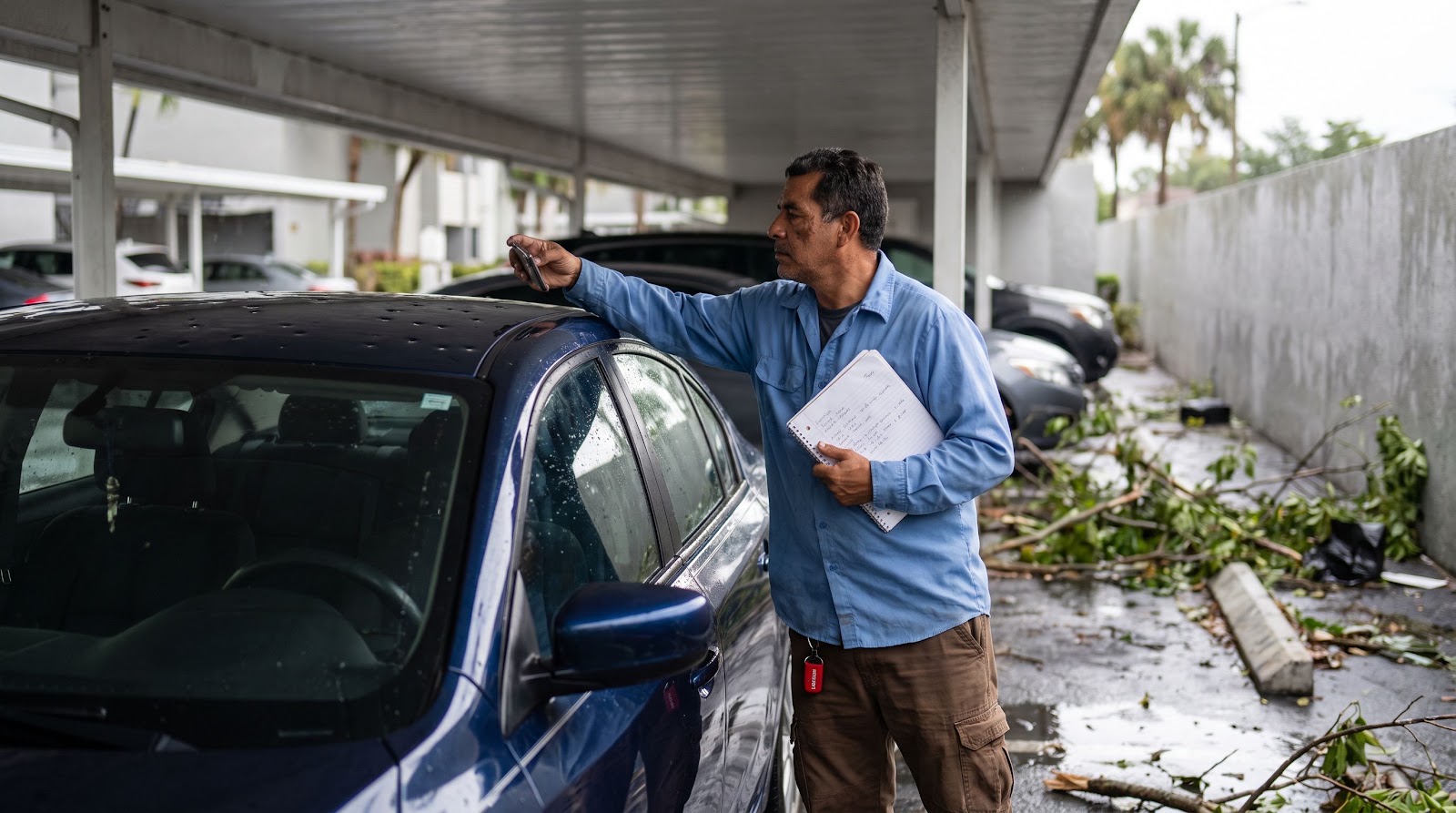
What photos, timestamps, and inspection details to collect right after the storm
Start with wide photos of the whole vehicle, then close shots of the hood, roof, trunk, windshield, and side glass. Take pictures from different angles so shallow dents show up. Keep the phone timestamps, note where the car was parked, and save any weather alert or warning you received that day.
If it is safe, write down what you can already see: cracked glass, water getting in, dents concentrated on one side, or mirrors and trim that were struck. That gives the adjuster a cleaner first picture of the loss.
How insurers evaluate hail dents, glass damage, and repair estimates
Insurers usually look at the type of damage, the affected panels, and whether repair or replacement makes more sense. Under Florida hurricane hail car insurance, comprehensive coverage is the part that generally handles hail, broken windshields, and other non-collision storm damage, according to NAIC and the Insurance Information Institute.
Expect the inspection to separate cosmetic dents from broken glass or parts that affect safe driving. A repair shop estimate helps, but the insurer may still send its own appraiser or request photos first.
When repair delays, deductible questions, or total-loss concerns become important
These issues matter as soon as the claim is approved and you start comparing the repair amount to your deductible. If glass is broken or visibility is affected, ask about inspection timing right away so the car does not sit exposed longer than necessary.
Total-loss concerns usually come up when hail damage is widespread across multiple panels or glass areas. And if you only carry Florida minimum coverage, remember that the required $10,000 PIP and $10,000 property damage liability do not repair your own hail-damaged car, as Florida Highway Safety and Motor Vehicles explains.
 Vehicle
  Home & Property
  Commercial
  Life
Life  Health