


If your refrigerator died after a major blackout, Florida home insurance spoiled food power outage coverage is possible, but it is rarely automatic. The answer usually comes down to your policy wording, the cause of the outage, and whether you added broader protection to your home insurance policy.
Can Florida home insurance cover spoiled food after a power outage?
Yes, sometimes. But a massive outage by itself does not force an insurer to pay for every dollar of rotten food. Florida consumer guidance says coverage depends on what your policy says and what caused the loss.
What policy language usually controls spoiled food claims
The key wording is the food-spoilage provision, any stated causes of loss, and the deductible. The Florida Insurance Consumer Advocate says some homeowners policies include this coverage and some do not, so the first question is whether your policy even lists it.
Limits are often modest. Typical Florida food-spoilage limits run from $500 to $2,500, according to the Florida Insurance Consumer Advocate, and the Insurance Information Institute says standard policies often cap this loss at up to $500.
When a covered peril may trigger payment
A claim is more likely to work when the outage ties back to a covered peril under the policy. A common example is lightning or a tree falling on your property and knocking out power to the home. In that situation, the spoiled food loss may be covered, subject to the policy limit and deductible.
Why off-premises outages are often treated differently from losses caused on the insured property
This is where many claims run into trouble. Florida consumer guidance explains that neighborhood-wide outages caused by off-premises power-line problems are often treated differently and may not be covered under standard homeowners insurance. The same guidance also warns that spoilage from appliance failure, service shutoff, or some flood-related outages may fall outside standard coverage.
How optional endorsements can expand food-spoilage coverage
Some carriers sell broader endorsements that apply to food spoilage from any outage for an extra premium. That add-on can matter more than the size of the blackout. The Florida Insurance Consumer Advocate explains this in its consumer FAQ, available through the Florida Insurance Consumer Advocate.
Why do many Florida spoiled food claims get underpaid or denied?
Because the claim may be valid in theory, but weak in dollars or weak on policy wording. With Florida home insurance spoiled food power outage claims, the biggest problems are usually low limits, deductibles, and a cause of loss that falls outside standard coverage.
Low sublimits for refrigerated or frozen food
Many homeowners expect reimbursement for the full value of a packed fridge and freezer. The policy often says otherwise. The Florida Insurance Consumer Advocate says typical food-spoilage limits in Florida run from $500 to $2,500, and the Insurance Information Institute says standard policies often pay up to $500.
That gap is where frustration starts. If you lost frozen meat, baby formula, and a week’s groceries, your actual loss can easily push past the sublimit even when coverage exists.
How deductibles can wipe out small grocery-loss claims
A covered loss does not always mean a check. The Insurance Information Institute says the homeowners deductible generally applies unless the insurer offers a separate deductible endorsement.
So if your spoiled food totals $400 or $500, the deductible can erase the practical value of the claim. In that situation, the insurer may not owe anything beyond the deductible threshold, even if the outage itself was tied to a covered peril.
Common denial reasons tied to excluded causes and missing proof
Florida consumer guidance flags several trouble spots: off-premises line failures, refrigerator or freezer mechanical breakdown, service shutoff, and some flood-related outages under standard homeowners policies. Those are common denial paths.
Proof also matters. The Florida Department of Financial Services and the Florida Insurance Consumer Advocate advise taking pictures of the spoiled food before throwing it away and keeping receipts when available. If you submit a claim with no photos, no item list, and no purchase records, an adjuster has less to work with.
Why a massive area-wide outage alone does not guarantee reimbursement
A widespread blackout may explain why your food spoiled, but it does not automatically trigger payment. Florida guidance says many policies require the outage to come from a covered peril, or from a cause that occurred on the insured property, unless you bought broader optional outage coverage.
That is why two neighbors on the same dark street can get different results. One may have an endorsement for any outage. The other may have standard wording that does not cover a neighborhood power-line failure.
What should you do in the first 24 hours after a Florida power outage ruins your food?
Move fast. For a Florida home insurance spoiled food power outage claim, the first day is about preserving proof before the mess gets cleaned up.
Your insurer may question what spoiled, when it spoiled, and how much it was worth. Good documentation answers those points early.
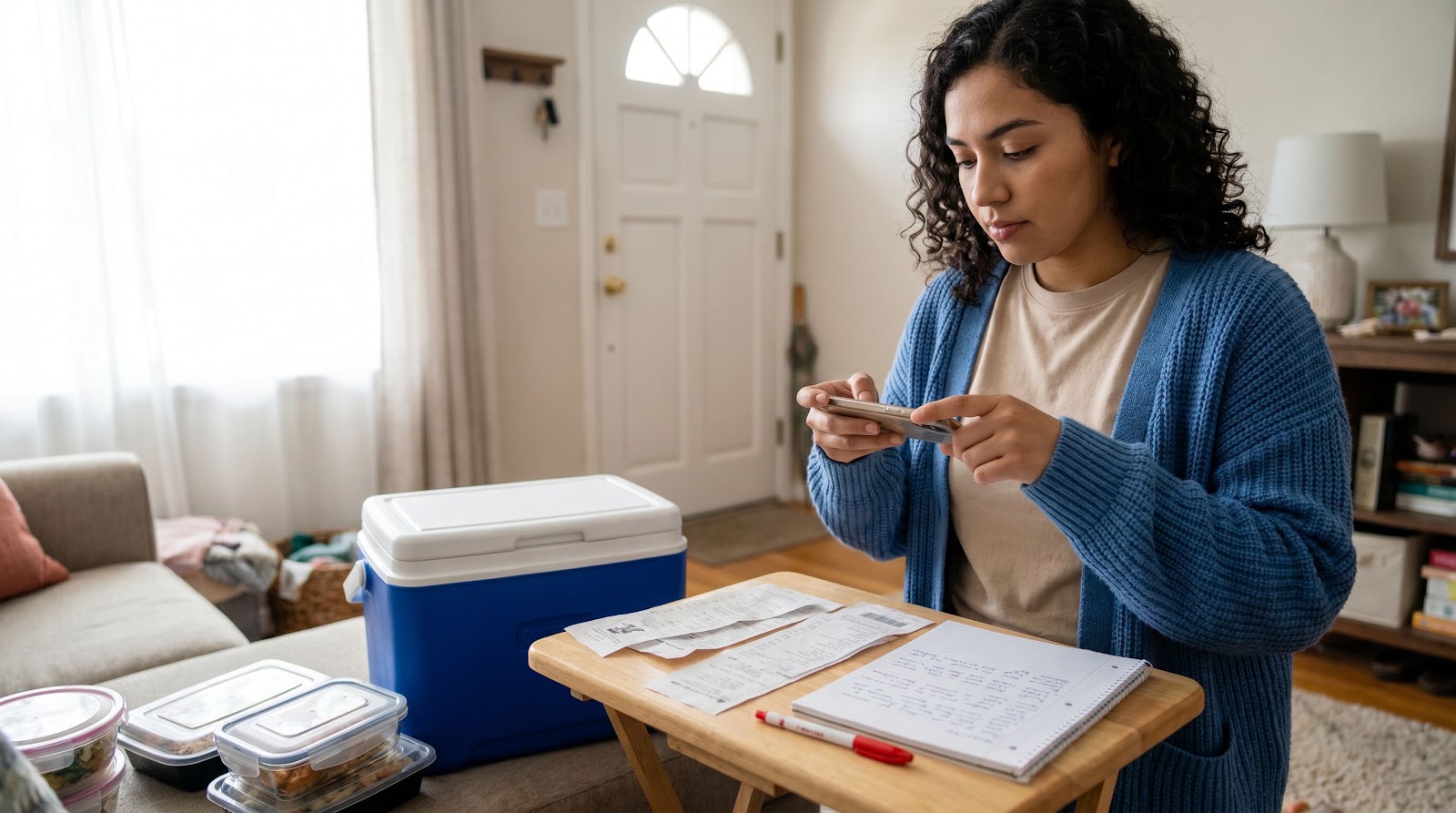
How to document spoiled food with photos, video, receipts, and itemized lists
Take wide photos first, then close-ups. Open the refrigerator and freezer, photograph shelves, drawers, labels, and any spoiled liquids, thawed meats, or ruined frozen items.
Record a short video while naming what you lost. Then make an itemized list by category: meat, dairy, frozen foods, produce, medications if refrigerated, and specialty items. The Florida Department of Financial Services and the Florida Insurance Consumer Advocate both advise taking pictures of spoiled food before discarding it and providing receipts when available.
What to save before throwing food away
Save the evidence, not the odor. Keep store receipts, delivery app confirmations, warehouse club order history, and credit card records that show grocery purchases.
If you can, save packaging for higher-value items until the adjuster confirms they do not need more proof. At minimum, keep photos of brand names, sizes, and quantities before disposal.
How to estimate value when you no longer have every receipt
Use a reasonable replacement estimate. Write down the item, size, and what you paid recently if you remember it. If you do not, use your normal store price and stay consistent.
Do not round everything upward. A realistic list is more credible than an inflated one.
When to contact the insurer and what to say in the first notice of loss
Report the claim directly to the insurer as soon as your list and photos are ready. Say that a power outage caused food spoilage, give the outage date, explain what you documented, and ask whether your policy has food-spoilage coverage or an outage endorsement.
If the carrier asks for proof of loss in writing, track the timeline. Under Florida’s Homeowner Claims Bill of Rights, you have the right to acknowledgment within 7 days, a response within 30 days after a complete proof of loss if requested in writing, and payment of the claim, the undisputed amount, or a denial within 60 days, according to the Florida Senate.
How much can you realistically recover for rotten food in Florida?
Usually less than people expect. With a Florida home insurance spoiled food power outage claim, the final payout often gets squeezed by three things at once: the food-spoilage sublimit, the deductible, and the actual value of what you lost.
Typical claim math: sublimit versus deductible versus total grocery loss
Start with the loss amount, then compare it to your policy cap. Florida consumer guidance says typical food-spoilage limits range from $500 to $2,500, while the Insurance Information Institute says standard homeowners policies often cover up to $500.
Then the deductible enters the picture. If your spoiled food totals $450 and your deductible applies, a covered claim may still produce no payment. If your loss is $1,200 but your sublimit is $500, the cap can stop recovery there before the rest of the groceries are considered.
Comparison of standard policy wording versus broader optional spoilage coverage
Standard wording is usually narrower. The Florida Insurance Consumer Advocate says many policies cover spoilage only when the outage was caused by a covered peril or the cause happened on the insured property.
Broader optional coverage can work very differently. Some insurers sell endorsements for spoilage from any outage for an extra premium, which can help when a mass blackout started off premises.
When filing a claim may not be worth it financially
If your food loss is below the deductible, or just barely above it, filing may not make financial sense. The same goes for a neighborhood outage that likely falls outside standard wording.
That does not mean you should guess. Check the policy language first, especially the spoilage limit and whether you added wider outage coverage.
How do you file a stronger spoiled food claim with your Florida insurer?
Make the claim easy to verify and hard to ignore. For a Florida home insurance spoiled food power outage claim, the strongest file ties your food loss to your policy wording, backs up the amount with proof, and keeps written pressure on the carrier’s deadlines.
The documents and evidence adjusters usually ask for
Expect the adjuster to ask for photos of the spoiled food, a detailed item list, and receipts where you have them. Florida Department of Financial Services guidance also supports keeping records of emergency measures and documenting the loss before disposal.
Your list should be specific: item, brand, size, quantity, and estimated cost. If you bought groceries through an app or warehouse club, include order confirmations or account history. A vague claim that says “fridge contents” gives the insurer room to cut it down.
How to cite the exact policy clause or endorsement supporting payment
Quote the actual wording from your policy. Point to the food-spoilage provision, any off-premises or on-premises cause requirement, and any endorsement that broadens coverage for power outages.
If you purchased an any-outage endorsement, say so plainly in your email or claim letter and attach that page. If your policy covers spoilage only when the outage came from a covered peril, identify the event you believe triggered it and match that event to the policy language.
How the Florida Homeowner Claims Bill of Rights timelines can help keep the claim moving
If the carrier requested a proof of loss in writing and you submitted it completely, Florida’s Homeowner Claims Bill of Rights gives you the right to acknowledgment within 7 days, a coverage decision or investigation notice within 30 days, and payment of the claim, the undisputed amount, or a denial within 60 days, according to the Florida Senate.
Use those dates in follow-up emails. Ask the insurer to confirm the file is complete and to state what, if anything, is still missing.
What to request in writing if the insurer pays only part of the loss
Ask for the payment breakdown line by line. Request the exact reason for each reduction, the policy clause used to support it, whether the deductible was applied, and whether the carrier is treating any portion as undisputed.
If the partial payment does not make sense, ask for the denial of the unpaid portion in writing. If the dispute continues, Florida Department of Financial Services offers free residential property mediation before appraisal or suit.
What happens if your insurer denies or lowballs the spoiled food claim?
You can push back, but do it in writing and tie every objection to the policy. For a Florida home insurance spoiled food power outage dispute, the goal is simple: make the insurer explain exactly why it refused payment or cut the amount.
How to ask for the denial reason and policy basis in writing
Ask for a written explanation that quotes the exact policy language used for the denial or reduction. If the carrier paid only part of the loss, request a line-by-line breakdown showing what was allowed, what was rejected, whether the deductible was applied, and whether any amount is being treated as undisputed.
If you already submitted a complete proof of loss after the insurer requested it in writing, remind the carrier of the Florida deadlines: 30 days for a coverage decision or investigation notice, and 60 days for payment, undisputed payment, or denial, according to the Florida Senate.
When to escalate through the Florida Department of Financial Services consumer helpline
If the adjuster stops responding, gives vague answers, or keeps repeating that a neighborhood outage is not covered without pointing to the wording, contact the Florida Department of Financial Services consumer helpline. DFS consumer guidance is also useful when you need help understanding whether the carrier is relying on an off-premises outage exclusion, appliance failure issue, or another policy limitation.
How free DFS mediation works for homeowners insurance disputes
Florida DFS offers free residential property mediation for disputed homeowners claims before appraisal or suit. It is designed for situations where the disagreement is about coverage, amount, or both.
This can be a practical next step when the insurer acknowledges the Florida home insurance spoiled food power outage claim but values it too low, or when the denial does not match the endorsement you bought.
When to consider legal advice or a licensed public adjuster
Consider legal advice when the insurer denies the claim and the policy wording appears to support coverage, or when the carrier misses deadlines and still will not explain its position clearly. A licensed public adjuster may help if the fight is mostly about documenting and valuing the loss, not just reading the policy.
Before you hire anyone, compare the likely recovery to the policy limit. Many spoiled-food claims are small enough that the cost-benefit math matters.
 Vehicle
  Home & Property
  Commercial
  Life
Life  Health