


If your car’s AC suddenly quits in Texas, auto insurance usually will not pay for the repair. In most cases, Texas car AC breakdown insurance does not apply because the problem falls under maintenance, not accidental damage. If you want help reviewing your coverage, start with Texas auto insurance options.
Does auto insurance cover a completely failed car AC in Texas?
Usually, no. A completely failed AC in Texas is most often treated as a mechanical problem inside the vehicle, not as an insured loss under your auto policy.
That means if the compressor locks up, the blower motor dies, or the system stops cooling because of age or internal failure, your insurer will likely deny the repair. This is the core issue behind most Texas car AC breakdown insurance questions.
Why is a dead AC usually considered maintenance, not an insurable loss
Insurance is built for sudden covered losses, like a crash, theft, or another physical-damage event named by the policy. A dead air conditioner usually looks different. It tends to come from wear, internal failure, or parts reaching the end of their useful life.
So even when the breakdown feels sudden to you, the policy may still treat it as maintenance. A car that blows hot air on a Texas afternoon is miserable, but that alone does not turn the problem into an insurance claim.
The Texas Personal Auto Policy exclusion for wear and tear, mechanical breakdown, and electrical failure
The standard Texas Personal Auto Policy excludes loss that is due to and confined to wear and tear, mechanical breakdown, and electrical failure. That is why most claims for AC compressors, condensers, refrigerant-related failures, and electrical AC parts do not get paid.
The same policy includes a narrow exception when damage results from the total theft of the covered auto. That is very different from an AC system simply failing on its own.
The difference between a denied repair claim and a covered physical-damage claim
A denied repair claim means the AC failed by itself, so the policy sees it as a non-covered breakdown. A covered physical-damage claim is different because the AC was damaged by a covered event first.
For example, if a collision damages the front end and the condenser is hit, that AC damage may be covered, subject to the policy terms and your deductible. Texas Department of Insurance also explains that towing and labor coverage may pay to move the car if it cannot be driven, but it does not pay to fix the failed AC system.
When can insurance pay for air conditioner damage after a covered event?
Texas car AC breakdown insurance can apply when the air-conditioning damage was caused by a covered loss, not when the system simply gave out. The key question is what damaged the AC first: a collision, theft-related event, vandalism, or ordinary mechanical failure.
Crash-related damage to the condenser, compressor, lines, or cooling components
If a wreck damages the front end of the car, the condenser, AC lines, or related cooling parts may be part of the claim. That is very different from a compressor failing on its own in summer traffic.
Texas Department of Insurance explains that when another driver causes damage, their property damage liability may pay up to $25,000 per accident under the Texas minimum limit. If that is not enough, your own collision coverage may help, depending on your policy and the facts of the loss.
Theft, vandalism, and other covered perils that may affect the AC system
An AC claim can also make sense when thieves or vandals damage parts tied to the system. Think of a broken front-end assembly, cut lines, or damage that happened during a theft-related loss.
The Texas Personal Auto Policy also carves out an important exception: the wear-and-tear or mechanical-breakdown exclusion does not apply if the damage results from the total theft of the covered auto. That does not turn every bad AC into a covered claim, but it does matter when the AC damage is part of a covered theft loss.
How deductibles and policy terms can reduce or eliminate payment
Even when the event is covered, payment is not automatic. Your deductible comes off first, and the insurer will still look closely at whether the AC damage came from the covered event or from preexisting wear.
That is why some Texas car AC breakdown insurance claims produce little or no payout. If the damage is minor, close to your deductible, or partly unrelated to the covered loss, the claim may not leave much money for repairs.
How much does it cost to fix a broken car air conditioner in Texas?
The honest answer is that repair bills vary a lot, and that is exactly why many drivers ask about Texas car AC breakdown insurance. But the bigger issue is simpler: if the AC failed from wear, age, or an internal defect, Texas auto insurance usually will not pay for it under the Texas Personal Auto Policy.
So the real calculation is not just the repair price. It is whether the damage came from a covered event and whether the payout would be higher than your deductible.
Typical repair scenarios: refrigerant leak, compressor failure, condenser damage, blower motor issues
A refrigerant leak, bad compressor, failed blower motor, or damaged condenser can all leave you with hot air and a miserable drive. From an insurance standpoint, those parts matter less than the cause.
If the compressor quits on its own or the blower motor fails from age, that usually falls under the policy’s mechanical-breakdown or wear-and-tear exclusion. If the condenser was crushed in a crash, that is a different story. Then the AC damage may be part of a covered physical-damage claim, subject to policy terms.
Repair cost vs. deductible: when filing a claim makes no financial sense
If your AC damage is tied to a covered collision or another covered loss, your deductible comes out first. That means a claim may not help much when the repair cost is close to what you must pay out of pocket anyway.
This is where Texas car AC breakdown insurance often disappoints drivers. Even when there is some coverage, a small AC-related claim can produce little payment after the deductible is applied. And if the insurer decides part of the failure came from preexisting wear, the number can shrink even more.
Replacement vs. repair decisions for older vehicles in extreme Texas heat
For an older car, a major AC repair can become a practical decision, not just a mechanical one. If the vehicle still runs well otherwise, repair may make sense. If the car already has recurring issues, putting more money into the cooling system may be harder to justify.
One thing many Texans worry about is registration. A dead AC by itself is not a statewide registration blocker for non-commercial vehicles. TxDMV says Texas ended the safety inspection requirement for those vehicles on January 1, 2025, though emissions testing still applies in 17 counties as of June 2026.
What should you do before filing a claim for AC damage?
Before you file, figure out whether the AC failed on its own or was damaged by a covered event. That step matters because Texas car AC breakdown insurance usually does not apply to wear, age, or internal mechanical failure under the Texas Personal Auto Policy.
If you rush into a claim without that distinction, you may waste time and end up with a denial that could have been avoided.
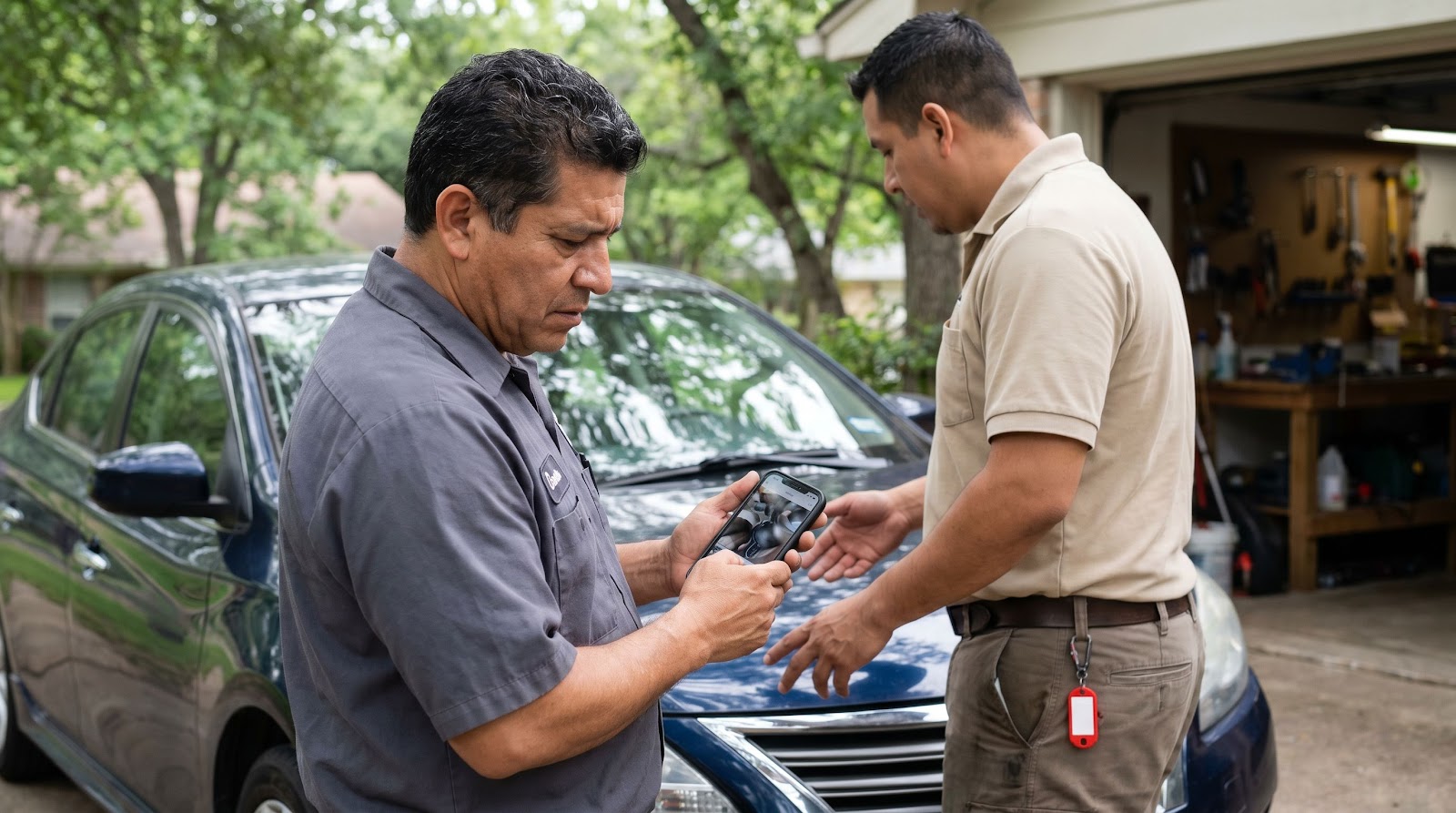
How to document the cause of failure and separate wear-and-tear from accident damage
Start with a simple timeline. Note when the AC stopped cooling, whether the car was recently hit, vandalized, or recovered after theft, and whether the front end or underhood area shows fresh damage.
Look for facts, not guesses. If the compressor failed internally with no related collision or theft damage, that points to a mechanical breakdown. If the condenser, lines, or connected parts were damaged in a crash, that points to a possible covered physical-damage loss.
What photos, repair invoices, and mechanic findings help support a covered-loss claim
Take clear photos of the vehicle from multiple angles, then close-ups of the damaged area. Focus on impact points, broken mounts, bent front-end parts, cut lines, or anything that connects the AC problem to a specific event.
Keep tow receipts, prior repair invoices, and the shop’s written findings. The most useful diagnosis is one that says what failed and why. For example, “condenser damaged by front-end impact” helps more than “AC not working.”
When to call your insurer, agent, or repair shop first
Call the repair shop first when the failure appears to be ordinary wear or an internal AC issue. Call your insurer or agent first when the AC damage happened right after a crash, theft-related loss, or another event that may be covered.
If the car cannot be driven, check whether you bought towing and labor coverage. Texas Department of Insurance says that coverage can help with the tow, but it does not pay for the AC repair itself.
What mistakes cause Texas drivers to get their AC claims denied?
The biggest mistake is treating a dead air conditioner like a covered insurance loss when it is really a repair issue. Most Texas car AC breakdown insurance denials happen because the facts point to wear, internal failure, or missing proof of a covered event.
That does not mean every AC-related claim is wrong. It means the cause has to match what the policy covers.
Assuming any expensive repair is automatically covered
A large repair bill does not create coverage by itself. If the compressor, blower motor, condenser, or another AC part failed from age or mechanical trouble, the standard Texas Personal Auto Policy generally excludes it.
This is where drivers get frustrated. The AC may have quit all at once, the heat may be brutal, and the estimate may be painful. But a sudden breakdown is still often just a breakdown.
Reporting a mechanical failure without evidence of a covered peril
If you tell the insurer, “the AC stopped working,” that usually sounds like maintenance, not a covered claim. You need facts showing the AC damage came from a collision, theft-related loss, or another covered physical-damage event.
Texas Department of Insurance draws that line clearly in practice: auto coverage can matter when vehicle damage comes from an insured loss, while towing and labor coverage may help move the car but not repair the failed AC system. A shop diagnosis that connects the damage to impact or theft is far more useful than a generic note saying the system blows hot air.
Ignoring deductible amounts, policy exclusions, and prior maintenance history
Some drivers file first and read the policy later. That is backward. Your deductible still applies, and preexisting wear can reduce or eliminate payment even when part of the damage followed a covered event.
Prior invoices matter too. If records show the AC had ongoing problems before the accident, the insurer may see the loss as unrelated or only partly related. Before filing, check the exclusion language, compare the repair estimate to your deductible, and gather any service history that supports your timeline.
Can you legally drive in Texas with no AC, and does it affect registration?
Yes, in most cases, you can legally drive in Texas with a dead AC, and by itself, it usually will not stop you from registering a non-commercial vehicle. For drivers asking about Texas car AC breakdown insurance, that is a separate issue from whether the car is road-legal for registration.
Why a failed AC is not a registration issue for most Texas drivers
A broken air conditioner is generally a comfort and maintenance problem, not a registration violation. If the car runs and meets the requirements that still apply in your county, the AC itself is not what decides registration.
That matters because many drivers assume a major heat-related failure automatically creates a legal problem. It usually does not. The tougher part is living with the Texas heat while you decide whether to repair the system out of pocket.
Texas registration reality in June 2026: no safety inspection for non-commercial vehicles, but emissions testing still applies in certain counties
As of January 1, 2025, Texas no longer requires a safety inspection for non-commercial vehicles before registration, according to TxDMV. But emissions inspections still apply in 17 counties as of June 2026.
Texas Department of Public Safety also says non-commercial vehicles pay a $7.50 inspection program replacement fee at registration. So if your AC dies, the registration question is usually not “Will the AC fail inspection?” It is “Do I still need an emissions test where I live?”
Bexar County’s emissions program starts on November 1, 2026, and why it still does not make AC a pass-fail item
Bexar County joins the emissions program on November 1, 2026. Even then, a failed AC is still not described here as a pass-fail item for registration. The emissions program and a dead cabin cooling system are different issues.
One practical warning: some drivers try to compensate with darker front-window tint. Texas Department of Public Safety allows that only with a medical exemption signed by a licensed physician or optometrist. A hot car is miserable, but it does not create a general tint exception.
What are your practical options if your AC dies during a Texas summer?
Your best move is usually practical, not insurance-based. If the system failed on its own, Texas car AC breakdown insurance will probably not help, so focus first on diagnosis, legal heat workarounds, and any separate protection you may have bought.
Lower-cost ways to diagnose the problem before authorizing major repairs
Ask the shop for a written diagnosis that explains what failed and why. That matters because a note saying “AC not cooling” tells you very little, while “compressor failed internally” or “condenser damaged after impact” points you in two very different directions.
If there was no crash, theft-related loss, or other covered damage, treat the visit like a repair decision first. If the car is not safely drivable or you do not want to risk overheating inside the cabin, the Texas Department of Insurance says towing and labor coverage may help with the tow, but not with the AC repair.
Heat-related workarounds, including the legal limits on darker front-window tint and medical exemptions
You can still drive a non-commercial vehicle in Texas with no AC, and a dead system by itself is not a statewide registration blocker. TxDMV says safety inspections ended for those vehicles on January 1, 2025, although emissions testing still applies in 17 counties.
Some drivers look at darker front-window tint for relief. Be careful there. Texas Department of Public Safety allows a darker-than-standard tint on the two front windows only with a medical exception supported by a licensed physician or optometrist. Heat alone does not create a general exemption.
When an extended warranty or mechanical breakdown protection may help more than auto insurance
If your failure came from wear, age, or an internal electrical or mechanical issue, a service contract, extended warranty, or mechanical breakdown protection may be more useful than auto insurance. That is because the Texas Personal Auto Policy generally excludes loss confined to mechanical or electrical breakdown and wear and tear.
So before filing a claim, pull out the paperwork for any dealer warranty, manufacturer coverage, or breakdown plan you bought. For many Texas drivers with a dead AC, that paperwork is more relevant than the auto policy.
 Vehicle
  Home & Property
  Commercial
  Life
Life  Health