


At 70 mph, a construction debris blowout can turn into an insurance fight in minutes. For a Texas highway debris blowout car insurance claim, the key question is simple: did the debris hit your car while moving, or did you hit debris already on the road? If you need help reviewing coverage in Texas, start here: Texas auto insurance.
What happens if construction debris causes a 70 mph blowout in Texas?
If construction debris causes a blowout on a Texas highway, the claim usually depends on how the debris made contact and what was damaged next. Texas law also addresses unsecured loads on public highways, and TxDOT recorded 1,385 crashes in 2024 with “LOAD NOT SECURED” as a contributing factor.
How Texas insurers separate flying debris from debris you hit on the road
This is the line adjusters look at first. The Texas Department of Insurance says comprehensive coverage applies when damage comes from something other than a collision, and it specifically includes flying gravel as an example. The Insurance Information Institute makes the same distinction by placing projectiles and fallen objects under comprehensive, while damage from hitting an object is generally collision.
So if a chunk of material flies off a truck and slams into your tire, windshield, or bumper, that often points toward comprehensive. If the debris is already lying in your lane and you run over it, that usually gets reviewed as collision.
Why a tire blowout can trigger collision, comprehensive, or both depending on the damage sequence
A blowout is not always a one-coverage event. If airborne debris first shreds the tire, that initial impact may fit comprehensive. If the blowout then sends you into a guardrail, median, or another object, the later body damage may be handled under collision.
The sequence matters. First contact, then loss of control, then secondary impact. That timeline can shape how the Texas highway debris blowout car insurance claim is evaluated.
What evidence matters most right after the crash scene is secured
After everyone is safe, focus on proof. Take photos of the tire, wheel, undercarriage, debris pieces, lane position, skid marks, and any nearby construction or hauling vehicle. If debris fell from a truck, a plate number, company name, trailer markings, or dashcam clip can make a major difference.
Get the crash report details and keep your tow and repair records. If the other driver is unknown, remember that minimum Texas liability insurance only covers damage you cause to others, not repairs to your own car. Texas minimum limits remain 30/60/25, according to the Texas Department of Insurance.
Which insurance pays for highway debris damage: collision, comprehensive, or UM/UIM property damage?
For a Texas highway debris blowout car insurance claim, the answer usually depends on one detail: was the debris airborne, or was it already in the road when your car hit it? That distinction often decides whether collision, comprehensive, or UM/UIM property damage comes into play.
| Scenario | Likely coverage implication in Texas |
|---|---|
| Debris or gravel strikes your car while airborne | Often falls under comprehensive/other-than-collision, based on TDI’s example of flying gravel and III guidance on fallen objects/projectiles |
| You drive into debris already in the roadway | Often analyzed as collision because the vehicle impacted an object, per III’s collision definition |
| Unidentified driver causes damage and leaves | Your own liability coverage will not fix your car; TDI says collision or UM/UIM property damage may pay |
| You only carry Texas minimum liability insurance | You are legal to drive, but your policy generally does not pay to repair your own car after a debris loss |
When collision coverage usually pays for striking nails, wood, metal, or fallen cargo
If you run over a board, metal piece, tire shred, or cargo already sitting in the lane, insurers usually review that as collision. The Insurance Information Institute defines collision as damage caused by hitting an object, which fits many road-debris impacts.
When comprehensive may apply to flying gravel and other airborne objects
Comprehensive is usually the better fit when something hits your vehicle through the air. The Texas Department of Insurance specifically lists flying gravel as an example of damage often covered by comprehensive if you carry that coverage.
How UM/UIM property damage can help if the at-fault driver is uninsured or underinsured
If a driver drops debris, causes the loss, and has no insurance or not enough insurance, UM/UIM property damage may help with repairs to your vehicle. Texas Department of Insurance guidance also makes clear that your own liability coverage does not repair your car after this kind of event.
Why Texas minimum liability limits of 30/60/25 may not be enough in a multi-vehicle debris crash
Texas still requires minimum liability limits of 30/60/25: $30,000 per injured person, $60,000 per accident, and $25,000 for property damage. In a chain-reaction debris crash with several damaged vehicles, that property damage limit can get tight fast.
That matters because TxDOT recorded 1,385 crashes in 2024 with “LOAD NOT SECURED” as a contributing factor. In a serious highway debris loss, being legal to drive and being well protected are not the same thing.
What does Texas law say about unsecured loads and falling construction debris?
Texas law does address this directly. For a Texas highway debris blowout car insurance case, the legal issue starts with whether a truck, trailer, or semitrailer was carrying material that could blow or spill onto a public highway.
Under Texas Transportation Code Chapter 725, “loose material” includes material that can be blown or spilled from a vehicle because of movement or exposure to wind or weather. That matters because falling construction debris is not just bad luck. It can point to a load-securing failure tied to a specific commercial vehicle.
Texas rules require loads to be secured to prevent spills on highways
The rule is straightforward: loads on public highways must be secured so material does not blow or spill out. Chapter 725 applies to motor vehicles, trailers, and semitrailers, which is exactly why debris cases often involve dump trucks, flatbeds, or contractor vehicles hauling gravel, scrap, wood, or broken concrete.
This is a real highway risk in Texas. TxDOT recorded 1,385 crashes in 2024 with “LOAD NOT SECURED” as a contributing factor.
How liability may fall on the truck owner, contractor, or another responsible party
Liability does not always stop with the person behind the wheel. If debris came from a commercial vehicle, responsibility may fall on the truck owner, the contractor controlling the job, or another party responsible for how the material was loaded, covered, or transported.
That becomes especially important when several cars are damaged. Texas minimum property damage liability is still $25,000, according to the Texas Department of Insurance, and that amount can disappear quickly in a multi-vehicle debris crash.
Why a police report and witness statements are critical when debris comes from a commercial vehicle
When debris comes off a work truck and keeps moving, proof disappears fast. A police report can document the roadway conditions, the type of debris, and any commercial vehicle identified at the scene.
Witness statements help connect the debris to the truck that dropped it. If someone saw gravel, lumber, or metal fly from a trailer, that can support both the liability side of the claim and the coverage analysis later.
Texas highway debris crash numbers and insurance limits drivers should know
A Texas highway debris blowout car insurance claim is not about a freak accident that almost never happens. Texas records show this risk shows up on real crash reports, and the state minimum limits can leave very little room when several vehicles are involved.
Why statewide unsecured-load crash data shows this is an ongoing real-world risk
TxDOT recorded 1,385 crashes in 2024 with “LOAD NOT SECURED” listed as a contributing factor. That included 1 fatal crash. This is why a Texas highway debris blowout car insurance question comes up so often after highway losses involving gravel, tools, scrap, or construction material.
Texas Department of Transportation data also shows the state had one reportable crash every 57 seconds in 2024. Debris is just one slice of that picture, but it is clearly part of everyday driving risk here.
Comparison of Texas minimum liability limits versus realistic repair and injury costs
Texas minimum liability limits are still 30/60/25. That means $30,000 for one injured person, $60,000 per accident for bodily injury, and $25,000 for property damage, according to the Texas Department of Insurance.
Those limits satisfy the law. They do not guarantee enough protection after a high-speed debris crash involving multiple cars, guardrail damage, or a serious injury claim. Even before fault is sorted out, the available coverage can become the pressure point.
How underinsurance can leave drivers paying out of pocket after a chain-reaction crash
If a driver drops debris and several vehicles are damaged, the at-fault policy may run out before every repair bill is paid. That is where underinsurance hurts. One chain-reaction loss can spread the available property damage coverage across multiple vehicles.
And if you only carry liability, your own policy generally will not repair your car after a debris blowout. Texas Department of Insurance guidance is clear on that point.
What should you do immediately after hitting massive road debris?
First, get out of the traffic flow if the car can still move safely. For a Texas highway debris blowout car insurance claim, the first few minutes matter because they shape both safety and proof.
If the tire is shredded, the steering feels off, or warning lights come on, do not keep driving at highway speed. A short move to the shoulder is one thing. Continuing for miles can make the damage harder to sort out later.
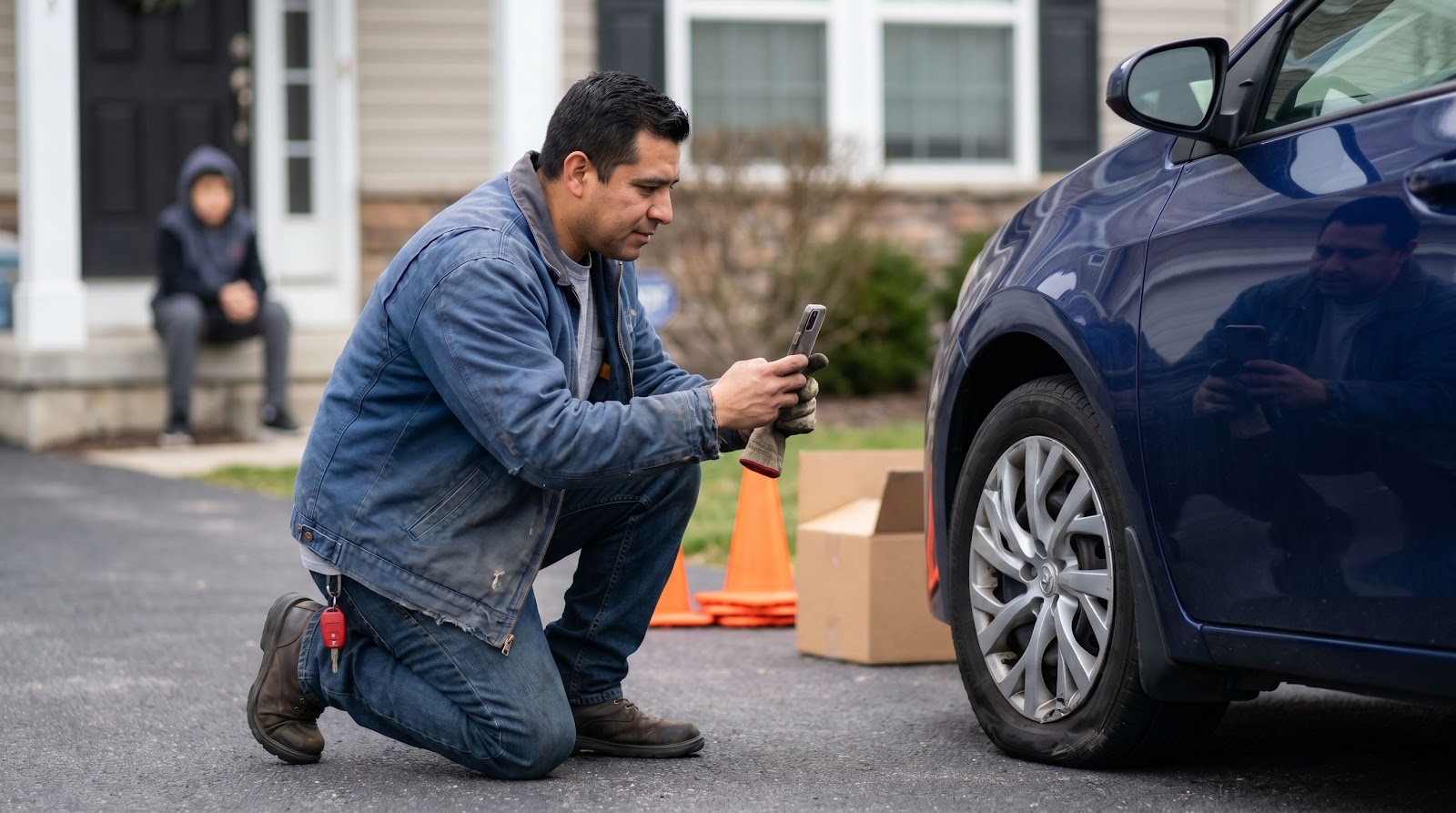
How to protect safety, document the debris, and preserve dashcam or phone evidence
Once you are in a safer spot, check for injuries and call for help if needed. Then document the scene before the debris gets kicked aside or traffic changes the picture.
Take clear photos of the tire, wheel, bumper, undercarriage, debris pieces, lane position, and any nearby truck, trailer, or construction vehicle. Save the full dashcam clip. Do not rely on a short app preview. If you used your phone, keep the original files and screenshots showing the time and location.
What to say when reporting the claim to your insurer
Stick to a simple timeline. Say where you were, whether the debris was airborne or already on the road, what part of the car was hit first, and what happened next. That wording matters because Texas Department of Insurance guidance and Insurance Information Institute definitions separate flying-object damage from damage caused by striking an object.
Ask the adjuster to note if the loss involved a blowout, wheel damage, and any second impact after the tire failed.
When to seek towing, tire inspection, alignment checks, and hidden damage diagnostics
Call for towing if the car pulls hard, the rim is bent, the tire will not hold air, or you hear scraping underneath. Even if the car seems drivable, get the tire and wheel inspected quickly.
Also ask for an alignment check and a look at the suspension, brake lines, and underbody shields. A debris strike can start as one flat tire and turn into hidden damage that shows up later.
How much can a debris blowout crash cost without the right coverage?
A Texas highway debris blowout car insurance problem can get expensive fast, even when nobody is injured. If you do not carry the right physical damage coverage, the bill for the tire may be only the start.
Typical out-of-pocket losses for tires, wheels, suspension, undercarriage, and body damage
A hard debris strike can damage the tire, bend the wheel, knock the alignment out, scrape the undercarriage, and crack bumper or body panels in the same event. If the blowout happens first and the car then hits a barrier or another object, the repair bill usually grows beyond a simple tire replacement.
That is why drivers are often surprised after a highway debris loss. What looks like one flat tire can turn into wheel damage, suspension issues, and hidden underside damage that shows up after the tow or inspection.
How deductibles change the real payout under collision or comprehensive coverage
Even when coverage applies, your deductible changes what you actually receive. If the damage is handled under comprehensive because debris was airborne, or under collision because you struck debris in the roadway, the insurer generally pays the covered loss minus your deductible.
That matters in smaller claims. If the visible damage is limited, a high deductible can leave you paying much of the repair cost yourself. And if you only carry Texas minimum liability, your policy is legal for driving, but it generally will not pay to repair your own vehicle after this kind of crash, according to the Texas Department of Insurance.
Why financing or leasing a vehicle often makes physical damage coverage essential
If your car is financed or leased, physical damage coverage is often practically essential because the lender or leasing company still has a financial interest in the vehicle. A debris blowout does not pause your loan or lease just because the car is damaged.
Texas minimum liability limits remain 30/60/25, including just $25,000 for property damage to others. Those limits do not fix your own financed vehicle after a debris crash. For that, collision, comprehensive, and in some situations UM/UIM property damage are usually the coverages that matter most.
The most expensive mistakes Texas drivers make after a debris-related crash
The costliest mistake in a Texas highway debris blowout car insurance claim is assuming “debris is debris” and every claim works the same way. In Texas, the damage path matters, the coverage you bought matters, and the wrong first report can push the claim into the wrong bucket.
A common example: a driver says, “I hit something,” when the real sequence was that construction material flew off a truck, struck the tire, and then caused a blowout. Texas Department of Insurance guidance and Insurance Information Institute definitions treat those facts differently. That can affect whether the claim is reviewed under comprehensive or collision.
The next expensive mistake is carrying only 30/60/25 and assuming that means your own car is protected. It does not. Texas Department of Insurance says liability insurance is required by law, but it generally does not repair your vehicle after this kind of loss. If you only have the state minimum, including $25,000 for property damage to others, you may be legal to drive and still be paying your own repair bill.
Another bad move is failing to identify the vehicle that dropped the debris. Texas Transportation Code Chapter 725 applies to unsecured loads on public highways, and TxDOT recorded 1,385 crashes in 2024 with “LOAD NOT SECURED” as a contributing factor. If you miss the plate, trailer number, company name, or dashcam footage, you may lose the clearest route to proving who caused the crash.
Last, many drivers fix the tire and move on without checking for secondary damage. After a high-speed debris strike, wheel, suspension, alignment, and underbody problems can show up after the car leaves the shoulder.
 Vehicle
  Home & Property
  Commercial
  Life
Life  Health