


A summer puddle in Florida can hide the kind of impact that bends metal, shreds a tire, and leaves your car unsafe in seconds. If you are reviewing your Florida auto insurance options, this is exactly why hidden road damage matters before a claim ever starts.
What damage can a hidden rain-filled pothole cause to your car?
A hidden pothole can damage far more than a tire. The biggest risk is a hard strike to the suspension, wheel, or steering parts when the water masks the hole’s true depth.
Florida’s summer rain makes this worse because you often cannot judge whether you are driving through a shallow puddle or a road defect. Under FDOT maintenance standards, a pothole becomes unacceptable when it exceeds 1.5 inches deep in any single measurement or more than 1/2 square foot in area.
Suspension, steering, tire, wheel, and alignment damage drivers should expect
The usual damage starts low and spreads fast: bent rims, sidewall cuts, tire bubbles, knocked-out alignment, and suspension stress. A strong hit can also affect steering response, especially if the wheel takes the impact at an angle.
That is why Florida pothole damage rain car insurance questions often begin after the driver notices the car pulling to one side or the steering wheel no longer sitting straight.
Why flooded potholes in summer are more dangerous than visible potholes
A visible pothole gives you one advantage: time to react. A flooded pothole removes that warning. You cannot see the edges, depth, or broken pavement under the water, so drivers hit it at normal speed and take the full shock.
The risk is real, not theoretical. The Florida Department of Financial Services, Division of Risk Management, recently reported vehicle property-damage claims tied to deteriorated road conditions.
Warning signs after impact that mean you should stop driving
Stop and check the car if you notice a flat or rapidly losing tire, a loud clunk, strong vibration, fluid leaking, or the car pulling sharply. If the steering feels loose or the wheel is off-center, keep driving only long enough to reach a safe place.
For insurance purposes, damage from hitting a pothole is usually handled under optional collision coverage, not Florida’s mandatory $10,000 PIP and $10,000 PDL, according to the Insurance Information Institute, NAIC, and Florida Highway Safety and Motor Vehicles.
Does car insurance cover pothole damage in Florida?
Usually, yes, but only if you carry collision coverage. For most Florida pothole damage car insurance claims, the key question is simple: did your policy include collision before the impact happened?
If your car drops into a water-hidden hole and comes out with a bent rim, damaged suspension, or steering problems, that is generally treated as impact damage. The Insurance Information Institute and the National Association of Insurance Commissioners both place pothole losses under collision, not basic Florida minimum coverage.
Why collision coverage usually handles pothole damage
Collision coverage pays when your car is damaged by hitting an object, and a pothole fits that category. That is why a claim for a cracked wheel or suspension damage after a summer puddle strike usually starts there.
This matters because the damage often looks mechanical, but insurance does not treat every mechanical issue the same way. If the problem came from a sudden road impact, collision may respond. If it is normal wear, old tires, or pre-existing suspension trouble, it usually will not.
Why Florida PIP and PDL do not pay for your own pothole damage
Florida requires $10,000 in PIP and $10,000 in PDL for most registered four-wheel vehicles, according to Florida Highway Safety and Motor Vehicles. But those coverages are often misunderstood.
PIP is for injury benefits. PDL pays for damage you cause to someone else’s property. Neither one is designed to repair your own car after you slam into a flooded pothole.
When a deductible can make a claim not worth filing
Even with collision coverage, the deductible changes the math. If your repair bill is close to your deductible, filing may bring little or no payment.
Say the impact leaves you with one damaged tire and an alignment issue. If the total repair cost is barely above your deductible, many drivers choose to pay out of pocket instead of opening a claim. The bigger the wheel, tire, or suspension damage, the more likely the claim makes sense.
How much does pothole damage cost in Florida, and when should you file a claim?
It depends on what broke and how your deductible compares to the repair bill. For Florida pothole damage and car insurance decisions, the smartest move is usually to compare the shop estimate against your collision deductible before you file.
Typical repair bills for tires, rims, alignment, suspension, and underbody damage
A flooded pothole can leave you with a simple tire issue or a much bigger repair. The common pattern starts with the tire or rim, then moves into alignment, suspension, steering, or even underbody damage if the hit was hard enough.
That matters because these repairs stack fast. A tire and alignment may be manageable out of pocket. A bent wheel plus suspension work is a different conversation, especially when the car starts pulling, vibrating, or scraping underneath.
Repair cost vs. deductible comparison: when paying out of pocket may be smarter
If your policy includes collision, pothole damage is usually handled there, according to the Insurance Information Institute and NAIC. But coverage does not always mean the claim is worth filing.
Here is the practical test: if your repair total is close to your deductible, paying yourself may be cleaner. With a $500 deductible, a $650 tire-and-alignment repair may bring very little insurance payment. If the estimate jumps into wheel, suspension, and underbody repairs, the claim makes more sense.
Also remember that Florida’s required minimums are only $10,000 in PIP and $10,000 in PDL, and those do not repair your own car after a pothole strike, according to FLHSMV.
How repeated road-condition claims in Florida show the risk is real in 2026
This is not just a bad-luck story drivers tell after summer storms. The Florida Department of Financial Services, Division of Risk Management, reported recent vehicle property-damage claims tied to deteriorated road conditions that caused debris damage.
And FDOT still treats potholes as unacceptable defects once they exceed maintenance thresholds, including 1.5 inches deep in a single measurement. That helps explain why a puddle-covered impact can turn into a real Florida pothole damage rain car insurance claim so quickly.
What should you do immediately after hitting a flooded pothole?
First, protect yourself and keep the damage from getting worse. Then document everything before the road dries, the puddle disappears, or the shop starts repairs. That sequence gives a Florida pothole damage rain car insurance claim a much better chance of holding up.
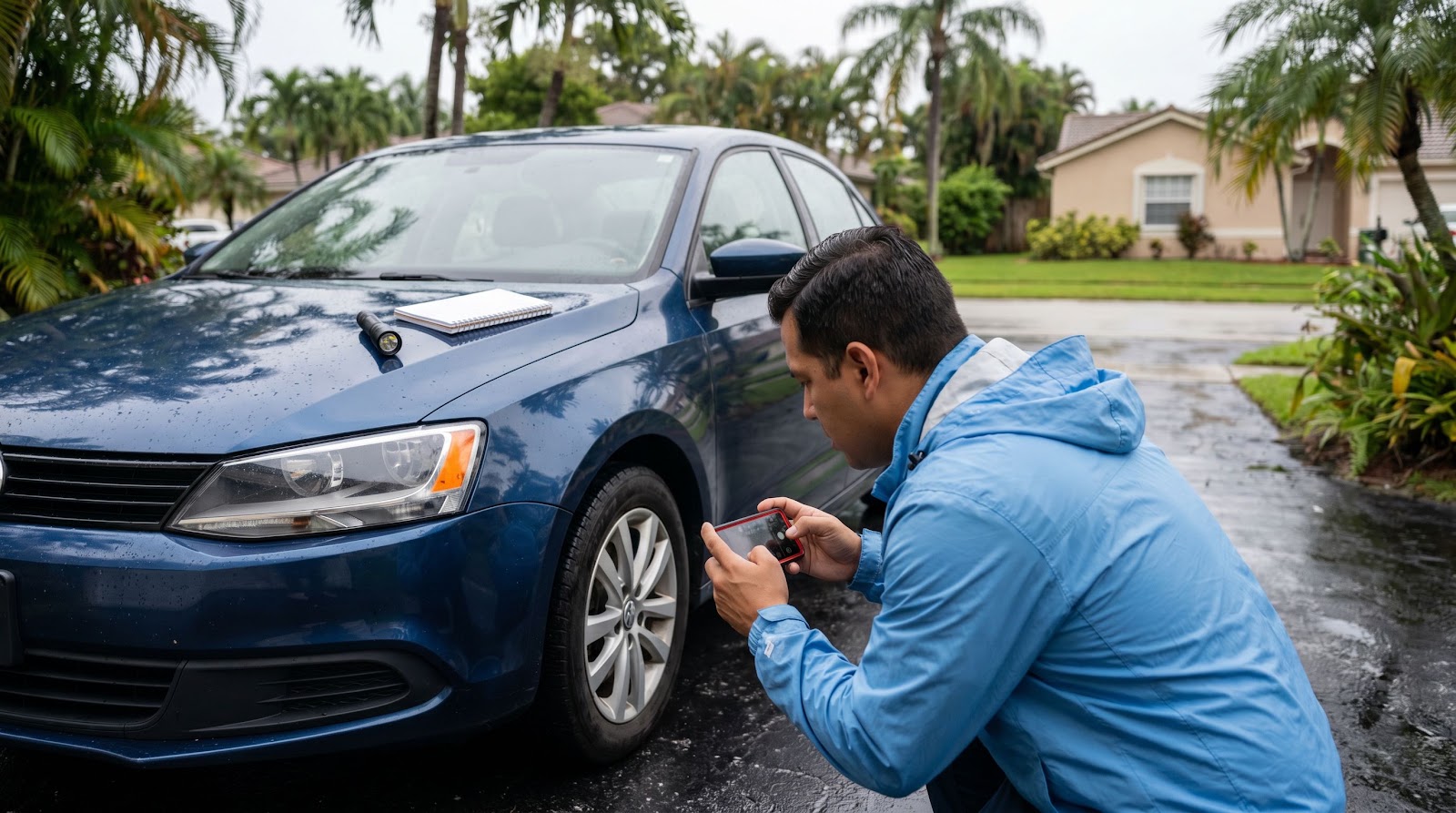
Safety steps at the scene
If the tire blows, the steering pulls, or you hear metal scraping, get off the road as soon as you safely can. Turn on your hazard lights and do a quick walk-around.
Look for a flat, a bent wheel, leaking fluid, or anything hanging under the car. If the vehicle feels unstable, do not keep driving just to get home. A short tow can be cheaper than turning one suspension hit into bigger damage.
For insurance, pothole impact damage is usually handled under collision coverage, according to the Insurance Information Institute and NAIC. Florida’s required $10,000 PIP and $10,000 PDL do not repair your own car after this kind of strike.
Photos, video, and road-condition evidence that strengthen a claim
Take wide shots first. Show the lane, the standing water, nearby signs, and where your car stopped. Then get close photos of the tire, wheel, underbody area, and any visible scrape, crack, or bulge.
A short video helps if the puddle is still there. Record the water-covered hole, traffic conditions, and the car’s symptoms if the wheel is crooked or the tire is losing air. If you can do it safely, note the exact location, direction of travel, time, and weather.
That matters if the road defect was severe. FDOT treats potholes as unacceptable once a single depth measurement reaches 1.5 inches or more.
What to ask the repair shop to document for insurance
Ask the shop for a written estimate that separates impact damage from normal wear. You want clear notes on the damaged parts, whether the rim is bent, whether the tire sidewall failed, and whether alignment, suspension, or steering components were affected.
Also ask for photos from the lift and keep the old parts if possible until the claim is reviewed. If you later explore a road-negligence claim against the state, Florida Department of Financial Services says written notice must be given within 3 years, and the process is formal.
Can you file a claim against the city, county, or state in Florida?
Yes, sometimes. If a flooded pothole or road defect damaged your car, Florida does allow claims against a government entity, but this is a negligence process, not a simple insurance claim.
That distinction matters for any Florida pothole damage rain car insurance case. Your own car damage is still usually handled first through collision coverage, while a claim against the city, county, or state is a separate path that depends on who maintained the road and what they knew about the defect.
How Florida’s sovereign-immunity waiver affects vehicle property-damage claims
Florida has a sovereign-immunity waiver that allows property-damage claims against the state in certain cases, according to the Florida Department of Financial Services. So the answer is not “the government can never be sued.” The answer is that it can be, but under strict rules.
If the road was state-controlled, the claim typically turns on negligence. You are not claiming that the pothole simply existed. You are claiming the responsible agency failed to act reasonably after a dangerous defect was present.
Notice requirements, deadlines, and damage caps drivers need to know
For a negligence claim against the State of Florida for property damage, you must give written notice to both the involved agency and the Department of Financial Services within 3 years of the incident. The state then gets an 180-day investigation period before suit is generally allowed, unless the claim is denied earlier.
There is also a recovery limit. Florida Department of Financial Services says tort claims against the state are capped at $200,000 per person and $300,000 per occurrence, unless the Legislature approves more through a claims bill.
What you must prove: road defect, prior notice, failure to repair, and causation
A bad impact alone is not enough. You need to show there was a real road defect, that the government had prior notice of it, that it failed to repair or address it, and that this specific defect caused your vehicle damage.
That is why photos, repair records, the exact location, and timing matter so much. FDOT’s own standards treat potholes as unacceptable once a defect exceeds maintenance thresholds, including 1.5 inches in depth in any single measurement, which can help frame how serious a water-hidden defect was.
What mistakes can ruin a pothole damage claim?
The fastest way to weaken a Florida pothole damage car insurance claim is to leave gaps between the impact, the proof, and the repair. If the insurer or a government agency cannot clearly see what happened, where it happened, and what part failed because of that one road hazard, your claim gets much harder to defend.
Waiting too long to report the damage
Delay is a common mistake. A pothole claim looks stronger when the report, the photos, and the shop inspection all happen close to the impact.
If you wait days, the puddle is gone, the road may be patched, and the insurer may question whether the bent rim, blown tire, or suspension problem came from that event or something else. If you are pursuing a negligence claim against the state, the Florida Department of Financial Services says written notice must be sent within 3 years, and there is generally a 180-day investigation period before suit can move forward.
Failing to connect the repair to one specific road hazard
“I hit a bad road somewhere in the rain” is usually not enough. A better claim ties the damage to one exact location, one flooded hole, and one impact.
That means keeping the street name, nearest intersection, travel direction, time, and what the car did right after the strike. For Florida pothole damage rain car insurance cases, that direct link matters as much as the repair bill.
Skipping police, road, weather, or maintenance evidence
You do not always need every piece of evidence, but skipping all of it can hurt you. A police report, road photos, weather conditions, and any sign of standing water help show this was a sudden impact event, not normal wear.
If the defect was severe, FDOT’s maintenance standard treats a pothole as unacceptable when any single depth measurement reaches 1.5 inches or more.
Accepting repairs without a detailed estimate and parts breakdown
A vague invoice can create real trouble. “Front-end repair” tells an adjuster very little.
Ask for a line-by-line estimate with parts, labor, and notes explaining what was impact-related. Collision coverage usually applies to pothole strikes, according to the Insurance Information Institute and NAIC, but the shop still needs to separate sudden damage from pre-existing wear, old tires, or unrelated suspension issues.
How can Florida drivers reduce the risk of pothole damage during summer rains?
Slow down before you reach standing water, leave more space, and avoid driving through puddles you cannot read. That is the most practical way to reduce Florida pothole damage and car insurance trouble, before it turns into a bent rim, blown tire, or suspension repair.
Summer rain in Florida changes what you can see and how hard your car hits. A pothole hidden under brown water gives you almost no time to react, so speed becomes the difference between a rough splash and a damaging impact.
Give yourself room to steer around water-covered patches when traffic allows. Do not brake hard at the last second or swerve blindly into another lane. If the puddle stretches across the road and you cannot judge its depth, treat it like a hazard, not a harmless wet spot.
Tire condition matters too. Worn tires will not create pothole coverage, and the Insurance Information Institute says normal wear and tear is not covered the same way as sudden impact damage. Good tread and proper inflation will not stop a pothole, but they can help you keep control when the front wheel drops unexpectedly.
It also helps to know what your policy can actually do for you. Florida’s required minimums are only $10,000 in PIP and $10,000 in PDL, according to FLHSMV, and those do not repair your own car after a pothole strike. For most drivers, damage from hitting a pothole is usually handled by optional collision coverage, according to the Insurance Information Institute and NAIC.
If you drive often during heavy rain, the safest habit is simple: assume every deep summer puddle could be hiding a road defect that meets FDOT’s maintenance threshold, including potholes measuring 1.5 inches deep in a single measurement.
 Vehicle
  Home & Property
  Commercial
  Life
Life  Health