


A Florida business can face a serious rain-entryway claim fast because a simple puddle at the door can turn into a bodily injury lawsuit with defense costs, medical allegations, and a fight over what staff did before the fall. That is why many owners carry general liability coverage for businesses.
What makes a rain-related slip and fall claim so dangerous for Florida businesses?
A Florida commercial liability slip and fall rain case becomes dangerous when the facts suggest the business saw the hazard, should have seen it, or cannot prove it responded reasonably. In Florida, that notice issue drives the whole claim.
Under Florida Statute 768.0755, the injured person must prove the business had actual or constructive knowledge of the wet condition and should have taken action.
Why a wet entryway during a downpour can trigger a serious commercial liability claim
During heavy rain, water can be tracked in again and again. That matters because constructive knowledge may be shown if the condition existed long enough or happened regularly enough to be foreseeable, according to The Florida Senate.
In a front entry, that argument is easy to make. Customers keep coming in, umbrellas drip, floors stay slick, and the entrance becomes the one area employees should be watching most closely.
How customer injuries, attorney involvement, and documentation gaps escalate exposure
The risk grows the moment the injury claim involves a head impact, back complaint, or allegations of lasting pain. Then attorneys ask for incident reports, cleaning logs, mat placement records, warning sign use, camera footage, and staff training documents.
If those records are missing, the business loses valuable defense evidence. The Insurance Information Institute specifically points to employee training, warning signs, and written records as key proof in liability cases.
Why these cases are not automatic losses, but can become costly fast
These claims are not automatic losses for the business. A June 20, 2024 appellate decision, Publix Super Markets, Inc. v. Safonte, reinforced how central notice is in Florida premises cases.
There is also a strong fault argument in some Florida commercial liability slip and fall rain claims. If the claimant is found more than 50% at fault, recovery is generally barred in most Florida negligence actions under the comparative-fault statute. Still, even defensible cases can get expensive quickly once medical claims and legal defense start moving.
When is a business legally responsible under Florida slip-and-fall law?
A business is legally responsible only when the injured person can prove the company had notice of the dangerous wet condition. Under Florida law, rain at the front door does not create automatic liability by itself.
That is the core of a Florida commercial liability slip and fall rain case. The fight usually centers on what the business knew, when it knew it, and what staff did next.
How Florida Statute 768.0755 applies to water tracked into a commercial entrance
Florida Statute 768.0755 applies when the fall involves a transitory foreign substance, which includes water tracked into a store entrance. The injured person must prove the business had actual or constructive knowledge of that wet condition and should have taken action to fix it.
So if customers keep bringing in rainwater during a storm, the legal question is not whether the floor was wet. The question is whether the business had enough warning to mop it, block it, mat it, or warn people.
Actual knowledge vs. constructive knowledge in a wet-floor case
Actual knowledge means the business really knew about the hazard. For example, an employee saw the puddle, a customer reported it, or the store’s own inspection noted it.
Constructive knowledge is different. The Florida Senate explains it can be shown with circumstantial evidence that the water was there long enough that staff should have found it, or that the same condition happened so regularly that it was foreseeable.
The June 20, 2024 decision in Publix Super Markets, Inc. v. Safonte also reinforces how central notice is in Florida premises cases. If notice cannot be proved, the case gets much harder for the claimant.
How recurring conditions, time on the floor, and ignored hazards affect liability
Liability gets stronger when the wet entrance was a recurring problem during rain, and the business treated it like business as usual. A slick doorway during repeated downpours can support an argument that the danger was foreseeable.
Time matters too. If water sat on the floor long enough for employees to discover it, constructive knowledge may be inferred. Ignored hazards matter just as much: missing inspection logs, no warning signs, poorly placed mats, or no record of mopping can all weaken the defense.
And there is another layer. If the claimant is found more than 50% at fault, recovery is generally barred in most Florida negligence actions under the comparative-fault statute.
What evidence decides a Florida commercial liability slip and fall rain case?
In a Florida commercial liability slip and fall rain case, the strongest evidence usually shows one thing clearly: whether the business can prove it was watching the entrance and responding to wet conditions in real time. If that paper trail is thin, the notice argument gets much harder to defend.
Florida Statute 768.0755 keeps the focus on actual or constructive knowledge. So the case often turns less on the fall itself and more on the records, photos, and video created before and after it.
Inspection logs, cleaning schedules, and mopping protocols
Inspection logs matter because they help show when staff last checked the doorway, what they saw, and what they did. A log that shows repeated checks during heavy rain can support the defense that the business acted reasonably.
Cleaning schedules and mopping protocols matter for the same reason. If employees were supposed to inspect the entrance every time rain intensified, replace soaked mats, or recheck after a customer rush, those steps should appear in written records. The Florida Senate makes clear that constructive knowledge may be argued when the condition lasted long enough or happened regularly enough to be foreseeable.
Mat placement, warning signs, and entrance design
Photos of mat placement can help or hurt. A small mat that ends before the main walking path, a curled edge, or a gap between the door and the absorbent surface can become a central issue fast.
Warning signs matter too, but only if they were actually in place where people entered. Entrance design also comes into play. In a rain-entryway case, lawyers look closely at whether the layout pushed customers straight onto slick tile without enough mat coverage or visual warning.
Incident reports, witness statements, photos, and surveillance footage
After the fall, the best evidence is usually immediate evidence. That means same-day incident reports, employee observations, witness statements, timestamped photos, and surveillance footage showing the floor condition, customer traffic, and staff response.
If video shows water being tracked in for a long stretch with no cleanup, that can support constructive notice. If it shows employees inspecting, mopping, and placing signs shortly before the incident, that can strongly support the business instead. The Insurance Information Institute also points to written records, warning signs, and employee training as key liability evidence.
What happens if the injured person was also careless?
That can sharply reduce the value of a claim, and in some cases wipe it out. In a Florida commercial liability slip and fall rain case, Florida’s modified comparative negligence rule can turn the whole dispute toward the injured person’s own choices at the doorway.
How Florida’s modified comparative negligence rule can reduce or bar recovery
Florida now applies a modified comparative-fault rule in most negligence actions. Under the comparative-fault statute cited by The Florida Senate, a claimant’s damages may be reduced by that person’s share of fault, and if the claimant is found more than 50% at fault, recovery is generally barred.
That matters in wet-entryway cases because the defense does not need to prove the business did everything perfectly. It may be enough to show the injured person also acted carelessly in a clearly rainy entrance.
When a claimant found more than 50% at fault may recover nothing
If a jury decides the claimant was 51% or more responsible for the fall, the case may end with no recovery at all. The Florida Bar’s jury instruction materials reflect that post-HB 837 framework in current civil practice.
For a business facing a Florida commercial liability slip and fall rain lawsuit, that percentage fight can be just as important as the notice fight.
Common defense arguments in rain-entryway slip cases
Typical defense arguments focus on whether the wet condition was obvious, whether mats were available, whether warning signs were in place, and whether the person was distracted, rushed, or wearing footwear that made slipping more likely. The research also notes arguments about failing to use available mats.
These points do not replace the notice requirement under Florida Statute 768.0755. They work alongside it. One side argues the business should have handled the recurring rain hazard better. The other argues the claimant walked past an open and visible wet entrance and caused most of the problem.
How should a business respond immediately after a wet entryway accident?
Act fast, help the injured person, secure the doorway, and create a clean record before the scene changes. In a Florida commercial liability slip and fall rain claim, the first response can shape both customer safety and the later notice argument.
The first 24 hours: medical response, scene control, and internal reporting
Start with the injured customer. Call for medical help if needed, keep staff calm, and avoid moving the person unless there is an immediate danger. At the same time, stop more customers from walking through the same wet area.
Place warning signs, block off the entrance if necessary, and assign an employee to manage foot traffic. Then notify management and complete the business’s internal incident report the same day. The Insurance Information Institute identifies written records, warning signs, and employee training as key liability evidence.
What to document before conditions change
Document the floor exactly as it looked right after the fall. Take timestamped photos of water on the surface, the mat location, any warning signs, the customer path, and the weather outside. Preserve surveillance footage before it is overwritten.
Also document who inspected the area last, whether mopping had been done, and whether the entrance had become wet repeatedly during the storm. That matters because under Florida Statute 768.0755, the injured person must prove the business had actual or constructive knowledge, and constructive knowledge can be argued from a condition that lasted long enough or happened regularly enough to be foreseeable, according to The Florida Senate.
What not to say to the injured customer or their lawyer
Do not admit fault. Do not guess about how long the water was there. Do not say the floor is “always slippery when it rains” unless that exact statement belongs in a formal internal report with context and corrective action.
Keep conversations short and respectful. Give factual information, preserve evidence, and send any lawyer contact to management or the insurance representative handling the claim.
Which prevention steps reduce both accidents and lawsuit risk?
The best prevention steps are the ones your staff can repeat every time it pours: watch the entrance, dry it fast, warn clearly, and write down what was done. In a Florida commercial liability slip and fall rain claim, those habits help reduce falls and help show the business acted reasonably.
That matters in Florida because the injured person must prove the business had actual or constructive knowledge of the wet condition under Florida Statute 768.0755. The Florida Senate also makes clear that recurring conditions can support constructive knowledge, which is exactly why storm-entry protocols matter.
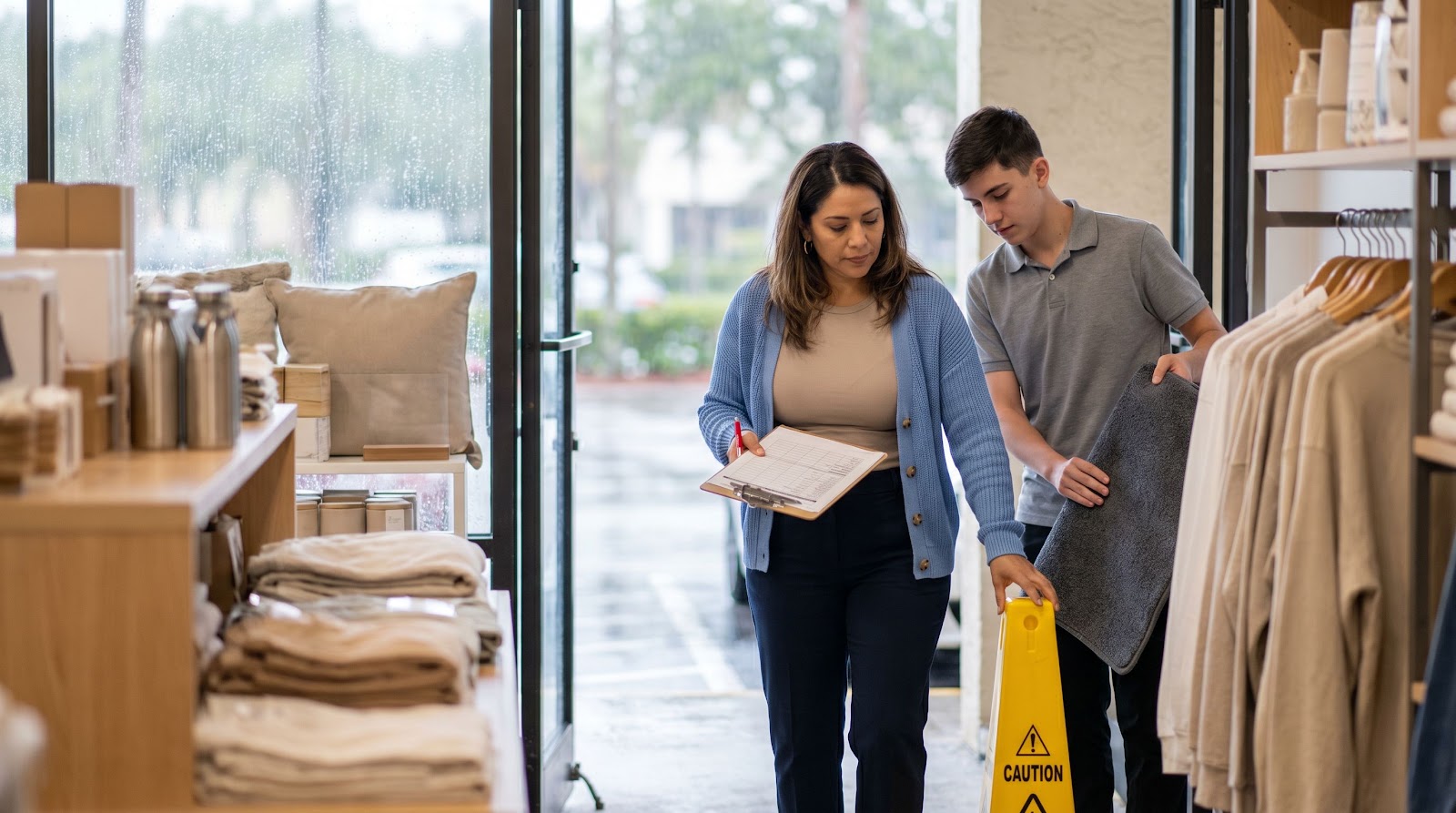
Creating a rainstorm floor safety protocol for employees
Give employees a simple script for heavy rain. Who checks the front door, who mops, who replaces soaked mats, and who documents each round should be clear before the storm starts.
A loose instruction like “keep an eye on it” is weak. A usable protocol is specific: inspect, dry, reset the entrance, and log the action. The Insurance Information Institute points to employee training and written records as key liability evidence.
Where to place absorbent mats, cones, and caution signs
Put absorbent mats where water is actually tracked, not off to the side. The main walking path from the exterior door into the first interior steps should be covered, and cones or caution signs should be placed where customers see them before stepping onto the slick area.
If the mat is saturated, wrinkled, or too short, replace it. If customers bypass the warning because the sign is hidden behind a door swing or display, it is not doing much for safety or defense.
How often to inspect and document during heavy Florida rain
During a major downpour, inspect often enough that no one can later say the entrance was ignored. The exact interval may vary by traffic and layout, but the key is consistency and documentation during the storm, not after the fall.
Florida gets 54.57 inches of statewide annual precipitation, according to the Florida Climate Center, and parts of the state face a long rainy season. That makes repeat inspections and same-shift written logs especially valuable when rainwater keeps reappearing at the door.
How does general liability insurance help with a rain-related slip and fall claim?
In a Florida commercial liability slip and fall rain claim, general liability insurance usually helps with the bodily injury claim and the legal defense that follows. For many small businesses, that protection is built into a business owner’s policy, and NAIC notes it typically helps pay medical expenses and legal fees when someone is hurt on the business premises.
| Topic | Current takeaway |
|---|---|
| Liability trigger | Plaintiff must prove the business had actual or constructive knowledge of the wet condition under Fla. Stat. 768.0755. |
| How notice is shown | By evidence the condition existed long enough to be discovered or happened regularly enough to be foreseeable. |
| Comparative fault | If claimant is found more than 50% at fault, recovery is generally barred in Florida negligence actions. |
| Insurance response | For many small businesses, general liability within a BOP is the main coverage that helps with bodily-injury claims and legal defense. |
| Best defense evidence | Inspection logs, mopping records, mat placement, warning signs, camera footage, and employee training records. |
What commercial general liability typically covers
That usually means the policy steps in when a customer alleges injury after a fall at your doorway. The practical value is simple: the insurer may handle the claim, investigate what happened, and respond to the demand or lawsuit under the policy terms.
Defense costs, settlements, and policy limits business owners should review
Business owners should review policy limits, who must report a claim, and how fast notice must be given. A defensible case can still trigger attorney work, claim investigation, and settlement pressure long before a court decides whether the business had notice under Florida Statute 768.0755.
If you carry a business owner’s policy, check whether general liability is included and whether the limit fits your customer traffic and storm-season exposure.
Coverage gaps, exclusions, and why documentation still matters even when insured
Insurance is not a substitute for proof. Coverage questions, exclusions, late reporting, or disputes about what happened can still complicate a Florida commercial liability slip and fall rain claim.
That is why same-day incident reports, photos, video preservation, and cleaning logs still matter even when you are insured. The Insurance Information Institute stresses written records, warning signs, and employee training because they help show the business responded reasonably when rain kept being tracked inside.
 Vehicle
  Home & Property
  Commercial
  Life
Life  Health