


If you were completely rear-ended in a Florida school drop-off rear-end collision, the rear driver is usually the one legally at fault. Florida law expects drivers in school lines to leave enough space, control speed, and anticipate sudden stops. If you want to review your coverage, start with Florida auto insurance.
Who is legally at fault in a Florida school drop-off rear-end collision?
In most cases, the rear driver carries the blame in a Florida school drop-off rear-end collision. That is the standard starting point under Florida traffic law, especially in a slow, stop-and-go pickup or drop-off line where stopping is expected.
Still, fault is not automatic every time. If the front vehicle cut into the line unsafely, stopped in a way that was not part of normal traffic, or another driver contributed, liability can be split under Florida comparative fault rules.
Why the rear driver is usually presumed at fault
Florida treats classic rear-end crashes seriously because drivers must leave enough room to stop safely. Under Florida Legislature Statute 316.0895, a driver may not follow another vehicle more closely than is reasonable and prudent, considering speed, traffic, and road conditions.
That fits school lines perfectly. Cars inch forward, pause, and stop again. If a driver looks down at a phone, rolls ahead too closely, or assumes the line will keep moving, a rear-end hit usually points back to that driver.
How Florida’s duty to follow at a reasonable and prudent distance applies in school lines
A school drop-off queue is exactly the kind of traffic condition covered by Florida Statute 316.0895. The rule is not about a fixed number of feet. It is about enough distance for the conditions in front of you.
In a school line, conditions change fast. A crossing guard steps out. A child opens a door. A vehicle stops to unload. That is why “reasonable and prudent” usually means extra space, not bumper-to-bumper crawling.
Why lower school-zone speeds raise the standard of care
Lower speeds in school zones do not give drivers a pass. Florida Statutes 316.183 and 316.185 require motorists to drive at a reasonable speed and reduce speed for special hazards, including pedestrians and traffic. School arrival lines have both.
Florida law allows school-zone speeds as low as 15 mph, and FDOT materials commonly show reduced school-zone speeds of 15 mph or 20 mph. Those slower limits reinforce a simple legal expectation: if you are driving near children and stopped cars, you must be able to stop without hitting the vehicle ahead.
When is the front driver not fully at fault-free after being rear-ended?
In a Florida school drop-off rear-end collision, the front driver is usually in the stronger legal position, but not always completely fault-free. If that driver created the danger with an unsafe move, an unlawful stop, or conduct that added to the crash, Florida law can shift part of the blame.
Unsafe lane changes into the drop-off queue
A common example is cutting into the school line at the last second. Under Florida Statute 316.089, a driver must stay in a single lane and cannot move from that lane until the driver has made sure the move can be done safely.
So if the lead vehicle suddenly slides into the drop-off queue with little room, and the rear driver has almost no time to react, that fact can matter. The rear driver may still share fault for following too closely, but the front driver may not be treated as completely innocent.
Sudden or unlawful stops outside normal traffic conditions
Stopping is expected in a school line. That part alone usually does not help the rear driver. But a stop that is outside normal traffic conditions can change the analysis.
Think about a driver who abruptly stops in an active lane before reaching the queue, or stops for a reason unrelated to traffic flow where other drivers would not reasonably expect it. Florida’s rear-end presumption can weaken when the front vehicle’s stop was unusual or improper rather than part of ordinary school-line movement.
Shared fault when a third driver, cyclist, or pedestrian contributed
Sometimes the crash starts with someone else. A third driver may force a car into the queue. A cyclist or pedestrian may cause a sudden evasive move. In those situations, Florida’s comparative fault rule under Statute 768.81 allows responsibility to be divided instead of pinned on one driver alone.
That matters in a Florida school drop-off rear-end collision because the final insurance decision may turn on details: where each car was, how the line was moving, and whether another road user triggered the chain of events.
What should you do immediately after a rear-end crash in the school drop-off line?
In a Florida school drop-off rear-end collision, your first job is simple: protect children and avoid making the scene more dangerous. Then document what happened before memories change and vehicles are repositioned.
That order matters in a school line because Florida drivers are expected to reduce speed for special hazards like pedestrians and heavy traffic under the Florida Legislature’s rules in Statutes 316.183 and 316.185.
Safety steps when children, crossing guards, and school staff are nearby
Check for injuries right away. If children are in or around the vehicles, keep them inside the car unless staying there creates a greater danger.
Look around before opening a door. In a drop-off lane, people may be walking between cars, and a crossing guard or staff member may already be directing traffic. If the vehicles can be moved safely and a school employee is signaling you forward, follow those directions carefully. If moving the cars would put children or staff at risk, leave them where they are until police or school personnel tell you otherwise.
What evidence to collect before cars are moved
Take photos first if it is safe. Capture the position of both vehicles, the lane, any school-zone markings, nearby signs, and the distance between cars.
Also photograph damage, skid marks if visible, and anything that may explain the impact, such as a recent lane change inside the queue. Get the other driver’s license, plate, insurance information, and contact details. If a crossing guard, staff member, or parent saw the crash, ask for their name and phone number.
When to call police and when to notify the school
Call police if anyone is hurt, if there is a dispute about what happened, or if the scene feels unsafe. That is especially helpful when the other driver claims you stopped suddenly or changed lanes in the line.
Notify the school if the crash is blocking the drop-off route, affecting student movement, or involved a staff-directed loading area. Keep your explanation short and factual. Later, when you report the claim, remember that Florida drivers must carry at least $10,000 in PIP and $10,000 in Property Damage Liability, according to the Florida Department of Financial Services.
How does insurance work for a Florida school drop-off rear-end collision?
For a Florida school drop-off rear-end collision, injury claims and car damage claims usually get handled under different parts of the policy. Injuries typically go through your own PIP first, while vehicle damage usually follows legal fault.
| Issue | Florida rule |
|---|---|
| Traffic fault | Usually the rear driver is primarily at fault because following too closely and failing to reduce speed for hazards violate Florida traffic laws. |
| Injury payment | Each injured driver usually turns first to their own PIP coverage regardless of fault, subject to policy terms and Florida law. |
| Vehicle/property damage payment | Property damage is generally paid by the legally liable driver’s Property Damage Liability coverage, up to policy limits. |
| Shared fault possibility | Fault can be apportioned if the lead driver made an unsafe lane change, stopped improperly, or another party contributed. |
How Florida PIP works for injury claims
Florida is a no-fault state for injury claims. That usually means you start with your own PIP coverage after a Florida school drop-off rear-end collision, even if the other driver caused the crash.
The Florida Department of Financial Services says drivers must carry at least $10,000 in PIP per vehicle. If you, your child passenger, or another covered person is hurt, your insurer generally looks at that coverage first, subject to policy terms and Florida law.
Who pays for vehicle damage under property damage liability rules
Car repair is different. Damage to your vehicle is generally paid by the legally liable driver’s Property Damage Liability coverage, not by PIP.
Florida drivers must carry at least $10,000 in Property Damage Liability, according to the Florida Department of Financial Services. In a typical rear-end hit in a school line, that often points to the rear driver’s insurer. If fault is shared, payment can also be affected by how responsibility is divided.
What happens if the at-fault driver is uninsured or disputes liability
If the other driver has no insurance, or their insurer argues you cut into the line or stopped improperly, the claim can slow down fast. That is where evidence matters: photos, witness names, the crash report, and details showing whether the stop was normal for school traffic.
Florida comparative fault rules under Statute 768.81 can reduce what one insurer pays if blame is split. So even in a Florida school drop-off rear-end collision, payment is not always automatic just because your car was hit from behind.
What evidence helps prove fault in a school drop-off rear-end claim?
In a Florida school drop-off rear-end collision, the best evidence shows two things: how the line was moving and whether the rear driver had enough time and distance to stop. That is what insurers and police look at when fault is clear, and it is also what matters when the other driver argues you cut in, stopped oddly, or caused part of the impact.
Florida law already leans against the striking driver because motorists must follow at a reasonable and prudent distance and reduce speed for traffic and pedestrian hazards, according to the Florida Legislature. But the claim still turns on proof.
Dashcam video, school cameras, and witness statements
Video is often the strongest piece of evidence because it captures timing. A dashcam may show the queue stopping normally, while school security footage can show whether a vehicle merged into the line at the last second.
Witness statements help fill gaps. In a school setting, that might mean a crossing guard, staff member, or parent who saw whether your car was already stopped or whether another vehicle moved unsafely before the hit. If there is video, ask that it be preserved quickly. School traffic footage is not always kept for long.
Vehicle damage patterns and why they matter
The damage itself can tell a story. A centered rear impact usually supports a classic follow-too-closely crash. Damage on one corner of a bumper may suggest a lane-change dispute or a last-second movement inside the queue.
Photos matter most when they show both cars before repairs. Capture the bumper height, angle of contact, and any marks that suggest braking or sideways movement. Those details can support or weaken a claim that the front driver changed lanes unsafely under Florida Statute 316.089.
Police reports, timestamps, and pickup-drop-off traffic flow records
A police report will not decide fault by itself, but it can lock in early statements, scene observations, and the basic sequence of events. Timestamps from your phone photos, dashcam files, or call logs can also help show exactly when traffic backed up or stopped.
In some cases, school pickup-drop-off flow records or staff procedures help too. If the line was being released in short waves, or cars were expected to stop at a loading point, that supports the argument that stopping was normal and foreseeable under Florida’s school-zone traffic rules.
What mistakes can reduce your payout after a school-line rear-end crash?
Yes, your payout can drop after a Florida school drop-off rear-end collision, even when the other driver hit you from behind. The usual problem is not the rear-end rule itself. It is giving the insurer facts they can use to argue you share part of the blame.
That matters because Florida applies comparative fault under Statute 768.81. If the insurer shows you cut into the line unsafely, stopped outside normal traffic flow, or gave inconsistent statements, your recovery for vehicle damage can be reduced.
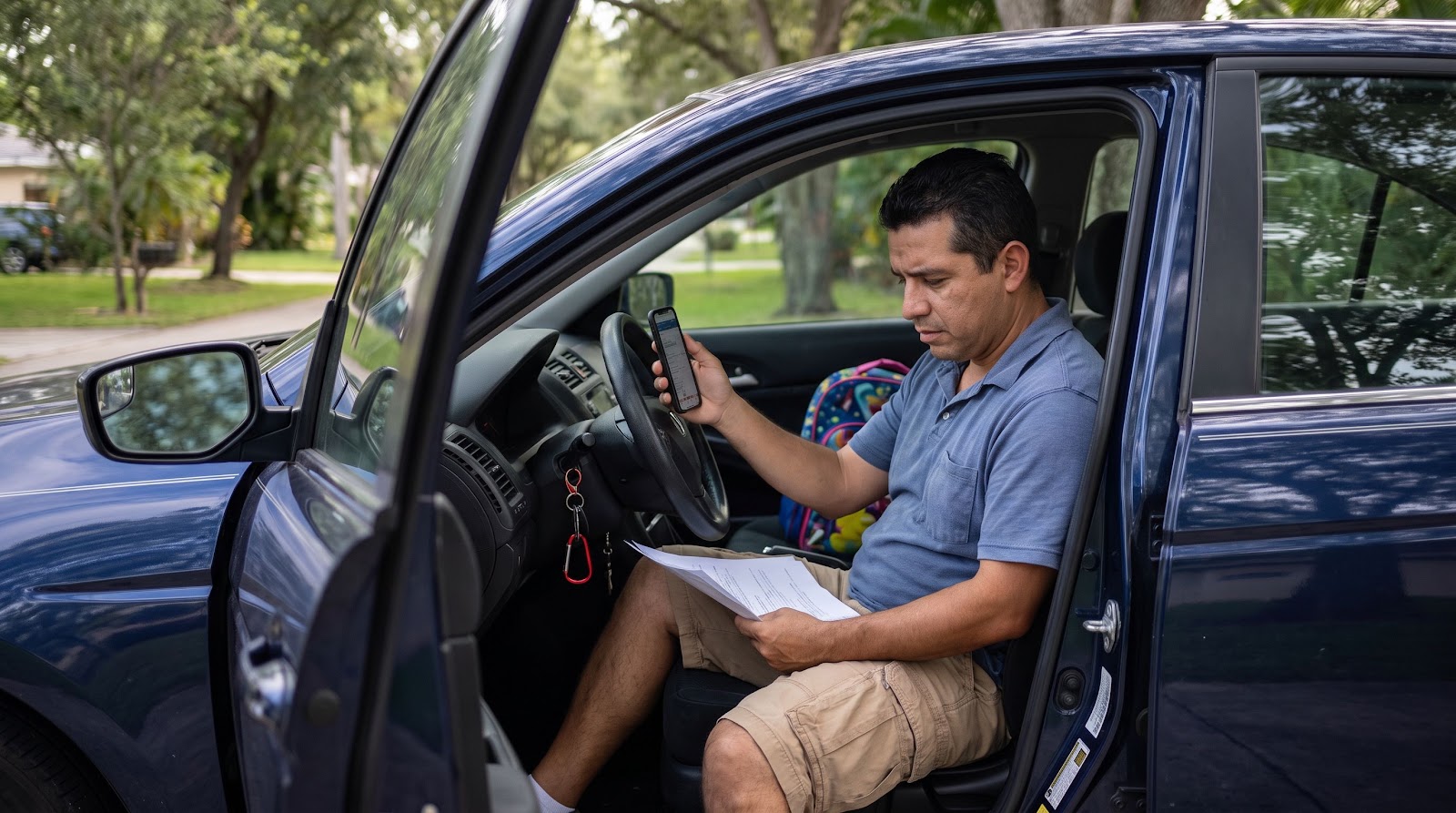
One common mistake is describing the crash too loosely. Saying “I stopped suddenly” may sound harmless to you, but in a school queue it can trigger an argument that your stop was unusual rather than part of normal traffic. Be specific. If traffic was inching forward and then stopped, say that.
Another mistake is leaving out a lane movement. If you merged into the drop-off line just before impact, the insurer will look closely at whether that move was safe under Florida Statute 316.089. Even a rear driver who was following too closely may argue you created the hazard.
Photos matter here too. If you only take close-ups of bumper damage and skip the lane, school markings, or vehicle positions, you lose context that could show your stop was predictable. And if there were witnesses, especially school staff or a crossing guard, failing to get their names can weaken your version fast.
Last, do not assume injury and property claims work the same way. Your injuries usually start under your own PIP, while car damage depends on legal fault and available coverage, including the other driver’s $10,000 minimum Property Damage Liability required by the Florida Department of Financial Services.
How can comparative fault change who pays in Florida?
Comparative fault can change payment by reducing each party’s share based on their own role in the crash. In a Florida school drop-off rear-end collision, the rear driver is still usually the main at-fault driver, but Florida Statute 768.81 allows blame to be divided when the facts support it.
That matters because injury and property claims do not move the same way. PIP usually starts with each driver’s own coverage, while vehicle damage often depends on who was legally responsible and by how much.
How partial responsibility is assigned
Insurers and courts look at conduct, not just impact position. If the rear driver followed too closely, that supports fault under Florida Legislature Statute 316.0895. If the front driver merged into the queue unsafely, Statute 316.089 can push part of the blame back the other way.
In school traffic, reduced speeds of 15 mph or 20 mph strengthen the expectation that drivers should anticipate stop-and-go movement.
Realistic examples of split fault in drop-off traffic
One common example is a driver who cuts into the drop-off line just before impact. The rear driver may still be blamed for not leaving enough space, but the merging driver may share responsibility for creating the hazard.
Another example is an unusual stop outside the normal queue flow. If a vehicle stops abruptly before reaching the line for a reason unrelated to traffic, the rear driver may not carry the entire loss.
How comparative fault affects settlement value
Shared fault can lower what you recover for car damage because payment generally follows legal liability. Florida drivers must carry at least $10,000 in Property Damage Liability and $10,000 in PIP, according to the Florida Department of Financial Services, but those coverages apply differently.
So even after a Florida school drop-off rear-end collision, a strong claim depends on proving your stop, position, and lane movement were normal for that school line.
 Vehicle
  Home & Property
  Commercial
  Life
Life  Health