


A hidden trampoline can put your Florida homeowners policy at risk fast. It raises your chance of a liability claim, and if you never told the insurer, that Florida home insurance trampoline liability issue can turn into an underwriting problem. If you need help reviewing your current home insurance options, this is one detail you should not leave out.
What happens if you hide a trampoline from your home insurer?
If you hide a trampoline, the insurer may see two separate problems: more injury exposure on your property and a failure to disclose a risk that matters to underwriting. In Florida, that can affect your renewal, your eligibility, or what happens after a claim.
How a trampoline changes your liability profile
A trampoline changes your liability picture because homeowners insurance includes personal liability coverage for injuries that happen on your property, according to the NAIC. That matters when the backyard feature is one that draws children and can lead to serious injuries.
The Insurance Information Institute says standard liability limits often start at about $100,000. For a higher-risk setup in the yard, that may not go very far if a guest is badly hurt. Triple-I uses pools as an example of an “attractive nuisance,” and insurers often apply that same logic when they review trampolines.
Why nondisclosure can be treated as a failure to meet underwriting requirements
If the company asked about trampolines when you applied, leaving it out is not a small detail. Under Florida law, after a policy has been active for 90 days, an insurer may still cancel for a material misstatement, failure to comply with underwriting requirements established before coverage began, or a substantial change in risk under The Florida Senate – Florida Statutes 627.4133.
When a hidden trampoline can trigger inspection problems at renewal or after a claim
Many owners get caught at inspection time, not installation time. A renewal review, aerial image, or post-claim inspection can reveal the trampoline even if nobody mentioned it before.
Florida generally requires 45 days’ written notice for many property-policy cancellations or nonrenewals, and the insurer must give the specific reason, including underwriting reasons when applicable, under The Florida Senate statutes 627.4133 and 627.4091. That is why Florida home insurance trampoline liability issues often surface in writing at renewal, right when your options feel tighter.
Can a trampoline get your homeowners insurance canceled in Florida?
Yes, it can. For Florida home insurance trampoline liability issues, the real question is usually not whether trampolines worry insurers, but whether the company can tie that trampoline to a legal ground for cancellation or nonrenewal.
That often happens when the trampoline was never disclosed, appears during an inspection, or changes the risk the insurer originally agreed to cover.
Florida rules on cancellation and nonrenewal after the first 90 days
After the first 90 days, Florida does not let an insurer cancel a residential property policy for just any reason. Under Florida Statutes 627.4133, the insurer may cancel if there was a material misstatement, a failure to comply with underwriting requirements set before coverage started, or a substantial change in the covered risk.
So if the application asked about backyard hazards and the trampoline was omitted, that can become more than a simple oversight. It can fit the underwriting or risk-change grounds Florida law still allows after that initial period.
What counts as a substantial change in risk
Florida law allows cancellation after 90 days for a substantial change in risk, but the statute does not give a trampoline-only definition. In practice, insurers look at whether the property now presents a meaningfully higher chance of injury and liability claims than what they accepted at the start.
That is why Florida home insurance trampoline liability reviews often focus on an undisclosed trampoline, the same way underwriters worry about other backyard hazards. The NAIC explains that homeowners insurance includes personal liability coverage for injuries on the property, and the Insurance Information Institute notes that many policies start around $100,000 in liability protection.
What notice and reason must an insurer provide under Florida law
If the insurer cancels or refuses to renew, Florida generally requires 45 days’ written notice for many property-policy cancellations and nonrenewals. The notice must also give the specific reason or reasons, including underwriting reasons when applicable, according to The Florida Senate statutes 627.4133 and 627.4091.
That detail matters. If your policy is being canceled over a trampoline, the company should say why, not leave you guessing whether the issue was nondisclosure, underwriting noncompliance, or a substantial change in risk.
Why do insurers treat trampolines as a serious liability risk?
Because one backyard accident can turn a routine homeowners policy into a costly Florida home insurance trampoline liability problem. Insurers see trampolines as a feature that raises the odds of injury, especially when children are involved, and guests use them.
That concern is not guesswork. The U.S. Consumer Product Safety Commission has long tracked trampoline injuries and reported 98,889 emergency room-treated injuries in one year of federal data, which helps explain why underwriters do not treat a backyard trampoline like an ordinary play item.
Child injury patterns and why broken-bone claims worry carriers
Children are the center of most trampoline risk discussions because they are the users most likely to get hurt. A broken arm, wrist, or leg may sound like a straightforward claim, but from an insurer’s side, it can mean emergency treatment, follow-up visits, imaging, and rehab.
That is why Florida home insurance trampoline liability issues get attention even before a claim happens. Carriers know that injuries involving minors often bring bigger medical bills and more pressure on liability coverage than a simple backyard mishap would suggest.
Attractive nuisance exposure and guest injury lawsuits
Trampolines also create what insurance professionals often view through the same lens as an attractive nuisance. The Insurance Information Institute uses that concept for pools, and the logic carries over here: a backyard feature that pulls in children can increase your liability exposure when a neighbor or visiting child gets hurt.
If a guest falls, collides with another jumper, or is injured after getting onto the trampoline without much supervision, the claim can move beyond medical payments and into a liability dispute.
How one backyard injury can escalate into medical bills, legal costs, and higher premiums
Homeowners insurance includes personal liability coverage for injuries on the property, according to the NAIC. But standard liability limits often start around $100,000, according to Triple-I, and that may feel small once medical expenses and legal defense costs start stacking up.
Even if the claim stays within the policy limit, the aftermath can affect your renewal and pricing. That is the practical side of Florida home insurance trampoline liability: one bad afternoon in the yard can keep showing up long after the ambulance leaves.
How much liability coverage do you need if you have a trampoline in Florida?
For most Florida homeowners, $100,000 in personal liability is the common starting point, but a trampoline usually puts you in a different risk category. If you are dealing with Florida home insurance trampoline liability concerns, many owners should at least ask whether $300,000 to $500,000 makes more sense.
The reason is simple: homeowners insurance does include personal liability for injuries on your property, according to the NAIC, and trampoline injuries can become serious fast. Triple-I uses pools as the classic attractive nuisance example, but the same underwriting logic often shows up with trampolines.
Standard personal liability limits versus higher-risk household needs
Standard limits are built for ordinary household exposure. A trampoline is not ordinary. It adds a backyard feature that can attract children, increase guest injury risk, and create claims that move beyond a small medical bill.
That is why the Insurance Information Institute says many policies start at about $100,000, while higher-risk hazards may call for more protection. For Florida home insurance trampoline liability planning, the starting limit should be reviewed, not assumed.
When to consider increasing limits or adding an umbrella policy
If kids regularly use the trampoline, neighbors visit often, or your yard setup makes access easy, it is smart to ask about higher limits. Triple-I says pool owners should consider $300,000 or even $500,000 in liability coverage, and NAIC notes that umbrella liability coverage can be added for higher limits.
An umbrella policy will not fix nondisclosure. It is extra protection, not a workaround for hiding the trampoline.
Questions to ask your agent before an inspection or claim happens
Ask direct questions. Does the carrier allow trampolines at all? Will netting, fencing, or placement affect eligibility? Is the trampoline already a problem under current underwriting rules? If there is a claim, would the company question when it was installed or whether it was disclosed?
You should also ask what liability limit the agent recommends for your setup and whether umbrella coverage is available through the same carrier.
What safety and property rules should Florida homeowners follow before installing a trampoline?
Before you install one, check the rules that apply to your property and tell your insurer first. For Florida home insurance trampoline liability, the biggest mistake is treating a trampoline like ordinary backyard equipment when carriers often treat it as a higher-risk feature.
If the trampoline shows up later during an inspection, the issue can become both a safety and an underwriting issue at the same time.
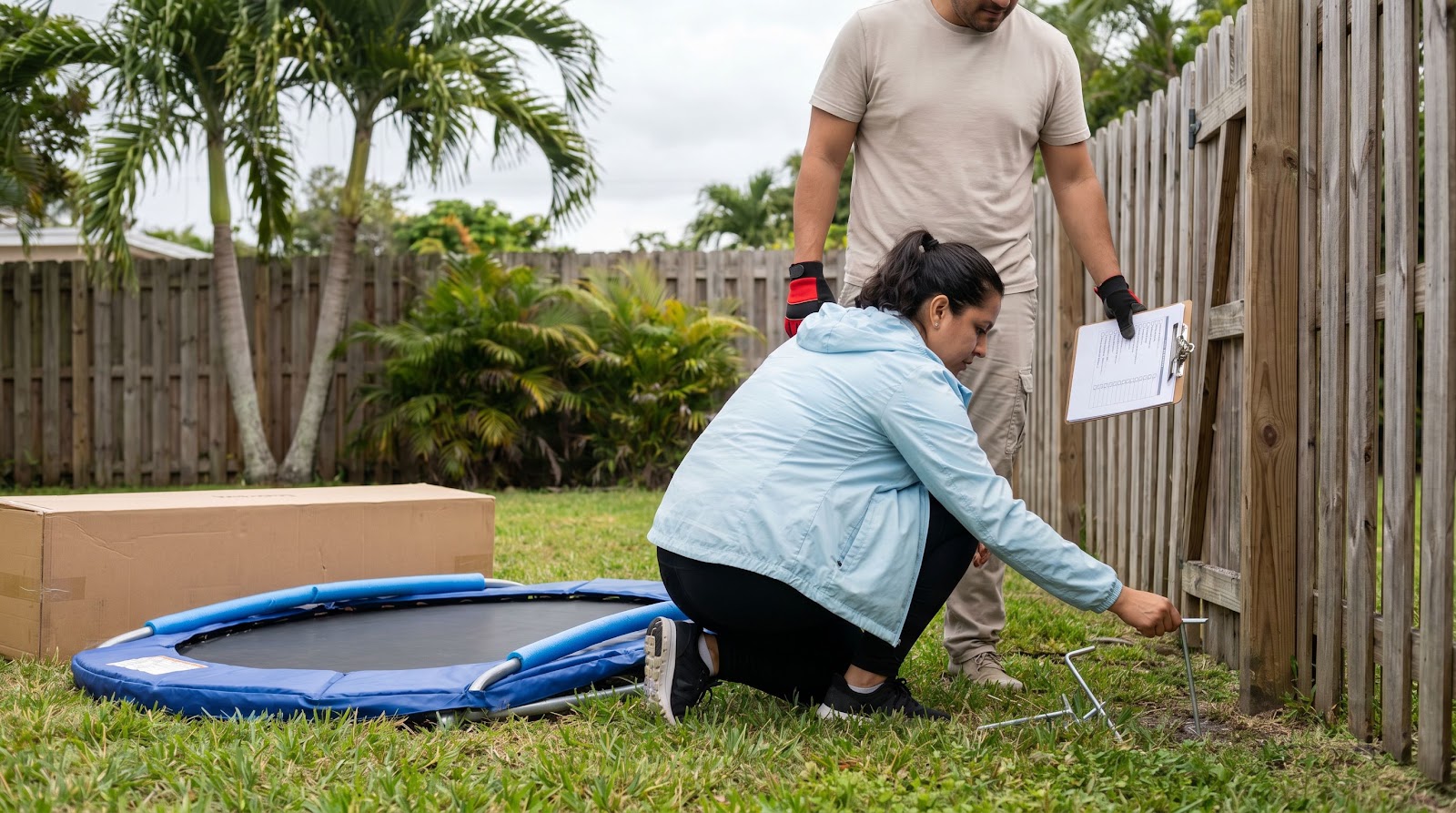
Local code, HOA rules, and backyard placement issues
Start with local property rules and your HOA, if you have one. Some communities care about where a trampoline sits, how visible it is, and whether it creates easy access from a side yard or common area.
Placement matters for insurance too. A trampoline near a fence opening, shared property line, or play area can look like a wider liability exposure, especially when children can reach it without much effort.
Common insurer requirements such as fencing, nets, anchors, and restricted access
Many carriers want clear safety controls before they agree to accept the risk. That often means fencing around the yard, netting on the trampoline, anchors to secure it, and some form of restricted access when it is not in use.
Even when a carrier allows trampolines, do not assume every setup passes inspection. The U.S. Consumer Product Safety Commission continues to maintain trampoline injury data, and that is one reason insurers look closely at basic safeguards instead of taking your word for it.
Why photos, receipts, and written disclosure matter for underwriting
Keep a simple paper trail: installation photos, safety-feature photos, purchase receipts, and your written disclosure to the insurer. If the company later questions when the trampoline was added or whether it met underwriting conditions, those records can help.
Florida law allows cancellation after 90 days for a substantial change in risk or failure to comply with underwriting requirements, and many property-policy cancellations or nonrenewals require 45 days’ written notice with reasons, under The Florida Senate statutes 627.4133 and 627.4091.
What do the numbers say about trampoline injuries, claims, and insurance scrutiny?
The numbers explain why carriers do not treat a trampoline as a minor backyard detail. For Florida home insurance trampoline liability, the concern starts with injury frequency and then moves straight into whether your policy limits and disclosure were enough.
National injury data that explains insurer concern
The U.S. Consumer Product Safety Commission has long tracked trampoline injuries, and one federal data set reported 98,889 emergency room-treated injuries in a single year. That figure is old, but the agency still maintains a dedicated trampoline injury resource, which tells you the risk never left insurers’ radar.
From an underwriting standpoint, that matters. A trampoline creates repeated exposure in a setting where children, guests, and neighbors may all be involved.
Claim severity versus prevention cost: safety upgrades, higher limits, or policy changes
A net, anchors, and restricted access may cost far less than dealing with a denied renewal or an injury claim that tests your liability limit. Triple-I says standard homeowners liability often starts at about $100,000, while its guidance for pool-related backyard hazard exposure points owners toward $300,000 to $500,000.
That does not mean every trampoline claim reaches those amounts. It means insurers price and underwrite based on what can happen, not just on what usually happens. The NAIC also notes that umbrella liability coverage can be added if you need higher protection.
Comparison table: disclosed trampoline vs hidden trampoline insurance outcomes
| Issue | What the source shows |
|---|---|
| Undisclosed risk change | Florida allows cancellation after 90 days for a substantial change in risk or failure to comply with underwriting requirements established before coverage began. |
| Cancellation/nonrenewal notice | Florida generally requires 45 days’ written notice and the insurer must state the reason(s). |
| Liability exposure | NAIC says homeowners insurance includes personal liability coverage for injuries on the property. |
| Adequacy of limits | III says liability limits generally start at $100,000, while higher-risk features may justify more protection. |
| Risk analogy used by insurance experts | III classifies pools as an “attractive nuisance” and recommends $300,000 to $500,000 in liability coverage, illustrating how backyard hazards can drive underwriting concern. |
What are the most common mistakes Florida homeowners make with trampoline insurance?
The biggest mistakes are simple: assuming the trampoline is automatically fine, mentioning it too late, mixing up liability with property coverage, and ignoring insurer follow-up. In Florida home insurance trampoline liability cases, those four errors are usually what turn a backyard feature into a policy problem.
Assuming a backyard toy is automatically covered
Many homeowners treat a trampoline like a swing set or patio furniture. Insurers often do not. A trampoline changes your liability exposure because homeowners insurance includes personal liability coverage for injuries that happen on the property, according to the NAIC.
That is why Florida home insurance trampoline liability should be reviewed before installation, not after an accident. Triple-I says standard liability limits often start around $100,000, which may feel thin for a serious guest injury.
Waiting until renewal to mention the trampoline
This mistake usually backfires because the company may learn about it first through an inspection, aerial image, or claim. By then, the issue is no longer just disclosure. It can look like a change in the risk the insurer originally accepted.
Under Florida law, after a policy has been active for 90 days, an insurer may cancel for a substantial change in risk, a material misstatement, or failure to comply with underwriting requirements established before coverage began. Florida also generally requires 45 days’ written notice for many cancellations or nonrenewals, with reasons stated, under the Florida Senate statutes 627.4133 and 627.4091.
Confusing property damage coverage with personal liability protection
Some owners focus on whether the trampoline itself is covered if it tears, flips, or wears out. The larger insurance question is usually liability. If a child or guest gets hurt, the claim typically centers on your personal liability protection, not the value of the trampoline.
That confusion is common in Florida home insurance trampoline liability reviews, especially when owners never looked at their liability limit or asked about umbrella coverage.
Ignoring inspection requests or underwriting questionnaires
If the insurer asks whether you have a trampoline, wants photos, or sends an inspection request, answer clearly and fast. Silence can make the situation look worse than it is.
Florida requires insurers to give specific reasons for cancellation or nonrenewal when applicable, but you do not want to wait for that letter to find out your trampoline became an underwriting issue.
 Vehicle
  Home & Property
  Commercial
  Life
Life  Health