


If a summer storm drops a tree on your car in Florida, the bill usually goes to your own comprehensive coverage, not the state minimum policy. That is the key issue in most Florida fallen tree car insurance claims. If you are reviewing your options, start with your Florida auto insurance coverage and check whether comprehensive coverage is listed.
Who pays for a car crushed by a falling tree in Florida?
In most cases, your insurer pays under comprehensive coverage, minus your deductible. If you do not carry comprehensive coverage, you may be left paying out of pocket unless someone else was legally negligent.
Why comprehensive coverage usually pays for storm-related tree damage
For Florida fallen tree car insurance, comprehensive is usually the coverage that matters. The Insurance Information Institute says comprehensive coverage covers non-collision damage and specifically includes fallen objects such as trees and branches.
That means a tree crashing onto a parked car, or a large branch hitting your vehicle during a storm, is generally handled as a comprehensive claim. If the damage is severe, the insurer may decide the car is a total loss and pay what the vehicle was worth, according to the National Association of Insurance Commissioners.
The practical question is simple: do you have comprehensive coverage on the policy, and what deductible applies?
Why Florida’s minimum auto insurance does not pay to repair your own car
Florida requires at least $10,000 in PIP and $10,000 in Property Damage Liability for registered vehicles, according to the Florida Department of Highway Safety and Motor Vehicles. But that minimum does not repair your own car after a tree falls on it.
PDL pays for damage you cause to other people’s property. It is liability coverage, not physical damage coverage for your own vehicle.
When another party may be legally responsible instead of your insurer
Sometimes another party may be responsible. A property owner, business, or another party could face a claim if negligence can be proven, such as a known dangerous tree that was ignored.
Florida, being a no-fault state, does not change the vehicle damage piece. The NAIC explains that property damage can still be pursued against the at-fault party when negligence caused the loss.
What coverage do you need for Florida fallen tree car insurance?
For most Florida fallen tree car insurance claims, the coverage that matters is comprehensive. If your policy only carries Florida’s minimum required insurance, a crushed car after a storm is usually not covered.
| Scenario | Typical payer / coverage |
|---|---|
| A tree falls on your parked or moving car during a storm, and you carry comprehensive | Your own auto insurer under comprehensive coverage, minus your deductible |
| Tree falls on your own car, but you do not carry comprehensive | Usually no first-party auto coverage; you may need to pursue a liable party if negligence can be proven |
| You damage someone else’s property with your car | Your Property Damage Liability (PDL) coverage, subject to policy limits |
| Your financed or leased car is damaged | Comprehensive is often required by the lender or lessor, but claim payment still depends on the policy terms and deductible |
Comprehensive coverage versus collision coverage
Comprehensive and collision are not the same thing. For a fallen tree, comprehensive is typically the relevant part because the Insurance Information Institute classifies trees and branches as fallen objects, which are non-collision losses.
Collision usually applies when your car hits another vehicle or object, or when another car hits yours. If a storm drops a tree onto your hood while the car is parked, that is generally a comprehensive claim, not a collision claim.
How deductibles affect your payout after a summer storm
Your deductible comes straight out of the claim payment. If repairs cost $4,000 and your comprehensive deductible is $500, the insurer generally pays the covered amount above that deductible.
The National Association of Insurance Commissioners also notes that drivers choose their comprehensive and collision deductibles, and higher deductibles usually mean lower premiums. One point that confuses many Florida drivers: hurricane deductibles discussed by the Florida Department of Financial Services apply to home insurance, not auto comprehensive claims.
What happens if you only carry PIP and property damage liability
If you only carry the state minimum, you may have no coverage for your own vehicle after a tree falls on it. Florida requires $10,000 in PIP and $10,000 in PDL, according to the Florida Department of Highway Safety and Motor Vehicles, but PDL pays for damage you cause to someone else’s property, not your own car.
That is why Florida fallen tree car insurance often comes down to one line on the declarations page: comprehensive.
How much could a falling tree claim cost you out of pocket?
For most Florida fallen tree car insurance claims, your out-of-pocket cost is usually your comprehensive deductible. If you do not have comprehensive coverage, the bill can fall on you unless another party was negligent and can be held responsible.
Typical deductible scenarios and what drivers actually pay
The part many drivers feel right away is the deductible. If your repair bill is lower than the deductible, you may end up paying the full amount yourself. If the damage is more serious, your insurer generally pays the covered amount above that deductible.
A simple example: with a $500 deductible, a covered $4,000 repair would typically leave you paying the first $500. The National Association of Insurance Commissioners explains that comprehensive deductibles are chosen by the policyholder, and higher deductibles usually reduce the premium.
One detail that trips people up in Florida: hurricane deductibles discussed by the Florida Department of Financial Services apply to home insurance policies, not auto comprehensive claims for a fallen tree.
When the car may be declared a total loss
A crushed older vehicle can be totaled fast. The NAIC says insurers may declare a car a total loss if it has little value and paying the vehicle’s value makes more sense than repairing it.
That means a heavy tree impact does not automatically lead to a repair check. In some Florida fallen tree car insurance cases, the insurer may pay what the car was worth before the loss, minus the deductible, instead of fixing it.
Repair costs versus actual cash value: how insurers compare the numbers
Insurers look at two numbers: the cost to repair the car and the car’s actual cash value before the tree fell. If repairs climb close to or beyond that value, a total loss decision becomes more likely.
This is why two drivers with similar roof damage can have very different outcomes. A newer financed car may be repairable, while an older car with low market value may be settled as a total loss even with moderate-looking damage.
What should you do immediately after a tree falls on your car?
First, protect yourself and start building the claim file. In most Florida fallen tree car insurance situations, the fastest path is to document the damage well and report it to the right party without moving the car unless safety requires it.
Safety steps before you document the damage
If the tree brought down power lines, stay back and keep others away. Do not touch the vehicle, branches, or anything nearby that could be energized or unstable.
If the car is blocking traffic or creates an immediate hazard, call emergency services. If it is safe to remain nearby, wait until the scene is stable before getting close enough to take photos.
Try not to remove branches or clean up debris before your insurer sees the damage. A rushed cleanup can make a Florida fallen tree car insurance claim harder to prove.
What photos, videos, and records help support the claim
Take wide shots first. Show the whole car, the fallen tree, the address, the parking area, and any nearby property that helps explain what happened.
Then get close-up photos of the roof, hood, glass, doors, and interior if rain got inside. A short video helps capture angles that still photos miss.
Keep practical records too: the date, time, weather conditions, where the car was parked, and any towing or cleanup receipts. If the car is likely a total loss, those details can matter when the insurer compares damage with the vehicle’s value, as the National Association of Insurance Commissioners explains.
Who to call first: insurer, police, landlord, business owner, or city
Call your auto insurer early if you carry comprehensive coverage. The Insurance Information Institute says comprehensive coverage covers fallen objects such as trees and branches, so this is usually the main claim.
Call the police if there is an injury, a road hazard, or a public safety issue. Contact a landlord, business owner, or the city if the tree came from their property and you think poor maintenance may have played a role. That does not replace your own claim, but it can help preserve responsibility questions if negligence becomes part of the case.
Can your neighbor, landlord, HOA, or the city be forced to pay?
Sometimes, yes, but only if you can show negligence. In a Florida fallen tree car insurance dispute, ownership of the land is not enough by itself. The issue is whether the party responsible for the property failed to address a dangerous tree that they should have dealt with.
The negligence standard in Florida for hazardous or dead trees
A claim against a neighbor, landlord, HOA, business, or public entity usually depends on proving the tree was hazardous and that the responsible party failed to act. A dead tree, a visibly decayed trunk, or large broken limbs hanging over parking spaces can matter if those conditions were known or should have been noticed.
That is very different from saying, “the tree came from their property, so they owe me.” In practice, Florida fallen tree car insurance claims against someone else get stronger when there is evidence of neglect, not just storm damage.
Why does an act of nature usually not create liability
A strong summer storm by itself usually does not create legal responsibility for a property owner. If a healthy-looking tree falls during severe weather with no clear warning signs, the event is often treated as an act of nature rather than negligence.
That is why many drivers still end up using their own comprehensive coverage first. Florida’s no-fault system does not change the basic rule that vehicle damage claims against another party still depend on fault, as the National Association of Insurance Commissioners explains.
Evidence that can strengthen a claim against a property owner or public entity
Photos taken before cleanup can help a lot. Focus on the base of the tree, visible rot, hollow areas, fungus, split limbs, roots lifting the ground, and where the tree stood in relation to your car.
It also helps to keep records of prior complaints, maintenance requests, code reports, emails from a landlord or HOA, and any city notices if they exist. If witnesses heard earlier concerns about the tree, that can support the timeline. The stronger your proof that the danger was known and ignored, the better your chance of shifting the loss away from your own Florida fallen tree car insurance claim.
What are the most common claim mistakes after a Florida summer storm?
The biggest mistakes in a Florida fallen tree car insurance claim usually happen after the damage, not during the storm. Drivers often assume the weather changes who pays, move the car too soon, or give up after a quick denial without reading the policy details.
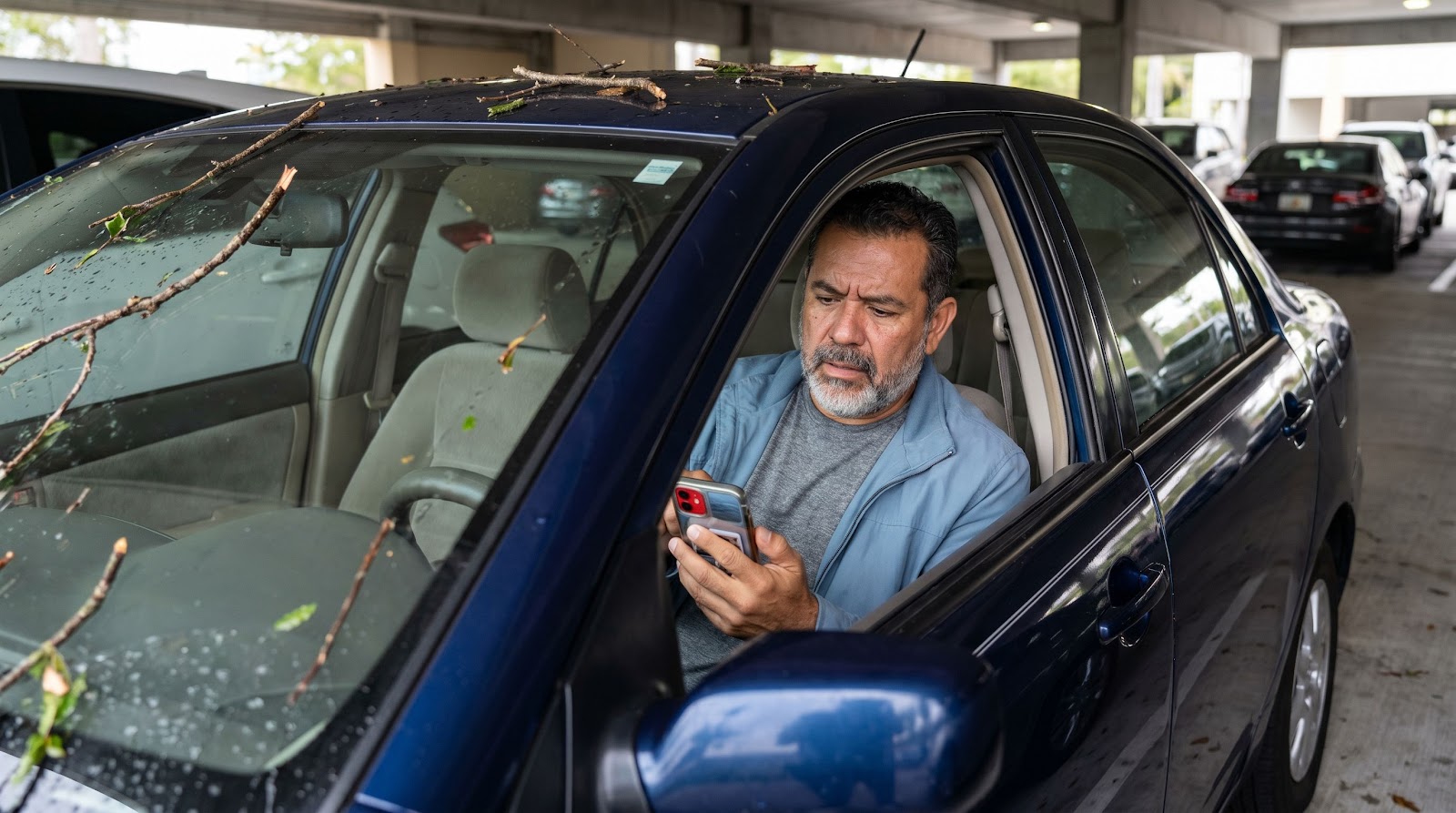
Assuming severe weather automatically shifts liability to someone else
A bad storm does not automatically make a neighbor, landlord, HOA, or city responsible. If the tree simply fell during severe weather, many claims still go through your own comprehensive coverage first.
This is where drivers get tripped up. They spend days arguing about who owned the tree and overlook the faster question: whether their policy includes comprehensive coverage and what deductible applies.
Delaying the claim or moving the vehicle without proper documentation
Waiting too long can weaken the file. So can dragging the car away, cutting branches off, or cleaning everything up before you have clear photos and video.
If the vehicle must be moved for safety, document it first when possible. Get wide shots, close-ups, and images that show where the tree landed, the condition of the car, and the surrounding area. That record matters if there is later disagreement about the extent of damage or whether the car should be repaired or treated as a total loss.
Accepting a denial without checking policy language, exclusions, and deductible details
Some drivers hear “not covered” and stop there. That is a mistake. Florida’s required minimums are $10,000 in PIP and $10,000 in PDL, and the Florida Department of Highway Safety and Motor Vehicles says PDL pays for damage you cause to other people’s property, not your own car.
Read the declarations page and the coverage section. Confirm whether comprehensive coverage was active on the loss date, review the deductible, and check the exact reason for denial before you accept the answer.
 Vehicle
  Home & Property
  Commercial
  Life
Life  Health