


Towing a trailer in Texas comes down to three things. The trailer has to be registered. It has to meet the state rules on brakes and safety chains. And the vehicle pulling it needs at least the state minimum liability of 30/60/25. Your auto insurance policy covers the vehicle. The trailer is a separate conversation with your agent.
Texas Parks and Wildlife’s general white-tailed deer season opened Saturday, November 7, 2026. It runs through January 3, 2027 in the North Zone and January 17, 2027 in the South Zone. That means a lot of hitches in use this month: utility trailers, ATV haulers, work trailers that only come out a few weekends a year. Before you load up, here is what the state asks of you and what to confirm on your Texas auto policy.
Does your trailer need registration and a title in Texas?
Registration is required for every non-farm trailer driven on Texas public highways, no matter the weight. A title is required when a manufactured trailer has a gross weight over 4,000 pounds. At 4,000 pounds or less, the title is optional, according to the Texas Department of Motor Vehicles trailer page.
Farm trailers get different treatment. A farm trailer with a gross weight of 4,000 pounds or less, used primarily as a farm vehicle, is exempt from both title and registration. Above that, the Farm Trailer plate for units over 4,000 and up to 34,000 pounds costs $5.00 a year, per the Texas Department of Public Safety.
The trailer you borrowed from your cousin
Borrowed or bought off a neighbor, the rules do not change. If the trailer rolls on a public highway and it is not a farm trailer, it needs to be registered. If it is manufactured and over 4,000 pounds gross, it needs a title in your name before you can register it properly. Handle that paperwork before the trip, not at a roadside stop on the way to the lease.
When does a trailer need brakes?
Texas DPS says a trailer is not required to have brakes if its gross weight is 4,500 pounds or less. There is a second exception. A trailer over 4,500 but not more than 15,000 pounds does not need brakes if it is drawn at 30 miles per hour or less.
Read that second one carefully, because the speed is part of the rule, not a suggestion. A 9,000-pound trailer with no brakes is legal at 30 mph. The same trailer at 65 mph on a Texas highway is not. The full breakdown is on the DPS Brakes Required page, which cites Transportation Code section 547.401.
Gross weight means the trailer plus everything on it. The ATV, the cooler, the feed, the generator. People calculate the empty weight and stop there. That is how a trailer that looked exempt in the driveway stops being exempt once it is loaded.
Are safety chains required in Texas?
Yes. Texas Transportation Code section 545.410 states that a passenger car or light truck may not draw a trailer unless approved safety chains are attached. The rule does not apply to agricultural trailers, but for a weekend hunting trailer behind a pickup, it applies.
The Texas Department of Insurance’s Light-Duty Trailer Safety Fact Sheet recommends crossing the chains in an X under the tongue and using chains rated for the trailer’s gross weight. Chains cost little, and a set with the right rating is easy to find at any trailer supply store.
Rules at a glance
| Requirement | Texas state threshold | Agency and rule |
|---|---|---|
| Non-farm trailer registration | Required on public highways, any weight | TxDMV, Trailers page |
| Title for a manufactured trailer | Required over 4,000 lb gross; optional at 4,000 lb or less | TxDMV, Trailers page |
| Farm trailer exemption | 4,000 lb or less, used primarily as a farm vehicle: no title, no registration | TxDMV / DPS |
| Farm trailer plate | $5.00 per year (over 4,000 and up to 34,000 lb) | DPS, Farm Registration |
| Trailer brakes | Not required at 4,500 lb gross or less | DPS, Brakes Required (TRC 547.401) |
| Brake exception by speed | Over 4,500 up to 15,000 lb: no brakes only if drawn at 30 mph or less | DPS, Brakes Required (TRC 547.401) |
| Safety chains | Required for passenger cars and light trucks; not for agricultural trailers | TRC 545.410; TDI fact sheet |
| Minimum liability on the towing vehicle | $30,000 / $60,000 / $25,000 | TDI (Transportation Code 601) |
| Driving without insurance | $175 to $350 first offense; $350 to $1,000 with a prior conviction | Transportation Code 601.191 |
What does your auto policy actually do when you tow?
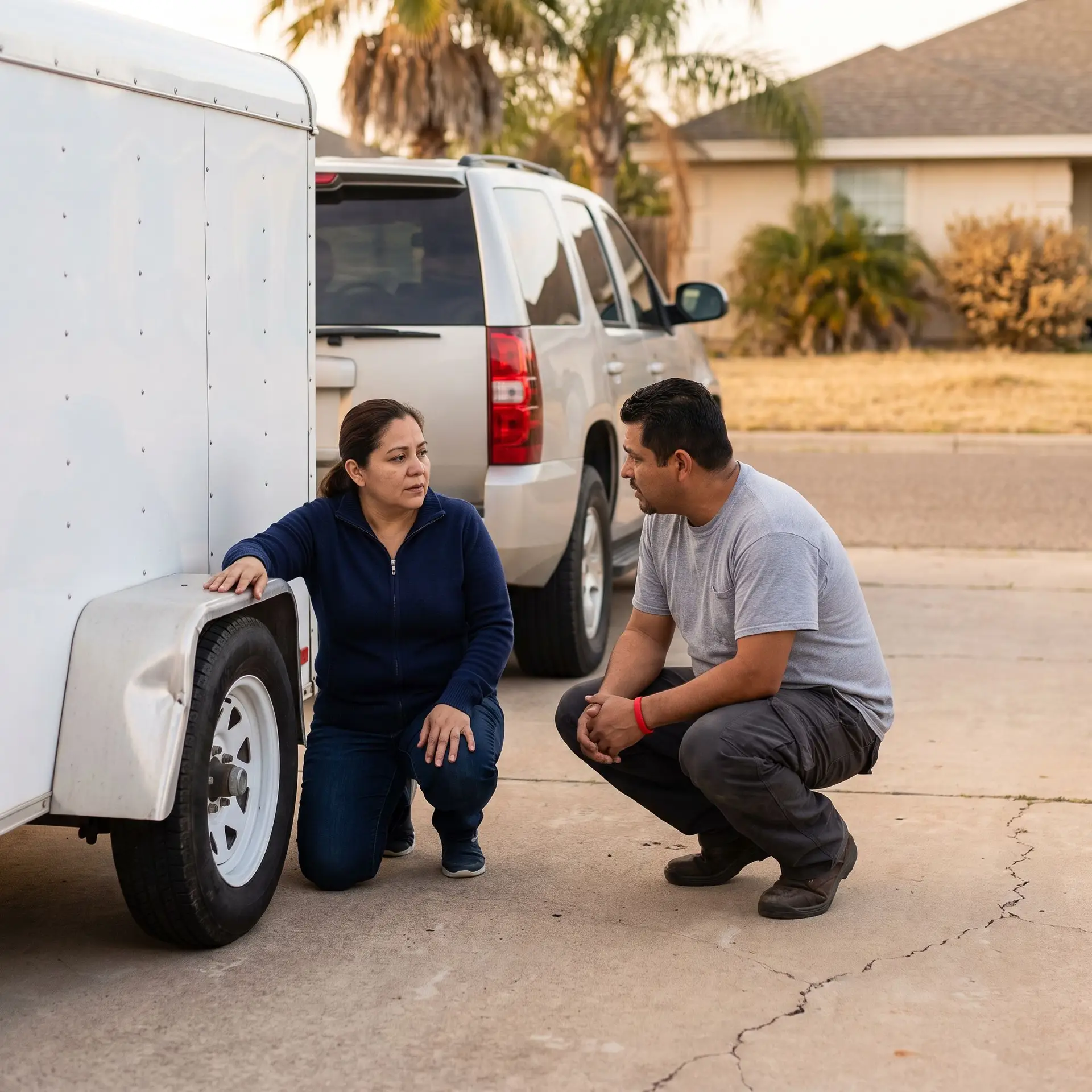
Your liability coverage follows the vehicle you are driving. Texas sets that minimum at 30/60/25: $30,000 per person for injuries, $60,000 per accident and $25,000 for property damage, according to the Texas Department of Insurance. TDI also notes the minimum might be too low if you cause a multi-vehicle accident.
That note matters more with a trailer behind you. Stopping distance grows and the rig is longer. A chain-reaction crash on I-35 or US-281 can involve more than one vehicle, and $25,000 in property damage goes fast when two late-model trucks are in the mix.
Towing and labor coverage is not about the trailer
Towing and labor coverage pays to tow your car when it cannot be driven. That is it. It is about getting your vehicle off the shoulder, not about pulling a trailer behind it. Drivers mix these two up constantly because both use the word “towing.”
Three questions to ask your agent before the trip
- Does my policy list the trailer, and does it need to be listed?
- What does the policy pay if the trailer causes damage to someone else’s property or vehicle?
- Does the trailer itself, or what I am hauling in it, need its own coverage?
Get those answers before you hitch up, not after an incident. A Univista agent can pull up your declarations page and read you the exact wording while you are on the phone, in English or Spanish, whichever is easier for you.
What happens if you drive without insurance in Texas?
A first offense under Transportation Code section 601.191 carries a fine of $175 to $350. With a prior conviction, the range rises to $350 to $1,000. A second or later conviction also brings a two-year driver license suspension, according to TxDMV and TexasSure, plus court costs.
If no company will write you a policy, TAIPA offers the minimum 30/60/25 limits along with UM/UIM and PIP. That comes from the TDI commercial auto biennial report of November 2024. It is a last resort, not a first stop. Comparing companies first usually leaves you with more options than you expect.
Frequently asked questions
More answers on coverage, limits and claims are in our auto insurance FAQ section.
What insurance do I need to tow a trailer in Texas?
The vehicle doing the towing must meet the Texas minimum liability of 30/60/25. That is $30,000 per person for injuries, $60,000 per accident and $25,000 for property damage under Transportation Code 601, according to TDI. Ask your agent separately whether your trailer needs to be listed on the policy.
Does my trailer need its own registration or title in Texas?
Registration is required for every non-farm trailer used on Texas public highways, regardless of weight. A title is required for a manufactured trailer over 4,000 pounds gross. At or below that weight it is optional, per TxDMV. Farm trailers of 4,000 pounds or less are exempt from both.
When does a trailer need brakes in Texas?
Texas DPS says brakes are not required when the trailer’s gross weight is 4,500 pounds or less. For a trailer over 4,500 and up to 15,000 pounds, the exemption applies only if it is drawn at 30 miles per hour or less. Above those limits, the trailer needs brakes.
Univista Insurance’s licensed agents compare more than 20 companies in a free quote, by phone, online or at a Univista Insurance office. Get a free quote and compare in minutes.
 Vehicle
 Home & Property
 Commercial
 Life
 Health